Oklahoma Social Studies USG.C.4
Standard Cluster
Compare the legislative, executive, and judicial branches of the United States of America's government as they address the needs of the public. Describe the scope and powers of the legislative branch of the federal government as delineated in Article 1 of the Constitution of the United States of America. Compare the composition of the United States of America House to the United States of America Senate. Identify the constitutional qualifications, terms of office, and compensation for members of the United States of America Congress, including change created by passage of the 17th and 27th Amendments. Explain why the Framers established a bicameral legislative body and how the House of Representatives functions differently from the Senate. Describe the leadership roles of the Speaker of the House, the Senate President Pro Tempore, and majority and minority leaders, including the responsibilities of major congressional committees. Examine the scope and powers of the executive branch as delineated in Article II of the Constitution of the United States of America. Identify the constitutional qualifications, term of office, and impeachment process for the President of the United States of America, including the impact of the 12th, 20th, 22nd, and 25th Amendments. Compare the original intent of the Chief Executive’s roles as described by Hamilton in Federalist Paper No.69 to the modern presidency. Describe the function of executive departments and the federal bureaucracy, including the authority and influence of the President’s Cabinet. Examine the purpose of independent regulatory agencies (e.g., Federal Reserve, Securities and Exchange Commission). Describe the growth of federal agencies during the 20th century, analyzing the constitutional and statutory bases for the delegation of powers to departments or agencies of the executive branch. Explain the steps of the legislative process, including the authority, responsibilities, and influence of Congress, the President, and special interest groups, using examples from contemporary policy making and evaluating how the process reflects democratic principles of United States of America constitutional government. Describe the scope and powers of the federal judiciary as delineated in Article III of the Constitution. Explain the length of terms, selection and confirmation process, jurisdiction, and process for the removal of Supreme Court justices. Examine the Framers’ intent regarding the judiciary’s authority, including the principle of judicial review, as described by Hamilton in Federalist Paper No.78 and established in Marbury v. Madison. Examine the role of district courts, the courts of appeals, and the Supreme Court in regards to the judicial review process. Explain the importance of an independent judicial system as integral to the interpretation and defense of citizens’ rights and liberties.
Oklahoma Academic Standards for Social Studies (2026)
Cluster contents
Standards in This Cluster
USG.C.4 is a cluster heading. These are the individual standards under it.
- USG.C.4.1
Describe the scope and powers of the legislative branch of the federal government as delineated in Article 1 of the Constitution of the United States of America...
- USG.C.4.1.A
Compare the composition of the United States of America House to the United States of America Senate.
- USG.C.4.1.B
Identify the constitutional qualifications, terms of office, and compensation for members of the United States of America Congress, including change created by ...
- USG.C.4.1.C
Explain why the Framers established a bicameral legislative body and how the House of Representatives functions differently from the Senate.
- USG.C.4.1.D
Describe the leadership roles of the Speaker of the House, the Senate President Pro Tempore, and majority and minority leaders, including the responsibilities o...
- USG.C.4.2
Examine the scope and powers of the executive branch as delineated in Article II of the Constitution of the United States of America.
- USG.C.4.2.A
Identify the constitutional qualifications, term of office, and impeachment process for the President of the United States of America, including the impact of t...
- USG.C.4.2.B
Compare the original intent of the Chief Executive's roles as described by Hamilton in Federalist Paper No.69 to the modern presidency.
- USG.C.4.2.C
Describe the function of executive departments and the federal bureaucracy, including the authority and influence of the President’s Cabinet.
- USG.C.4.2.D
Examine the purpose of independent regulatory agencies (e.g., Federal Reserve, Securities and Exchange Commission).
- USG.C.4.2.E
Describe the growth of federal agencies during the 20th century, analyzing the constitutional and statutory bases for the delegation of powers to departments or...
- USG.C.4.3
Explain the steps of the legislative process, including the authority, responsibilities, and influence of Congress, the President, and special interest groups, ...
- USG.C.4.4
Describe the scope and powers of the federal judiciary as delineated in Article III of the Constitution.
- USG.C.4.4.A
Explain the length of terms, selection and confirmation process, jurisdiction, and process for the removal of Supreme Court justices.
- USG.C.4.4.B
Examine the Framers’ intent regarding the judiciary’s authority, including the principle of judicial review, as described by Hamilton in Federalist Paper No.78 ...
- USG.C.4.4.C
Examine the role of district courts, the courts of appeals, and the Supreme Court in regards to the judicial review process.
- USG.C.4.4.D
Explain the importance of an independent judicial system as integral to the interpretation and defense of citizens’ rights and liberties.
Teacher's field guide
What This Cluster Means
What Students Need to Do
- Students compare how Congress, the president, agencies, and courts respond to a public problem. They sort powers in Articles I, II, and III, then trace a bill, an agency action, and a court challenge. They use the two-chamber compromise, Federalist essays, and amendments to explain elections, terms, pay, impeachment, succession, and judicial independence.
What Mastery Looks Like
- Students can compare House and Senate membership, qualifications, terms, leaders, and committees, including changes to Senate elections and congressional pay. They can explain presidential qualifications, Cabinet advice, term limits, succession, impeachment, and why Congress delegates work to agencies such as the SEC. They can trace appeals from district court to the Supreme Court, explain judicial review, and describe how justices are confirmed and removed.
Common Misconceptions
- Students may think a bill becomes law after one chamber votes or that the president can make laws alone. They may confuse the House's impeachment charge with the Senate's trial, or think agencies get their powers directly from the Constitution. They may think justices serve fixed terms or that Article III names judicial review.
How to Assess It
- Exit ticket: A bill about stock trading apps passes the House but stalls in a Senate committee. What must happen before it becomes law, and what could the SEC and courts do afterward?
Lesson moves
Ways to Teach It
Give groups a school lunch bill and role cards for House, Senate, president, USDA, and court; have them map votes, enforcement, and review.
Read short excerpts from Federalist Nos. 69 and 78; ask how Hamilton's president and judge compare with today's president and Supreme Court.
Play amendment match: pair the 12th, 17th, 20th, 22nd, 25th, and 27th with election, term, succession, or pay scenarios.
Open Congress.gov and an advocacy group's website; compare a current bill's committee status with the group's stated position.
Free download
Printable USG.C.4 Worksheet
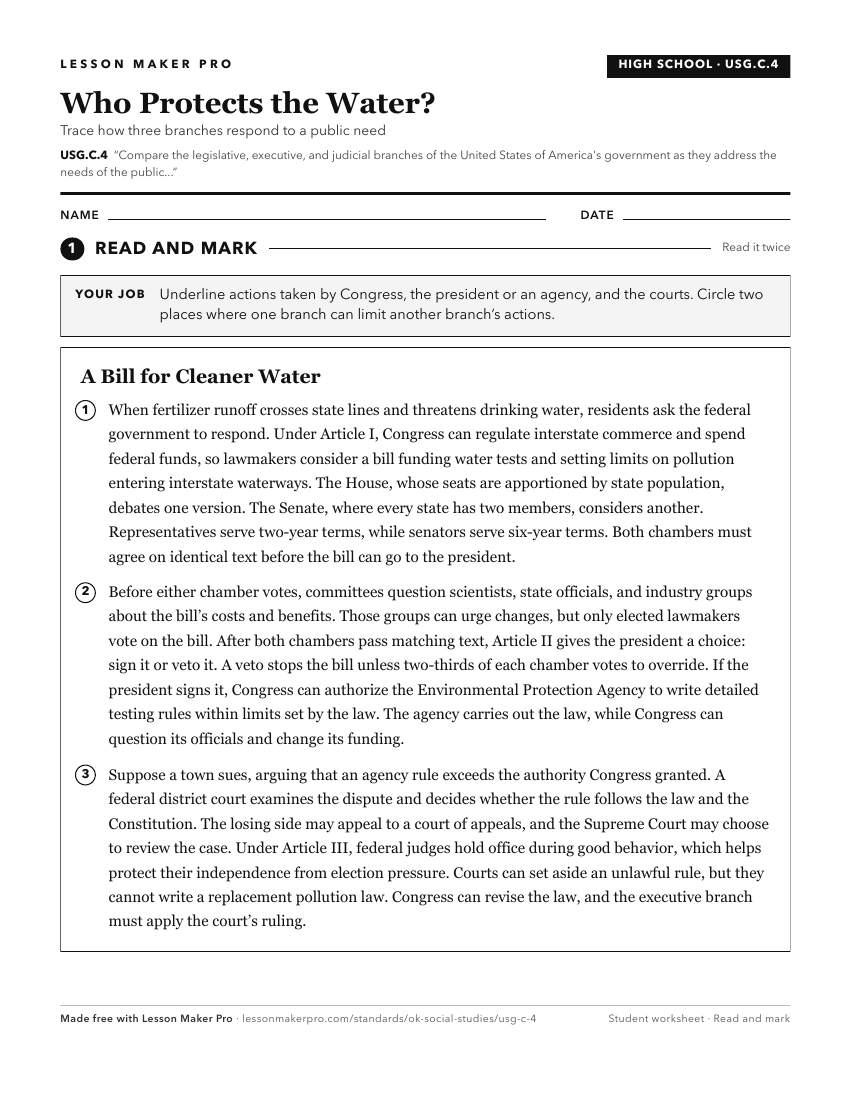
A ready-to-print activity worksheet aligned to USG.C.4, with an answer key for the teacher on its own page. No account needed.
PDF, US Letter, prints cleanly in black and white.
Download the worksheetKeep exploring
Related Standards
- 7.P.2.1.B
Compare the powers and responsibilities of the United States of America’s government to other forms of government, including the roles and rights of citizens.
- 6.P.2.1.B
Compare the powers and responsibilities of the United States of America’s government to other forms of government, including the roles and rights of citizens.
- OKH.C.5.1.B
Compare the structure of state government to the national system’s three branches with similar functions and powers.
- 8.P.2.1.B
Compare the powers and responsibilities of the United States of America’s government to other forms of government, including the roles and rights of citizens.
Turn this cluster into a lesson
Grade, subject, topic, and the complete cluster are prefilled. Create one free, no account needed.
Also for this cluster:Make a WorksheetMake a QuizMake a Sub Lesson