Oklahoma Social Studies USG.C.4.4
Standard Cluster
- USG.C.4
- Compare the legislative, executive, and judicial branches of the United States of America's government as they address the needs of the public.
Describe the scope and powers of the federal judiciary as delineated in Article III of the Constitution. Explain the length of terms, selection and confirmation process, jurisdiction, and process for the removal of Supreme Court justices. Examine the Framers’ intent regarding the judiciary’s authority, including the principle of judicial review, as described by Hamilton in Federalist Paper No.78 and established in Marbury v. Madison. Examine the role of district courts, the courts of appeals, and the Supreme Court in regards to the judicial review process. Explain the importance of an independent judicial system as integral to the interpretation and defense of citizens’ rights and liberties.
Oklahoma Academic Standards for Social Studies (2026) · USG.C.4
Cluster contents
Standards in This Cluster
USG.C.4.4 is a cluster heading. These are the individual standards under it.
- USG.C.4.4.A
Explain the length of terms, selection and confirmation process, jurisdiction, and process for the removal of Supreme Court justices.
- USG.C.4.4.B
Examine the Framers’ intent regarding the judiciary’s authority, including the principle of judicial review, as described by Hamilton in Federalist Paper No.78 ...
- USG.C.4.4.C
Examine the role of district courts, the courts of appeals, and the Supreme Court in regards to the judicial review process.
- USG.C.4.4.D
Explain the importance of an independent judicial system as integral to the interpretation and defense of citizens’ rights and liberties.
Teacher's field guide
What This Cluster Means
What Students Need to Do
- Students trace federal cases through district courts, appeals courts, and the Supreme Court. They explain how justices are chosen, how long they serve, and how they can be removed. They explain why judges can set aside unconstitutional laws.
What Mastery Looks Like
- Given a case, a student can tell whether it belongs in federal court and identify its possible path, including the rare cases that start in the Supreme Court. They can connect Hamilton’s argument to the ruling in Marbury v. Madison. They can explain how judges’ terms help protect rulings on citizens’ rights from political pressure.
Common Misconceptions
- Students may think every case starts in the Supreme Court or that it must hear every appeal. They may think Article III explicitly names judicial review. Some think the president can fire a justice or that justices serve fixed terms.
How to Assess It
- Exit ticket: A district judge strikes down a federal law, and the losing side appeals. Name the next court, explain what gives the judge authority to set aside the law, and say whether the president can fire the judge.
Lesson moves
Ways to Teach It
Give pairs federal law and state-versus-state case cards; have them place each on a district court, appeals court, or Supreme Court path.
Read a paragraph from Federalist 78, then write two sentences on how good-behavior tenure could protect an unpopular ruling.
Play court-route relay: teams sort case cards by starting court and possible appeal, then defend one route.
Use Oyez’s Mahanoy Area School District v. B.L. case summary; map its path through federal courts and identify the student speech right at stake.
Free download
Printable USG.C.4.4 Worksheet
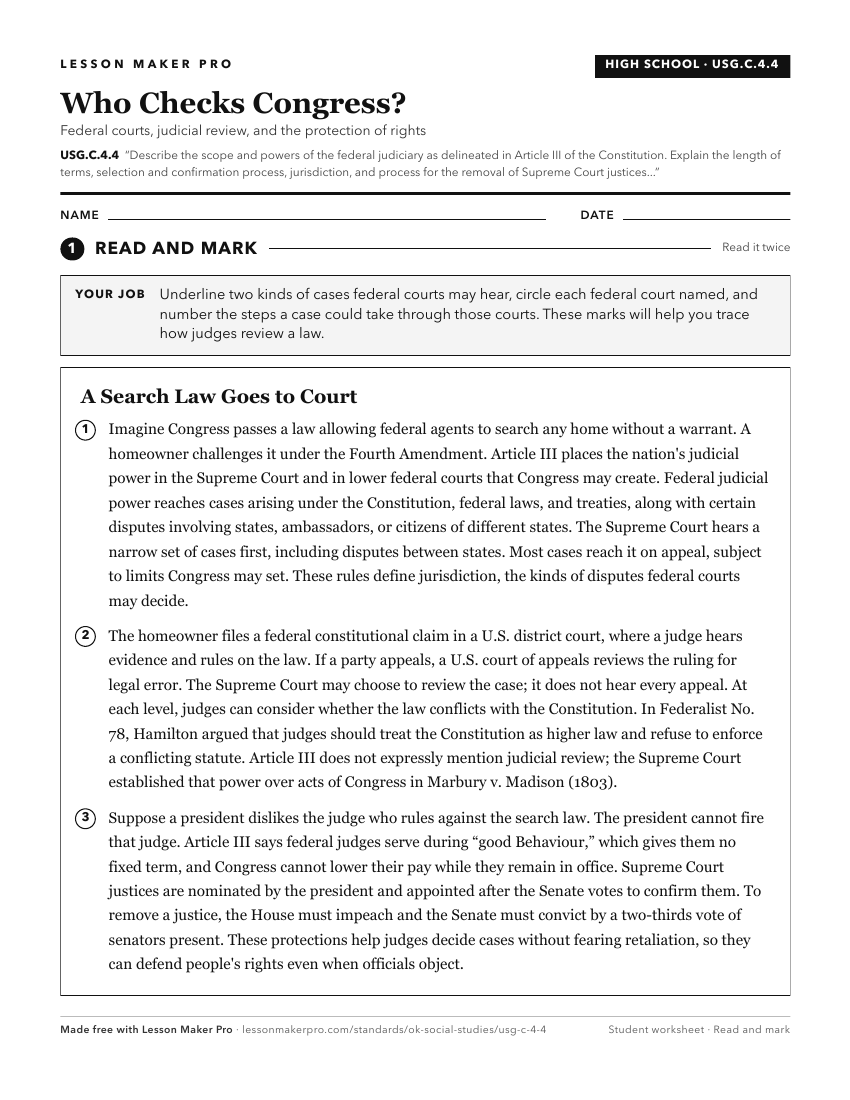
A ready-to-print activity worksheet aligned to USG.C.4.4, with an answer key for the teacher on its own page. No account needed.
PDF, US Letter, prints cleanly in black and white.
Download the worksheetKeep exploring
Related Standards
- USG.C.4.2
Examine the scope and powers of the executive branch as delineated in Article II of the Constitution of the United States of America.
- USG.C.4.1
Describe the scope and powers of the legislative branch of the federal government as delineated in Article 1 of the Constitution of the United States of America...
- USG.C.3.3.A
Describe and compare the scope of the powers vested to the Legislative Branch (Article 1), the Executive Branch (Article II), and the Judicial Branch (Article I...
Turn this cluster into a lesson
Grade, subject, topic, and the complete cluster are prefilled. Create one free, no account needed.
Also for this cluster:Make a WorksheetMake a QuizMake a Sub Lesson