Oklahoma Social Studies USG.C.4.1
Standard Cluster
- USG.C.4
- Compare the legislative, executive, and judicial branches of the United States of America's government as they address the needs of the public.
Describe the scope and powers of the legislative branch of the federal government as delineated in Article 1 of the Constitution of the United States of America. Compare the composition of the United States of America House to the United States of America Senate. Identify the constitutional qualifications, terms of office, and compensation for members of the United States of America Congress, including change created by passage of the 17th and 27th Amendments. Explain why the Framers established a bicameral legislative body and how the House of Representatives functions differently from the Senate. Describe the leadership roles of the Speaker of the House, the Senate President Pro Tempore, and majority and minority leaders, including the responsibilities of major congressional committees.
Oklahoma Academic Standards for Social Studies (2026) · USG.C.4
Cluster contents
Standards in This Cluster
USG.C.4.1 is a cluster heading. These are the individual standards under it.
- USG.C.4.1.A
Compare the composition of the United States of America House to the United States of America Senate.
- USG.C.4.1.B
Identify the constitutional qualifications, terms of office, and compensation for members of the United States of America Congress, including change created by ...
- USG.C.4.1.C
Explain why the Framers established a bicameral legislative body and how the House of Representatives functions differently from the Senate.
- USG.C.4.1.D
Describe the leadership roles of the Speaker of the House, the Senate President Pro Tempore, and majority and minority leaders, including the responsibilities o...
Teacher's field guide
What This Cluster Means
What Students Need to Do
- Students identify Congress's powers and explain why it has two chambers. They compare the chambers' seats, qualifications, terms, and different jobs. They explain changes to Senate elections and congressional pay, and describe what leaders and committees do.
What Mastery Looks Like
- A student can name Congress's taxing and war powers and explain population-based House seats versus two senators per state. They can compare each chamber's age, citizenship, residency, and term rules, and explain direct Senate elections and why pay changes must wait until after a House election. They can explain what the Speaker, president pro tempore, party leaders, and committees do.
Common Misconceptions
- Students may think both chambers give every state the same number of seats, or that senators serve two-year terms. Some think state legislatures still choose senators or that congressional pay changes take effect right away. Others think committees pass bills into law on their own.
How to Assess It
- On an exit ticket, ask: Why might a bill go through a committee, the House, and the Senate? Name one difference between the two chambers and one rule that changed under the 17th or 27th Amendment.
Lesson moves
Ways to Teach It
Give pairs Article I and amendment excerpt cards; have them build a two-column chart of seats, terms, powers, and leadership.
Ask students to write why the House has population-based seats and two-year terms, while each state has two senators with six-year terms.
Read scenarios about tax bills, impeachment charges, and committee hearings; students hold up House, Senate, or both cards and explain their choices.
Show a current bill on Congress.gov; have students find its assigned committee and predict what the committee might do before a floor vote.
Free download
Printable USG.C.4.1 Worksheet
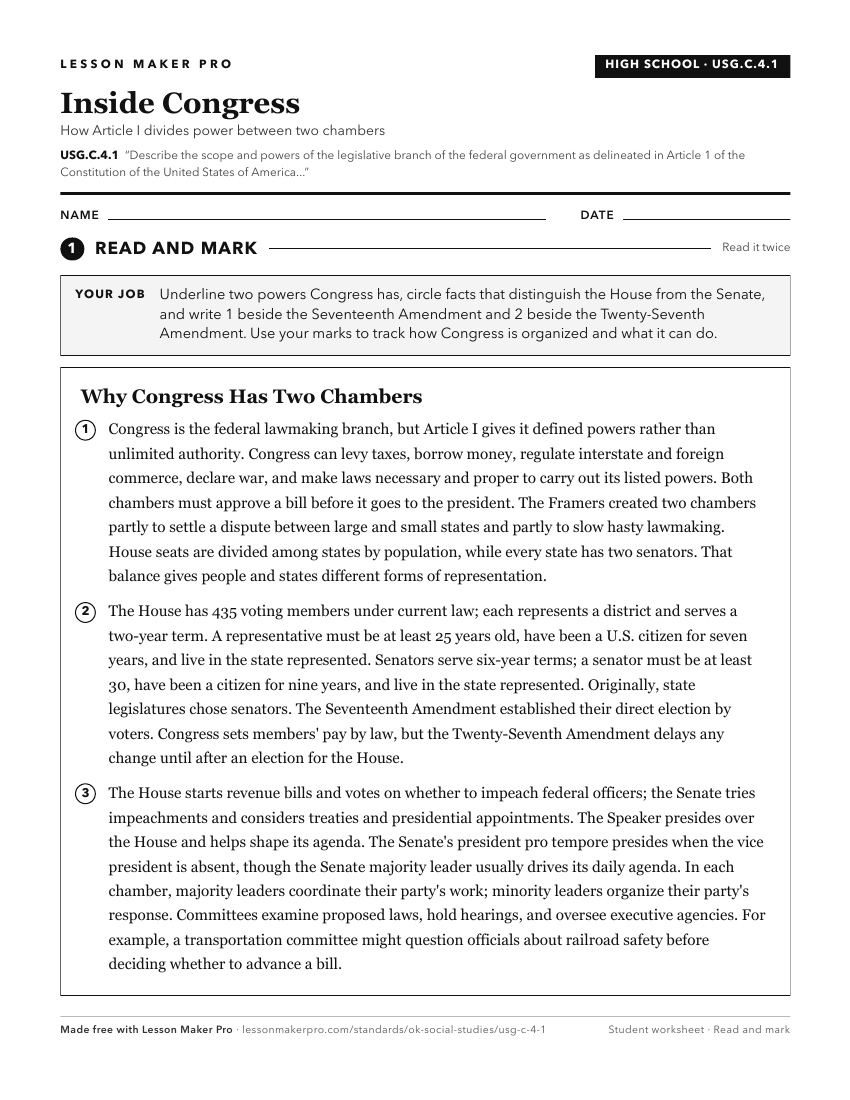
A ready-to-print activity worksheet aligned to USG.C.4.1, with an answer key for the teacher on its own page. No account needed.
PDF, US Letter, prints cleanly in black and white.
Download the worksheetKeep exploring
Related Standards
- USG.C.4.2
Examine the scope and powers of the executive branch as delineated in Article II of the Constitution of the United States of America.
- USG.C.3.4.A
Define and identify the enumerated (expressed) powers found in Article I.
- USG.C.3.3.A
Describe and compare the scope of the powers vested to the Legislative Branch (Article 1), the Executive Branch (Article II), and the Judicial Branch (Article I...
- USG.C.4.4
Describe the scope and powers of the federal judiciary as delineated in Article III of the Constitution.
Turn this cluster into a lesson
Grade, subject, topic, and the complete cluster are prefilled. Create one free, no account needed.
Also for this cluster:Make a WorksheetMake a QuizMake a Sub Lesson