Oklahoma Social Studies USG.C.4.2
Standard Cluster
- USG.C.4
- Compare the legislative, executive, and judicial branches of the United States of America's government as they address the needs of the public.
Examine the scope and powers of the executive branch as delineated in Article II of the Constitution of the United States of America. Identify the constitutional qualifications, term of office, and impeachment process for the President of the United States of America, including the impact of the 12th, 20th, 22nd, and 25th Amendments. Compare the original intent of the Chief Executive’s roles as described by Hamilton in Federalist Paper No.69 to the modern presidency. Describe the function of executive departments and the federal bureaucracy, including the authority and influence of the President’s Cabinet. Examine the purpose of independent regulatory agencies (e.g., Federal Reserve, Securities and Exchange Commission). Describe the growth of federal agencies during the 20th century, analyzing the constitutional and statutory bases for the delegation of powers to departments or agencies of the executive branch.
Oklahoma Academic Standards for Social Studies (2026) · USG.C.4
Cluster contents
Standards in This Cluster
USG.C.4.2 is a cluster heading. These are the individual standards under it.
- USG.C.4.2.A
Identify the constitutional qualifications, term of office, and impeachment process for the President of the United States of America, including the impact of t...
- USG.C.4.2.B
Compare the original intent of the Chief Executive's roles as described by Hamilton in Federalist Paper No.69 to the modern presidency.
- USG.C.4.2.C
Describe the function of executive departments and the federal bureaucracy, including the authority and influence of the President’s Cabinet.
- USG.C.4.2.D
Examine the purpose of independent regulatory agencies (e.g., Federal Reserve, Securities and Exchange Commission).
- USG.C.4.2.E
Describe the growth of federal agencies during the 20th century, analyzing the constitutional and statutory bases for the delegation of powers to departments or...
Teacher's field guide
What This Cluster Means
What Students Need to Do
- Students identify the president's Article II powers, including appointments, treaties, and military command. They explain eligibility, the four-year term, impeachment, and changes to elections and succession. They compare Hamilton's president with today's and explain how laws give federal departments and independent agencies their jobs.
What Mastery Looks Like
- Students can name the age, citizenship, and residency rules, and distinguish House impeachment from Senate conviction and removal. They can match the 12th, 20th, 22nd, and 25th Amendments to separate electoral votes, January 20, term limits, and succession or disability. They can compare Hamilton's checks with modern presidential power, distinguish Cabinet advice from agency rulemaking, and explain how New Deal laws expanded agencies.
Common Misconceptions
- Students may think impeachment automatically removes a president or that the Cabinet can make laws. They may assume every agency gets its power directly from the president, rather than from laws Congress passes. Some confuse a president's temporary inability to serve with a permanent vacancy.
How to Assess It
- Exit ticket: Match four situations to the correct amendment: separate votes for president and vice president, January 20 inauguration, a two-term limit, and a president unable to serve.
Lesson moves
Ways to Teach It
Give groups Article II, amendment, and agency statute cards; have them sort presidential actions by legal source and defend one match.
Read Federalist No. 69 and a recent executive order; ask, 'Would Hamilton call this power checked or unchecked? Cite both texts.'
Post 12th, 20th, 22nd, and 25th on classroom walls; read election, inauguration, term-limit, and succession scenarios for students to choose.
Match a Federal Reserve rate announcement and an SEC investor alert to excerpts from the 1913 and 1934 laws authorizing their work.
Free download
Printable USG.C.4.2 Worksheet
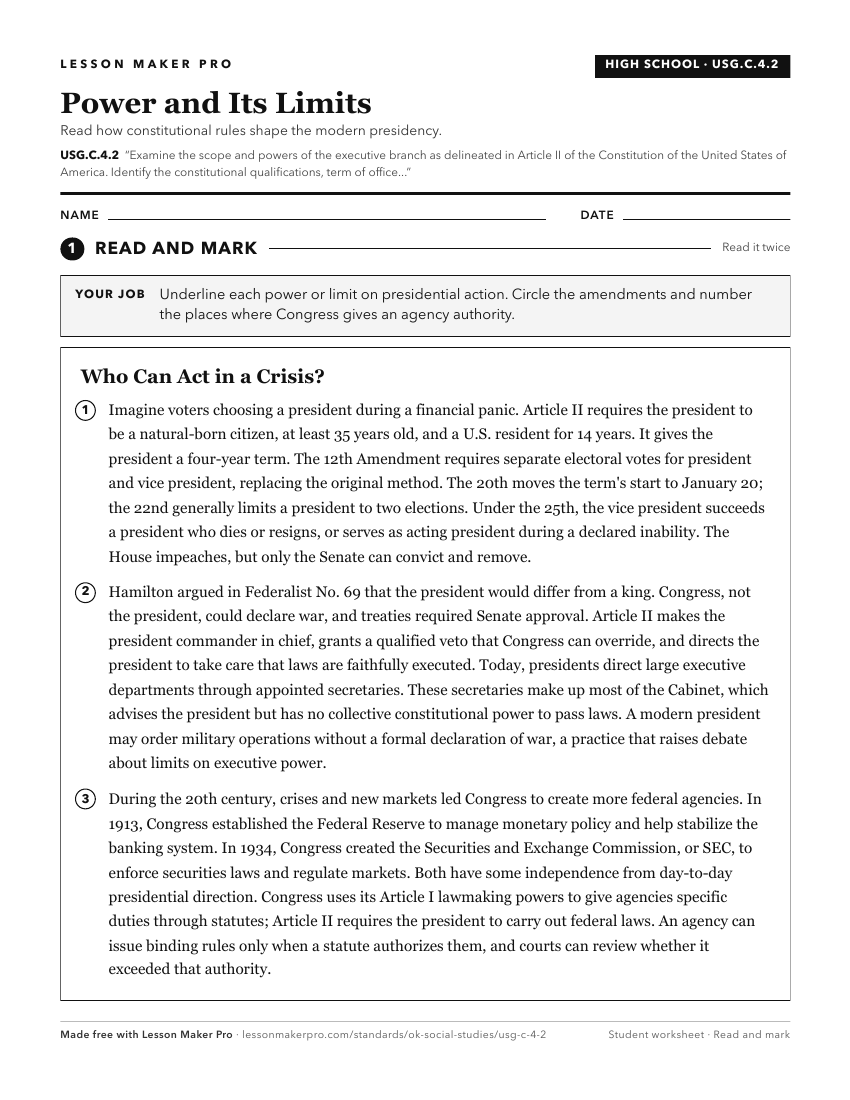
A ready-to-print activity worksheet aligned to USG.C.4.2, with an answer key for the teacher on its own page. No account needed.
PDF, US Letter, prints cleanly in black and white.
Download the worksheetKeep exploring
Related Standards
- USG.C.7.1.A
Identify and explain powers that the Constitution of the United States of America grants to the President and Congress to develop and carry out domestic policy.
- USG.C.4.1
Describe the scope and powers of the legislative branch of the federal government as delineated in Article 1 of the Constitution of the United States of America...
- 5.C.6.3
Analyze the structure and operations of government established in the Constitution of the United States of America.
- USG.C.3.3.A
Describe and compare the scope of the powers vested to the Legislative Branch (Article 1), the Executive Branch (Article II), and the Judicial Branch (Article I...
Turn this cluster into a lesson
Grade, subject, topic, and the complete cluster are prefilled. Create one free, no account needed.
Also for this cluster:Make a WorksheetMake a QuizMake a Sub Lesson