Oklahoma Social Studies S.4
Standard Cluster
Analyze the effects of social institutions on group behavior over the life course of individuals. Evaluate the characteristics of primary and secondary groups, including their influence over the behavior, attitudes, and values of their members. Identify various reference groups and explain how they are used by individuals to evaluate themselves. Explain in-group and out-group dynamics, and how these dynamics can shape behavior, perception, and morality. Examine the benefits of belonging to social groups, as well as the power of social groups over behavior and attitudes. Describe how stereotypes are formed, including the mechanisms of self-fulfilling stereotypes, and explain the impact stereotypes have on various groups in society. Explain how and why social institutions and cultures change over time.
Oklahoma Academic Standards for Social Studies (2026)
Cluster contents
Standards in This Cluster
S.4 is a cluster heading. These are the individual standards under it.
- S.4.1
Evaluate the characteristics of primary and secondary groups, including their influence over the behavior, attitudes, and values of their members.
- S.4.2
Identify various reference groups and explain how they are used by individuals to evaluate themselves.
- S.4.3
Explain in-group and out-group dynamics, and how these dynamics can shape behavior, perception, and morality.
- S.4.4
Examine the benefits of belonging to social groups, as well as the power of social groups over behavior and attitudes.
- S.4.5
Describe how stereotypes are formed, including the mechanisms of self-fulfilling stereotypes, and explain the impact stereotypes have on various groups in socie...
- S.4.6
Explain how and why social institutions and cultures change over time.
Teacher's field guide
What This Cluster Means
What Students Need to Do
- Students trace how family, school, work, and other institutions shape people at different ages and change over time. They compare close groups with task-focused groups and identify the groups people use to judge themselves. They explain how belonging, group pressure, and stereotypes affect choices and treatment of others.
What Mastery Looks Like
- Given a school or workplace story, a student identifies close groups, task-focused groups, and groups used for comparison. They explain how belonging can offer support but also lead members to exclude outsiders or excuse harm. They show how a label can lead to different treatment and help cause the behavior it predicts.
Common Misconceptions
- Students may think a close group must be family, or that people must belong to a group to compare themselves with it. They may assume outsiders are always disliked or that school rules never change. They often treat stereotypes as opinions alone, missing how different treatment can affect someone's behavior.
How to Assess It
- Exit ticket: A student joins a school team, compares their skills with varsity players, and is labeled unreliable by the coach. Identify the student's task-focused group and comparison group, then explain how the label might affect the student's behavior.
Lesson moves
Ways to Teach It
Give pairs cards labeled best friends, debate club, and varsity players; have them sort the cards by close ties, shared tasks, and comparison groups.
Ask students to write how a school dress code might change over 30 years and whose interests could shape the new rules.
Read short stories about a lunch table, a hiring team, and a rumor; students hold up cards marked in-group, out-group, or stereotype.
Bring a school club flyer and a local job ad; students map who might shape a teen's choices now and after graduation.
Free download
Printable S.4 Worksheet
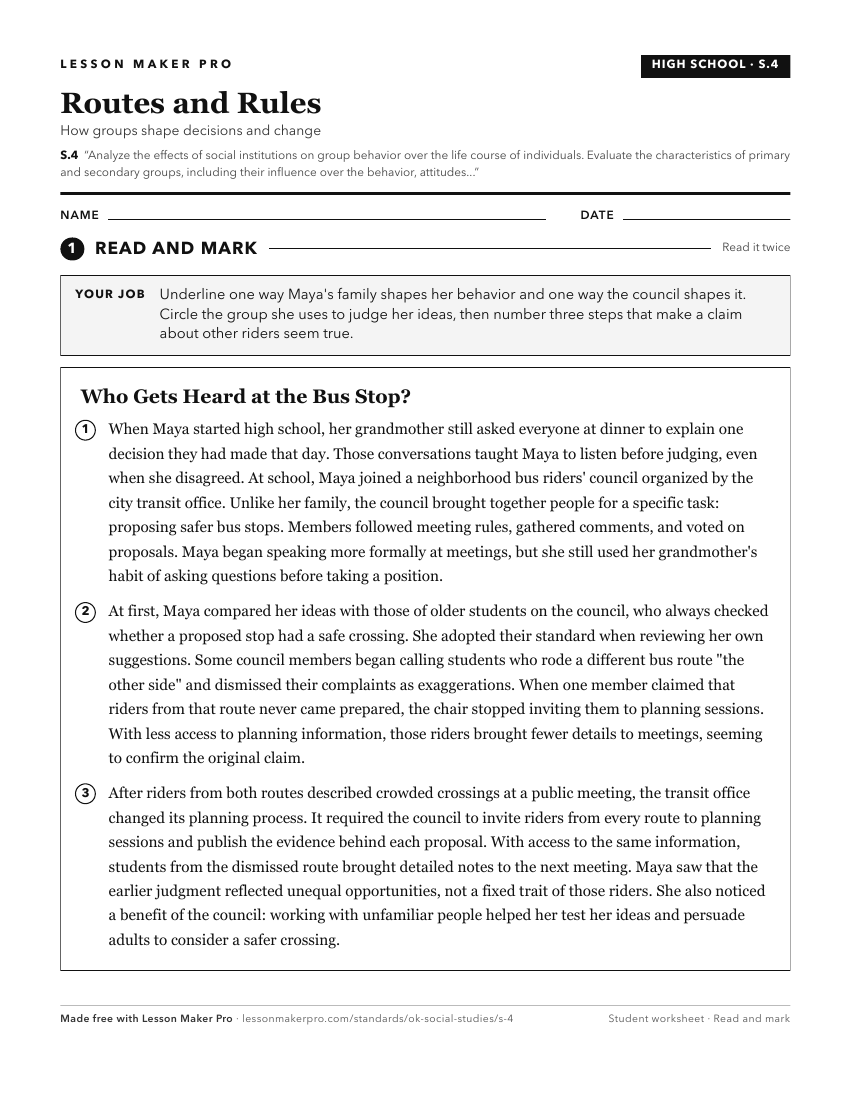
A ready-to-print activity worksheet aligned to S.4, with an answer key for the teacher on its own page. No account needed.
PDF, US Letter, prints cleanly in black and white.
Download the worksheetKeep exploring
Related Standards
- S.5.1
Analyze patterns of social stratification and their effects on individuals and groups.
- S.5.3
Analyze effects of stratification and social inequality on individuals and groups, including life outcomes, social problems, and group conflict.
- S.3
Examine the social construction of groups and their impact on individuals.
Turn this cluster into a lesson
Grade, subject, topic, and the complete cluster are prefilled. Create one free, no account needed.
Also for this cluster:Make a WorksheetMake a QuizMake a Sub Lesson