Oklahoma Social Studies S.4.1
The Standard
- S.4
- Analyze the effects of social institutions on group behavior over the life course of individuals.
Evaluate the characteristics of primary and secondary groups, including their influence over the behavior, attitudes, and values of their members.
Oklahoma Academic Standards for Social Studies (2026) · S.4
Teacher's field guide
What This Standard Means
What Students Need to Do
- Students tell close, lasting groups from groups formed around a shared task. They use details from an example to explain how a group's expectations can shape someone's choices or beliefs.
What Mastery Looks Like
- Given a family and a student council, students identify which is built on personal ties and which is built on a shared task. They name an expectation in each group and explain how it could change a member's actions or views.
Common Misconceptions
- Students may think “primary” means the most powerful group or the first group someone joined. They may assume clubs cannot have close friendships, or say a group affects someone without naming a specific expectation.
How to Assess It
- Exit ticket: A student joins a school cleanup committee to plan events and starts sorting lunch waste because teammates expect it. Is the committee mainly built on close ties or a shared task? Give one clue and explain the change in behavior.
Lesson moves
Ways to Teach It
Give pairs four cards: family, best friends, student council, and shift crew; have them sort by close ties or shared task.
Ask students to write: “How might a close friend's opinion about volunteering affect a student's choice differently from a club rule?”
Play group-type bingo with six short scenarios; students mark close ties or shared task and name the clue before the next call.
Show a local volunteer group's event flyer; students identify its purpose and predict one behavior members are expected to show.
Free download
Printable S.4.1 Worksheet
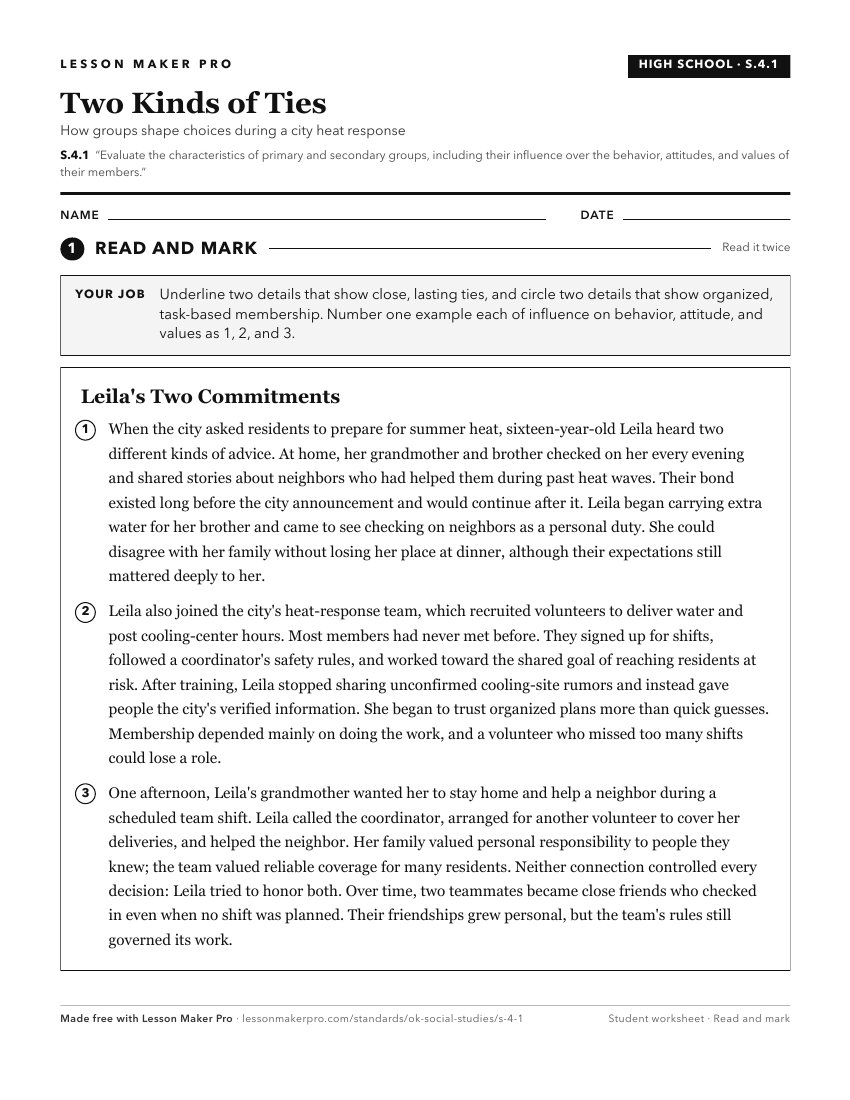
A ready-to-print activity worksheet aligned to S.4.1, with an answer key for the teacher on its own page. No account needed.
PDF, US Letter, prints cleanly in black and white.
Download the worksheetKeep exploring
Related Standards
- PS.5.2
Examine various types of social influence, including intergroup dynamics, persuasion, attraction, aggression, and altruism.
- S.5.6
Examine the extent to which individual and group responses influence potential resolutions to social problems.
- S.4.4
Examine the benefits of belonging to social groups, as well as the power of social groups over behavior and attitudes.
- S.3
Examine the social construction of groups and their impact on individuals.
Turn this exact standard into a lesson
Grade, subject, topic, and the complete standard are prefilled. Create one free, no account needed.
Also for this standard:Make a WorksheetMake a QuizMake a Sub Lesson