Oklahoma Social Studies S.4.3
The Standard
- S.4
- Analyze the effects of social institutions on group behavior over the life course of individuals.
Explain in-group and out-group dynamics, and how these dynamics can shape behavior, perception, and morality.
Oklahoma Academic Standards for Social Studies (2026) · S.4
Teacher's field guide
What This Standard Means
What Students Need to Do
- Students identify who counts as “us” and “them” in a situation. They explain how group loyalty can change what people notice, how they act, and which actions they excuse.
What Mastery Looks Like
- A student spots when someone praises their own group for an action but condemns another group for the same action. They point to details in the situation and avoid assuming every group member thinks alike.
Common Misconceptions
- Students may think loyalty to one group always means hatred of another. They may also miss a double standard when the only difference between two cases is the group name.
How to Assess It
- Exit ticket: Two school clubs each post a rude joke about the other. A student excuses their own club but calls the other club mean. Name the in-group and out-group, then explain the difference in judgment.
Lesson moves
Ways to Teach It
Give pairs Red and Blue club badges, read a card saying Blue broke a rule, then swap badges and compare verdicts.
Ask students to write why a fan might excuse their team’s cheating but call a rival team dishonest.
Play “Same Act, New Label”: read four matched scenarios, switch the group names, and have students flag each double standard.
Draw a soccer score sheet with one identical foul by each team; have students write how each team’s fans might describe the fouls.
Free download
Printable S.4.3 Worksheet
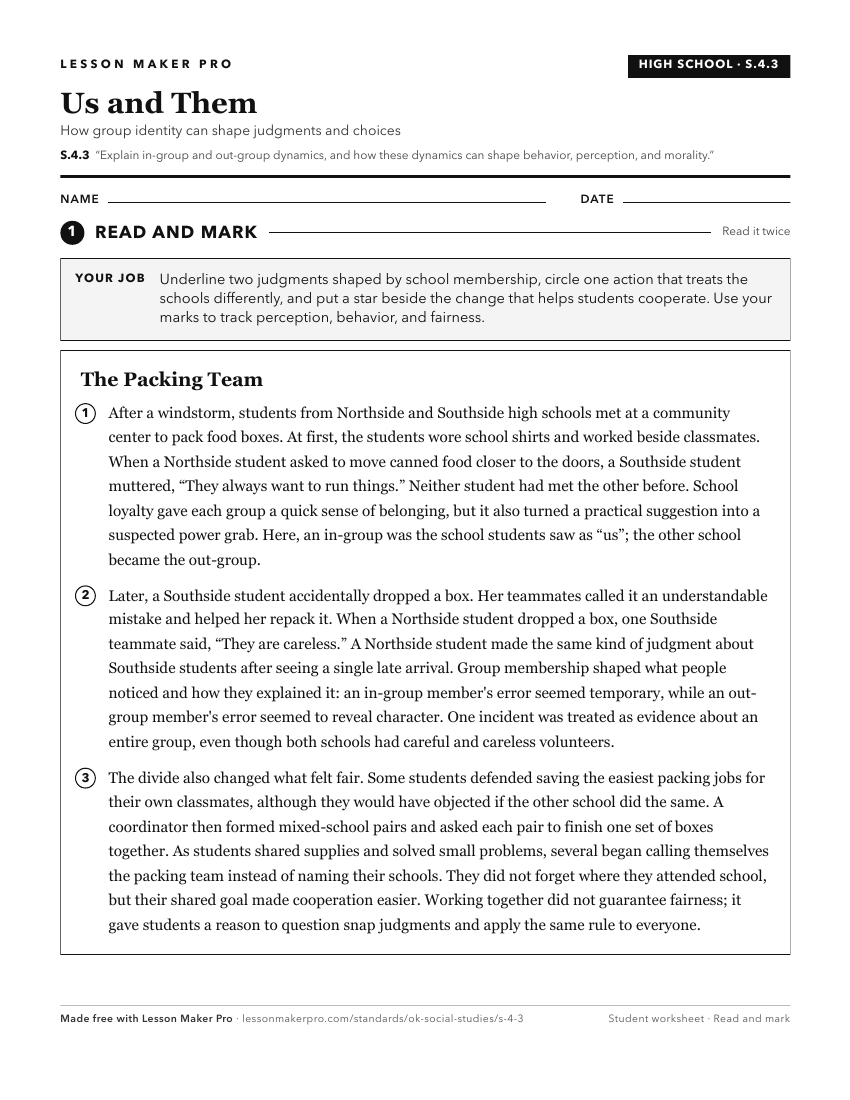
A ready-to-print activity worksheet aligned to S.4.3, with an answer key for the teacher on its own page. No account needed.
PDF, US Letter, prints cleanly in black and white.
Download the worksheetKeep exploring
Related Standards
- PS.5.2
Examine various types of social influence, including intergroup dynamics, persuasion, attraction, aggression, and altruism.
- PS.5.1
Explain how attitudes, biases, and beliefs affect behavior and relationships with others.
- S.4.4
Examine the benefits of belonging to social groups, as well as the power of social groups over behavior and attitudes.
- S.3
Examine the social construction of groups and their impact on individuals.
Turn this exact standard into a lesson
Grade, subject, topic, and the complete standard are prefilled. Create one free, no account needed.
Also for this standard:Make a WorksheetMake a QuizMake a Sub Lesson