Oklahoma Social Studies S.4.2
The Standard
- S.4
- Analyze the effects of social institutions on group behavior over the life course of individuals.
Identify various reference groups and explain how they are used by individuals to evaluate themselves.
Oklahoma Academic Standards for Social Studies (2026) · S.4
Teacher's field guide
What This Standard Means
What Students Need to Do
- Students name groups people use to judge themselves, such as classmates, family members, or a team they hope to join. They explain how someone might compare grades, habits, or skills with those groups.
What Mastery Looks Like
- Given a short scenario, students identify the comparison group and what the person is judging about themselves. They can explain why a student might compare their running with varsity athletes even if they are not on the team.
Common Misconceptions
- Students may name any group a person belongs to, even when no comparison is happening. They may think people only compare themselves with groups they belong to.
How to Assess It
- Exit ticket: Nia compares her quiz score with her classmates' scores and her running with varsity runners. Name both groups and explain what Nia is judging in each comparison.
Lesson moves
Ways to Teach It
Give pairs cards labeled novice runner, art student, varsity team, and art club; they match people to groups and write one self-comparison.
Ask: Can a ninth grader use varsity athletes to judge their own progress without being on the team? Explain.
Read aloud, 'A student checks her sketches against art club displays.' Teams name the comparison group and the skill being judged.
Give students a mock college admissions page with admitted students' average grades; ask how an applicant might judge their own chances.
Free download
Printable S.4.2 Worksheet
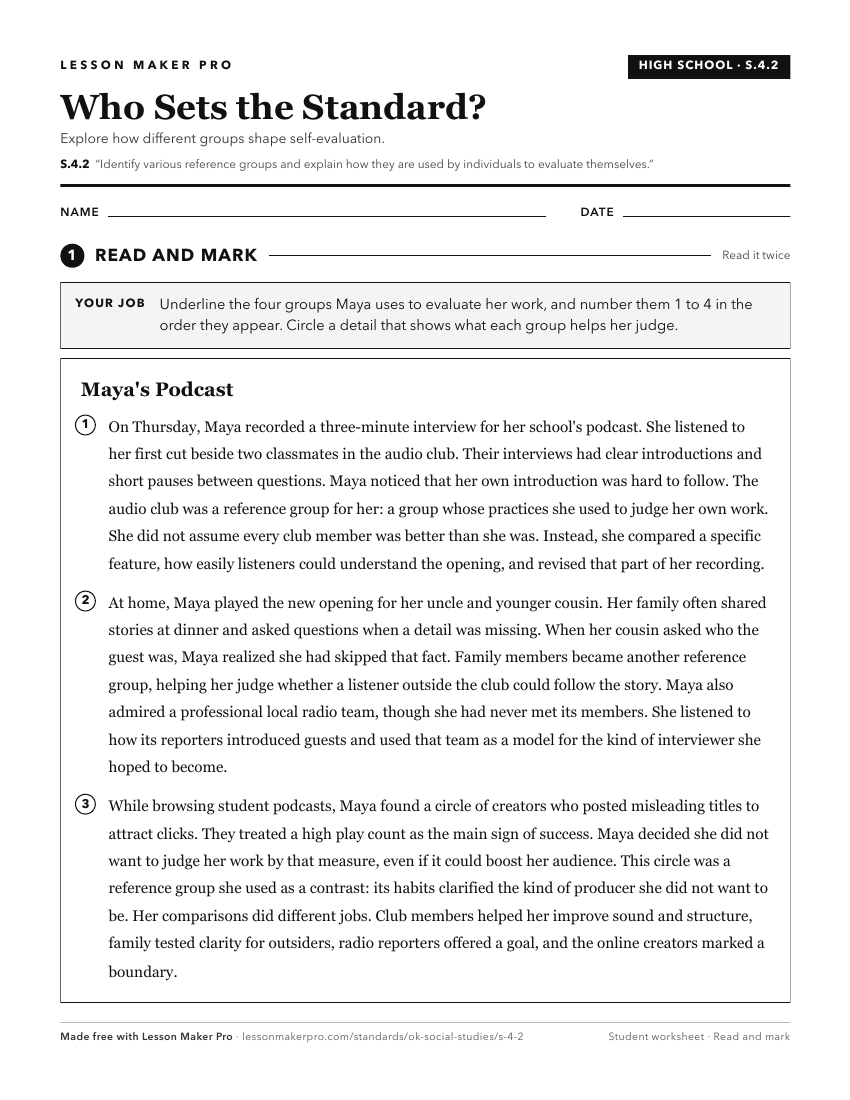
A ready-to-print activity worksheet aligned to S.4.2, with an answer key for the teacher on its own page. No account needed.
PDF, US Letter, prints cleanly in black and white.
Download the worksheetKeep exploring
Related Standards
- S.4.4
Examine the benefits of belonging to social groups, as well as the power of social groups over behavior and attitudes.
- S.4.1
Evaluate the characteristics of primary and secondary groups, including their influence over the behavior, attitudes, and values of their members.
- S.3
Examine the social construction of groups and their impact on individuals.
- 5.P.2.2.B
Compare perspectives of individuals and groups from different regions and experiences, including the past and present.
Turn this exact standard into a lesson
Grade, subject, topic, and the complete standard are prefilled. Create one free, no account needed.
Also for this standard:Make a WorksheetMake a QuizMake a Sub Lesson