Oklahoma Social Studies 8.P.2
Standard Cluster
Use interdisciplinary tools to acquire, apply, and evaluate content understanding of the four strands of social studies. Demonstrate an understanding of the principles of government, the benefits of democratic systems, and their responsibilities as citizens. Compare and analyze civic virtues and democratic principles in historic and global settings, explaining how they influence political institutions. Compare the powers and responsibilities of the United States of America’s government to other forms of government, including the roles and rights of citizens. Examine the impact of constitutions, laws, treaties, and international agreements on the limits of government, including the concepts of sovereignty and the rule of law. Develop skills which demonstrate an understanding of historical events and the people who shaped our history. Gather and draw conclusions from sources of evidence, identifying plausible author, occasion, audience, purpose, and possible bias. Describe multiple factors and explain how they can influence the perspectives of individuals and groups on events from history and the modern era. Distinguish multiple causation, including immediate versus long-term cause-effect relationships; construct timelines of related events. Demonstrate a mastery of geographic concepts and the use of geographic tools to understand the impact of geography on the past and present. Answer geographic questions and conduct investigations by acquiring, organizing, and interpreting information about the modern world and historical events. Use multiple mapping techniques, data visuals, satellite images, and geographic technology to analyze spatial patterns of physical and human characteristics, making connections between regions. Explain how the environment affects cultural patterns and historical events, providing opportunities and challenges for human development. Identify the principles of economic systems and develop an understanding of the benefits of a market system in local, national, and global settings. Analyze, interpret, and compare economic data from multiple charts and graphs. Identify different types of economic systems, comparing advantages and disadvantages for citizens and the growth of a nation’s economy. Explain how technology and trade impact standard of living and economic interdependence, using historical or contemporary examples.
Oklahoma Academic Standards for Social Studies (2026)
Cluster contents
Standards in This Cluster
8.P.2 is a cluster heading. These are the individual standards under it.
- 8.P.2.1
Demonstrate an understanding of the principles of government, the benefits of democratic systems, and their responsibilities as citizens.
- 8.P.2.1.A
Compare and analyze civic virtues and democratic principles in historic and global settings, explaining how they influence political institutions.
- 8.P.2.1.B
Compare the powers and responsibilities of the United States of America’s government to other forms of government, including the roles and rights of citizens.
- 8.P.2.1.C
Examine the impact of constitutions, laws, treaties, and international agreements on the limits of government, including the concepts of sovereignty and the rul...
- 8.P.2.2
Develop skills which demonstrate an understanding of historical events and the people who shaped our history.
- 8.P.2.2.A
Gather and draw conclusions from sources of evidence, identifying plausible author, occasion, audience, purpose, and possible bias.
- 8.P.2.2.B
Describe multiple factors and explain how they can influence the perspectives of individuals and groups on events from history and the modern era.
- 8.P.2.2.C
Distinguish multiple causation, including immediate versus long-term cause-effect relationships; construct timelines of related events.
- 8.P.2.3
Demonstrate a mastery of geographic concepts and the use of geographic tools to understand the impact of geography on the past and present.
- 8.P.2.3.A
Answer geographic questions and conduct investigations by acquiring, organizing, and interpreting information about the modern world and historical events.
- 8.P.2.3.B
Use multiple mapping techniques, data visuals, satellite images, and geographic technology to analyze spatial patterns of physical and human characteristics, ma...
- 8.P.2.3.C
Explain how the environment affects cultural patterns and historical events, providing opportunities and challenges for human development.
- 8.P.2.4
Identify the principles of economic systems and develop an understanding of the benefits of a market system in local, national, and global settings.
- 8.P.2.4.A
Analyze, interpret, and compare economic data from multiple charts and graphs.
- 8.P.2.4.B
Identify different types of economic systems, comparing advantages and disadvantages for citizens and the growth of a nation’s economy.
- 8.P.2.4.C
Explain how technology and trade impact standard of living and economic interdependence, using historical or contemporary examples.
Teacher's field guide
What This Cluster Means
What Students Need to Do
- Students use documents, maps, and graphs to explain events and decisions. They compare how governments use power, how citizens take part, and how geography and trade shape people's lives.
What Mastery Looks Like
- A student can identify who made a source and why, then use it to support a claim. They can tell a long-term cause from an immediate trigger. They can explain how a law or trade agreement affects citizens and compare who makes decisions in different governments.
Common Misconceptions
- Students may treat a firsthand account as unbiased or confuse a trigger with a long-term cause. They may read a rise in trade as proof that an agreement caused it, without checking other factors. Some assume leaders in a democracy can act without legal limits.
How to Assess It
- Show a map marking a U.S.-Canada crossing and a two-year trade chart labeled before and after a new tariff. Ask: "Where is the crossing, how did trade change, and why can't the chart prove the tariff caused it?"
Lesson moves
Ways to Teach It
Give pairs a border map, a trade bar chart, and a short trade agreement excerpt; have them mark a crossing and write one supported claim.
Read a merchant's and an official's accounts of a border law; ask whose interests each serves and how citizens could challenge the law.
Put five American Revolution event cards in order; label an immediate trigger and a long-term cause, then defend each choice.
Compare grocery receipts with local and imported produce; trace the imports on a world map and discuss how trade affects prices.
Free download
Printable 8.P.2 Worksheet
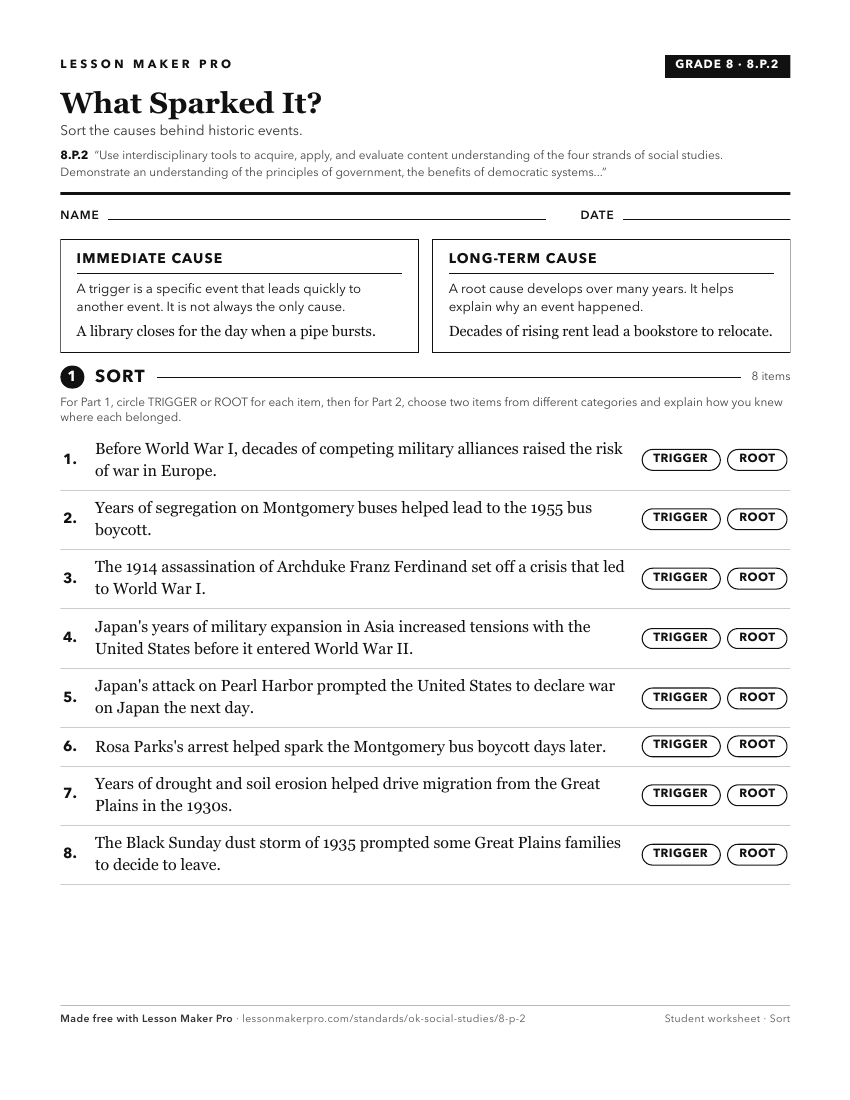
A ready-to-print activity worksheet aligned to 8.P.2, with an answer key for the teacher on its own page. No account needed.
PDF, US Letter, prints cleanly in black and white.
Download the worksheetKeep exploring
Related Standards
Turn this cluster into a lesson
Grade, subject, topic, and the complete cluster are prefilled. Create one free, no account needed.
Also for this cluster:Make a WorksheetMake a QuizMake a Sub Lesson