Oklahoma Social Studies 8.C.3.2
Standard Cluster
- 8.C.3
- Examine the formation of the United States of America’s system of government following the Revolutionary War and the creation of the Constitution of the United States of America.
Analyze the significance of the Constitutional Convention on the formation of a new organization for national government. Identify the relationship between the principles established in the Declaration of Independence and the government created by the Constitution of the United States of America. Describe the role of leaders at the Constitutional Convention, including its President George Washington, the influence of James Madison, and the contributions of Roger Sherman. Explain how the key debate regarding state representation in Congress, presented by opposing Virginia and New Jersey Plans, was resolved by the Great Compromise, creating a bicameral legislature. Explain how the Three-Fifths Compromise over congressional representation and the Fugitive Slave Clause avoided the slavery issue and maintained the institution in both northern and southern states by permitting each state to maintain, restrict, or abolish slavery and delaying a ban on the slave trade. Examine the rationales for the creation and functioning of the Electoral College.
Oklahoma Academic Standards for Social Studies (2026) · 8.C.3
Cluster contents
Standards in This Cluster
8.C.3.2 is a cluster heading. These are the individual standards under it.
- 8.C.3.2.A
Identify the relationship between the principles established in the Declaration of Independence and the government created by the Constitution of the United Sta...
- 8.C.3.2.B
Describe the role of leaders at the Constitutional Convention, including its President George Washington, the influence of James Madison, and the contributions ...
- 8.C.3.2.C
Explain how the key debate regarding state representation in Congress, presented by opposing Virginia and New Jersey Plans, was resolved by the Great Compromise...
- 8.C.3.2.D
Explain how the Three-Fifths Compromise over congressional representation and the Fugitive Slave Clause avoided the slavery issue and maintained the institution...
- 8.C.3.2.E
Examine the rationales for the creation and functioning of the Electoral College.
Teacher's field guide
What This Cluster Means
What Students Need to Do
- Students explain why delegates sought a stronger national government after the Articles of Confederation. They connect the Declaration’s ideas about equality and consent to the Constitution. They identify the convention’s leaders, representation and slavery compromises, and reasons for using presidential electors.
What Mastery Looks Like
- Students show how the Virginia and New Jersey Plans led to a population-based House and an equal-state Senate. They explain how the Three-Fifths count, fugitive returns, and delayed slave trade ban protected slavery despite the Declaration’s equality claim. They explain why delegates gave states a role in choosing the president through electors.
Common Misconceptions
- Students may think both houses of Congress give states equal representation. Some think the Three-Fifths count gave enslaved people votes, or that the Constitution ended slavery. Others think the Electoral College is a direct national vote.
How to Assess It
- Exit ticket: Draw the two houses created by the Great Compromise and label how each state gets seats. In one sentence, explain why the Three-Fifths count increased slaveholding states’ power.
Lesson moves
Ways to Teach It
Give pairs state cards with populations of 10 and 2; have them assign House seats by population, then give each state two Senate seats.
Ask: “How did equality in the Declaration clash with fugitive returns and the delayed slave trade ban?”
Have pairs match Washington to chair, Madison to the Virginia Plan, Sherman to the compromise, and the New Jersey Plan to equal state votes.
Project a current electoral map; students compare California and Wyoming’s elector totals and explain why candidates count state results, not just total votes.
Free download
Printable 8.C.3.2 Worksheet
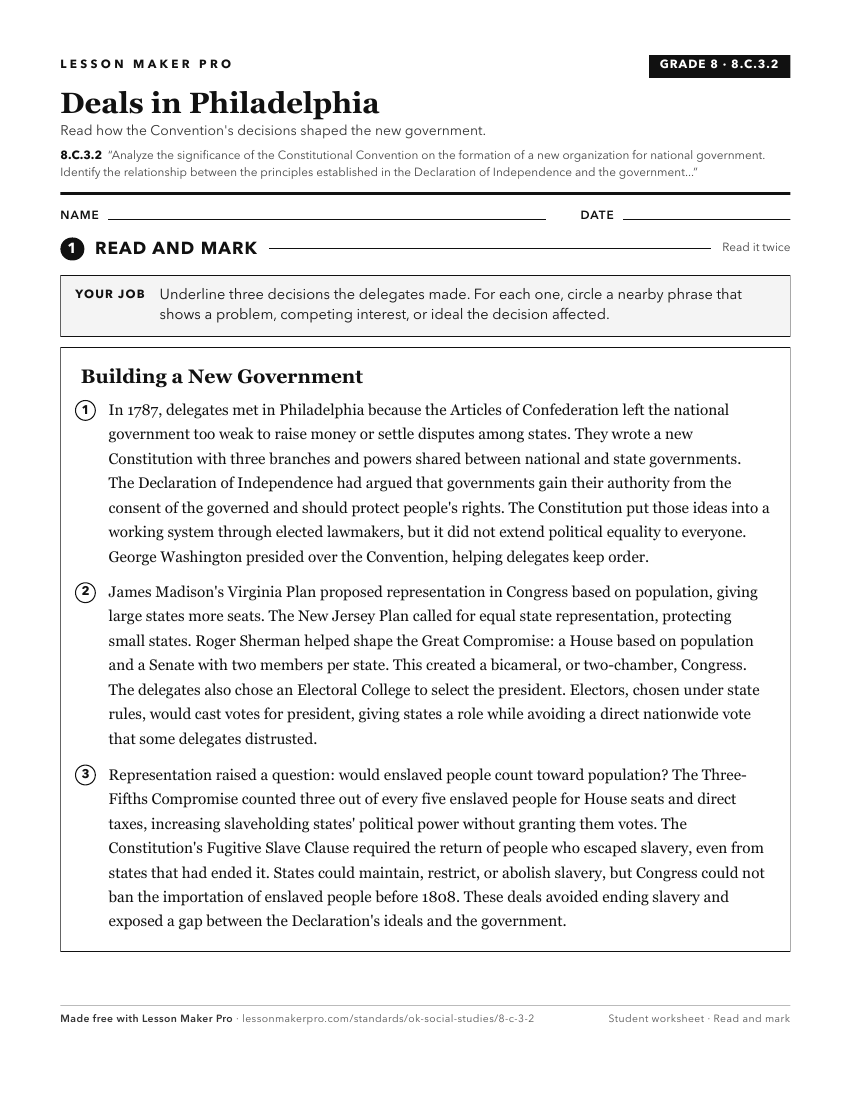
A ready-to-print activity worksheet aligned to 8.C.3.2, with an answer key for the teacher on its own page. No account needed.
PDF, US Letter, prints cleanly in black and white.
Download the worksheetKeep exploring
Related Standards
- 5.C.5
Examine the formation of the United States of America’s system of government following the American Revolution.
- 8.C.3
Examine the formation of the United States of America’s system of government following the Revolutionary War and the creation of the Constitution of the United ...
- 5.C.5.1
Evaluate the major issues that led to the Constitutional Convention, including the public alarm raised from Shays’ Rebellion and challenges faced by a national ...
- 8.C.3.1
Examine conditions in the new nation that led to the Constitutional Convention in Philadelphia in 1787
Turn this cluster into a lesson
Grade, subject, topic, and the complete cluster are prefilled. Create one free, no account needed.
Also for this cluster:Make a WorksheetMake a QuizMake a Sub Lesson