Oklahoma Social Studies 8.C.3.2.D
The Standard
- 8.C.3
- Examine the formation of the United States of America’s system of government following the Revolutionary War and the creation of the Constitution of the United States of America.
- 8.C.3.2
- Analyze the significance of the Constitutional Convention on the formation of a new organization for national government.
Explain how the Three-Fifths Compromise over congressional representation and the Fugitive Slave Clause avoided the slavery issue and maintained the institution in both northern and southern states by permitting each state to maintain, restrict, or abolish slavery and delaying a ban on the slave trade.
Oklahoma Academic Standards for Social Studies (2026) · 8.C.3.2
Teacher's field guide
What This Standard Means
What Students Need to Do
- Students explain how counting enslaved people increased slaveholding states' power in Congress, though those people could not vote. They explain why someone who escaped slavery could be returned from a state that had abolished it. They identify what states could decide about slavery and why Congress could not ban the importation of enslaved people before 1808.
What Mastery Looks Like
- Given a map of states, a student can explain why reaching a state without slavery did not guarantee freedom. They can calculate the three-fifths count for a sample population and explain that the 1808 limit concerned importation, not the end of slavery.
Common Misconceptions
- Students may think the three-fifths count gave enslaved people voting rights. They may think escape to a state without slavery guaranteed freedom, or that slavery ended in 1808.
How to Assess It
- Exit ticket: A person escapes slavery in Virginia and reaches Massachusetts in 1795. Explain what could happen under the Fugitive Slave Clause, how Virginia gained power from the three-fifths count, and what Congress could not ban before 1808.
Lesson moves
Ways to Teach It
Give pairs 10 blue counters for free residents and 10 red counters for enslaved residents; count only six reds toward congressional representation.
Ask: How could Massachusetts ban slavery yet still be required to return someone who escaped slavery in Virginia?
Sort claim cards about voting, escape, state laws, and the 1808 date into true and false piles; rewrite each false claim.
Compare a 1790 census excerpt with today's count of every resident; ask whose political power grew under the older rule.
Free download
Printable 8.C.3.2.D Worksheet
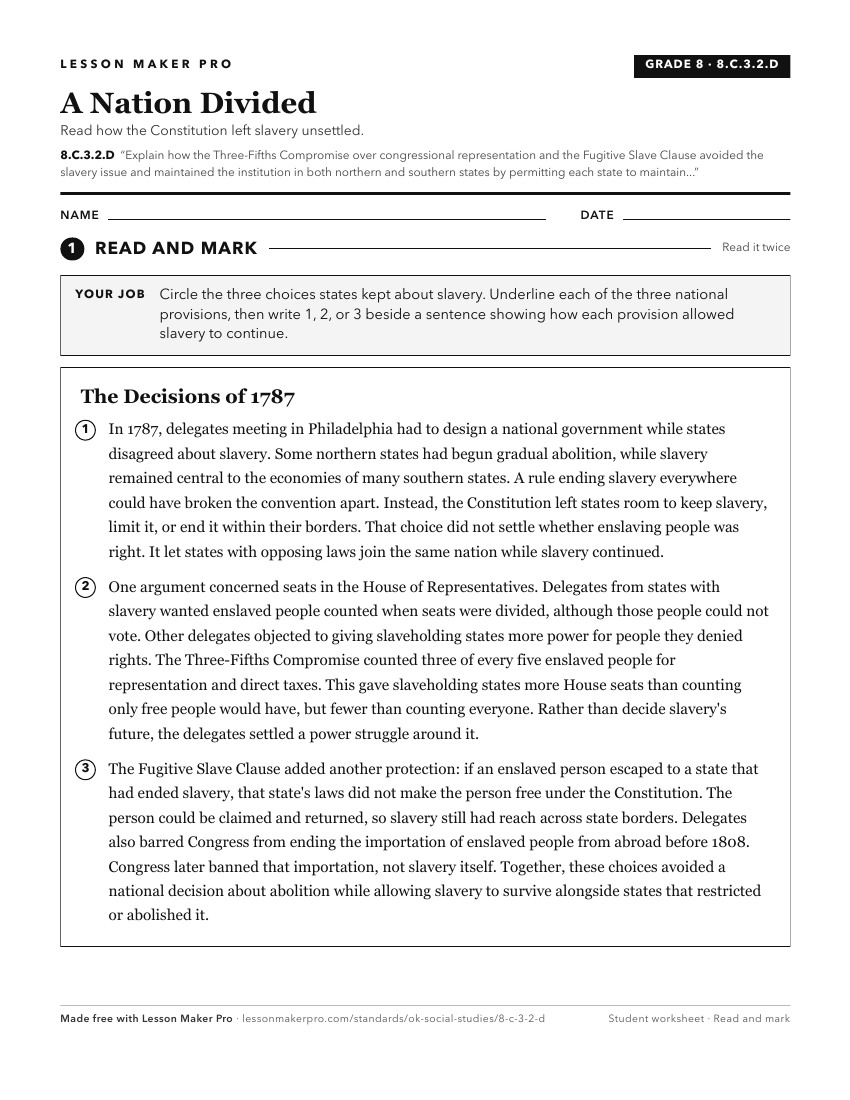
A ready-to-print activity worksheet aligned to 8.C.3.2.D, with an answer key for the teacher on its own page. No account needed.
PDF, US Letter, prints cleanly in black and white.
Download the worksheetKeep exploring
Related Standards
- 8.C.7.5
Analyze congress’ attempt to balance sectional interests and political power, by describing the impact of the Missouri Compromise on the expansion of slavery, b...
- 8.C.11.1
Evaluate the goals of the Compromise of 1850 regarding the issue of slavery.
- 8.C.11.1.B
Explain why the Compromise of 1850 may have succeeded as a temporary solution but proved that compromise could not offer a permanent solution to the issue of sl...
- 5.C.5.3.C
congressional representation resolved by the Three-Fifths Compromise and the potential for a future ban of the international slave trade.
Turn this exact standard into a lesson
Grade, subject, topic, and the complete standard are prefilled. Create one free, no account needed.
Also for this standard:Make a WorksheetMake a QuizMake a Sub Lesson