Oklahoma Social Studies 8.C.11.1
Standard Cluster
- 8.C.11
- Analyze slavery as the principal cause of increased sectional polarization leading to the Civil War.
Evaluate the goals of the Compromise of 1850 regarding the issue of slavery. Describe the series of measures proposed by Senator Henry Clay to avert the threat of dissolution of the Union, including a strengthened Fugitive Slave Act and the application of popular sovereignty regarding the spread of slavery into new states. Explain why the Compromise of 1850 may have succeeded as a temporary solution but proved that compromise could not offer a permanent solution to the issue of slavery.
Oklahoma Academic Standards for Social Studies (2026) · 8.C.11
Cluster contents
Standards in This Cluster
8.C.11.1 is a cluster heading. These are the individual standards under it.
- 8.C.11.1.A
Describe the series of measures proposed by Senator Henry Clay to avert the threat of dissolution of the Union, including a strengthened Fugitive Slave Act and ...
- 8.C.11.1.B
Explain why the Compromise of 1850 may have succeeded as a temporary solution but proved that compromise could not offer a permanent solution to the issue of sl...
Teacher's field guide
What This Cluster Means
What Students Need to Do
- Students identify Clay's proposals, including California's admission as a free state, a stronger Fugitive Slave Act, and local decisions about slavery in western territories. They explain what each side hoped to gain and why the deal delayed a breakup without settling slavery.
What Mastery Looks Like
- A student can explain why California's admission appealed to Northern leaders and the fugitive law appealed to Southern leaders. They can explain how resistance to the law and future decisions in western territories kept the conflict alive.
Common Misconceptions
- Students may think popular sovereignty meant a nationwide vote rather than decisions in western territories. They may think ending the slave trade in Washington, D.C., ended slavery there. Some assume the fugitive law applied only in slave states, though it required returns from free states too.
How to Assess It
- Exit ticket: Name one measure meant to satisfy each side. Then explain why the deal could not end the conflict over slavery.
Lesson moves
Ways to Teach It
Give pairs cards for California statehood, the fugitive law, and territorial decisions; have them sort each by who gained and what remained unsettled.
Have students write two sentences naming one measure that bought time and one that deepened conflict, with evidence for each.
Run a partner matching game with measure cards and consequence cards, such as fugitive law and Northern resistance; have partners explain each match.
Give students a short news paragraph about a budget deal; ask what it settled, what it postponed, and why slavery's stakes were different.
Free download
Printable 8.C.11.1 Worksheet
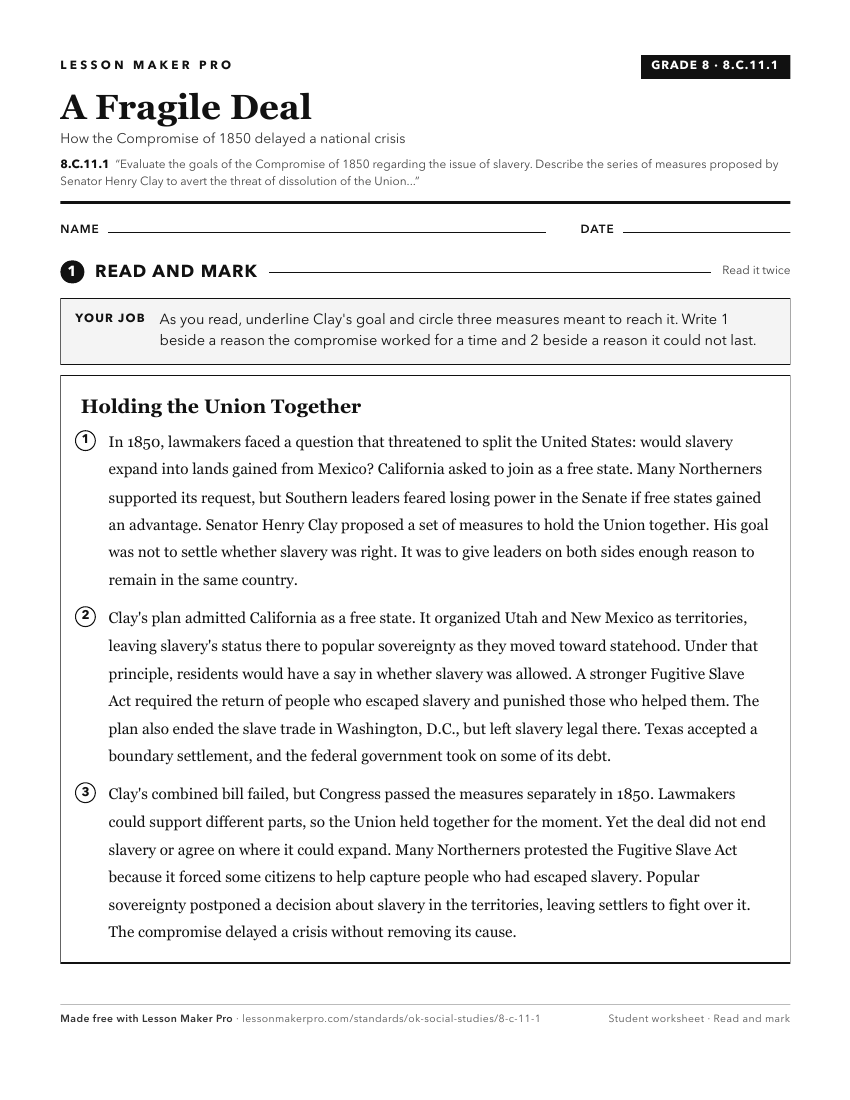
A ready-to-print activity worksheet aligned to 8.C.11.1, with an answer key for the teacher on its own page. No account needed.
PDF, US Letter, prints cleanly in black and white.
Download the worksheetKeep exploring
Related Standards
- 8.C.7.5
Analyze congress’ attempt to balance sectional interests and political power, by describing the impact of the Missouri Compromise on the expansion of slavery, b...
- 8.C.11.2.B
Examine why the North opposed the possibility that northern territories such as Kansas and Nebraska might adopt slavery, which had been prevented by the Missour...
- 8.C.3.2.D
Explain how the Three-Fifths Compromise over congressional representation and the Fugitive Slave Clause avoided the slavery issue and maintained the institution...
Turn this cluster into a lesson
Grade, subject, topic, and the complete cluster are prefilled. Create one free, no account needed.
Also for this cluster:Make a WorksheetMake a QuizMake a Sub Lesson