Oklahoma Social Studies 8.C.3.1
Standard Cluster
- 8.C.3
- Examine the formation of the United States of America’s system of government following the Revolutionary War and the creation of the Constitution of the United States of America.
Examine conditions in the new nation that led to the Constitutional Convention in Philadelphia in 1787. Identify strengths of the United States of America’s government operating under the Articles of Confederation, including a solution to territorial disputes, as resolved by the Northwest Ordinance and the organization necessary to win the war. Identify the weaknesses of the Articles of Confederation, including the lack of a common national currency, means for common defense, national judiciary to settle disputes among the states, inability to tax as a means to address the war debt, and the required unanimous vote by states to amend the document. Describe how severe economic conditions and civil unrest, typified by Shays’ Rebellion, contributed to a call for revision of the Articles of Confederation.
Oklahoma Academic Standards for Social Studies (2026) · 8.C.3
Cluster contents
Standards in This Cluster
8.C.3.1 is a cluster heading. These are the individual standards under it.
- 8.C.3.1.A
Identify strengths of the United States of America’s government operating under the Articles of Confederation, including a solution to territorial disputes, as ...
- 8.C.3.1.B
Identify the weaknesses of the Articles of Confederation, including the lack of a common national currency, means for common defense, national judiciary to sett...
- 8.C.3.1.C
Describe how severe economic conditions and civil unrest, typified by Shays’ Rebellion, contributed to a call for revision of the Articles of Confederation.
Teacher's field guide
What This Cluster Means
What Students Need to Do
- Students identify wartime coordination and the Northwest Ordinance as successes under the Articles. They explain how problems with money, defense, courts, and voting limited the government. They connect debt, hardship, and Shays’ Rebellion to the Philadelphia meeting.
What Mastery Looks Like
- A student explains how the Northwest Ordinance organized western territory and set a path to statehood. They explain why Congress could not tax to pay war debt or easily fund a common defense. They show how separate state currencies, no national court, and unanimous amendment votes made cooperation hard.
Common Misconceptions
- Students may say the Articles accomplished nothing, overlooking wartime coordination and the Northwest Ordinance. Some think Congress could collect taxes or take state disputes to a national court. Others treat Shays’ Rebellion as the only reason leaders called for change, rather than a warning sign amid debt and hardship.
How to Assess It
- On an exit ticket, name one success under the Articles and two weaknesses. Then explain how debt and Shays’ Rebellion pushed leaders toward the 1787 meeting.
Lesson moves
Ways to Teach It
Give pairs a Northwest Territory map and step cards; have them place the steps from territorial government to statehood.
Ask: Why might a Massachusetts farmer with debt and high taxes close a courthouse, and why would leaders call a meeting afterward?
Match cards: state currencies to hard trade, no tax power to unpaid debt, no national court to unresolved disputes, unanimity to blocked changes.
Show a current dollar bill beside images of two 1780s state notes; ask what a traveling shopkeeper would need to calculate.
Free download
Printable 8.C.3.1 Worksheet
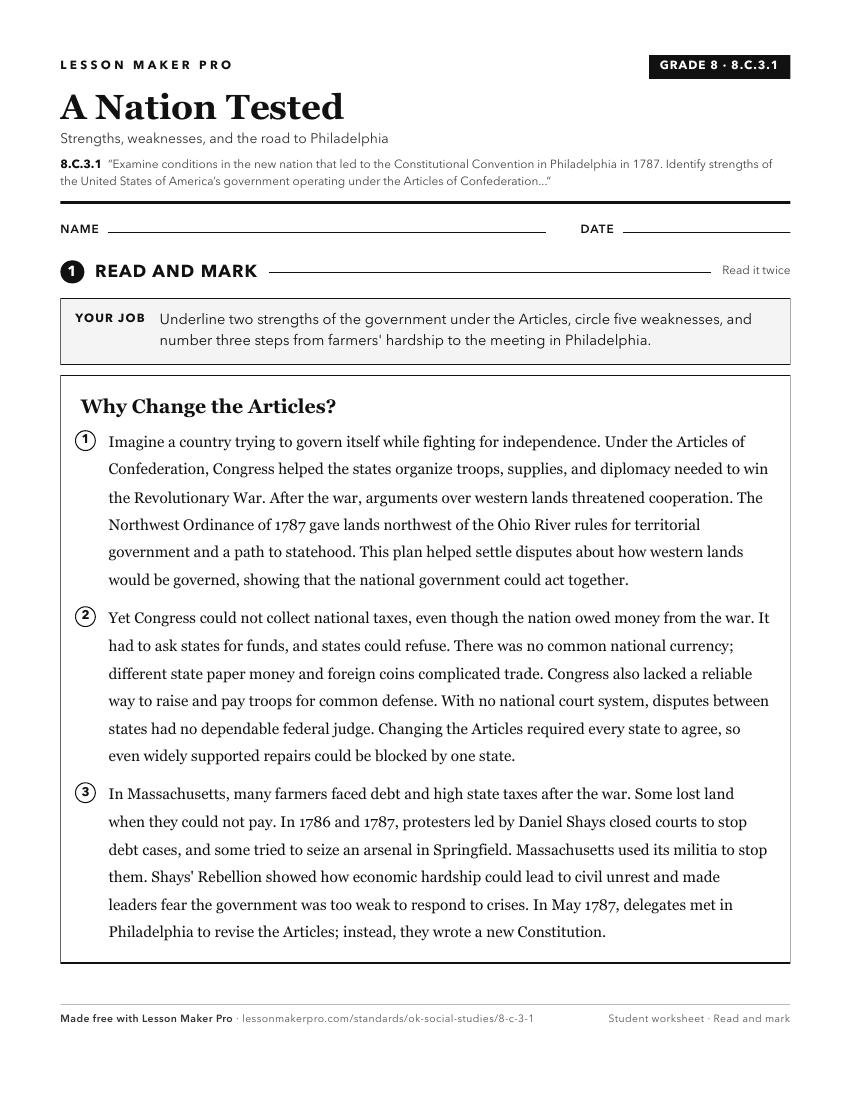
A ready-to-print activity worksheet aligned to 8.C.3.1, with an answer key for the teacher on its own page. No account needed.
PDF, US Letter, prints cleanly in black and white.
Download the worksheetKeep exploring
Related Standards
- 8.C.3.2
Analyze the significance of the Constitutional Convention on the formation of a new organization for national government.
- 5.C.5
Examine the formation of the United States of America’s system of government following the American Revolution.
- 8.C.3
Examine the formation of the United States of America’s system of government following the Revolutionary War and the creation of the Constitution of the United ...
- 5.C.5.1
Evaluate the major issues that led to the Constitutional Convention, including the public alarm raised from Shays’ Rebellion and challenges faced by a national ...
Turn this cluster into a lesson
Grade, subject, topic, and the complete cluster are prefilled. Create one free, no account needed.
Also for this cluster:Make a WorksheetMake a QuizMake a Sub Lesson