Oklahoma Social Studies 2.P.2.2
Standard Cluster
- 2.P.2
- Use interdisciplinary tools to acquire, apply, and evaluate content understanding of the four strands of social studies.
Develop skills which demonstrate an understanding of historical events and the people who shaped our history. Explain the difference between a primary and secondary source of information; gather basic information (i.e., author, date, facts). Define point of view and give examples relevant to the student’s experiences. Generate possible reasons for an event and draw conclusions from simple timelines by identifying immediate cause and effect relationships.
Oklahoma Academic Standards for Social Studies (2026) · 2.P.2
Cluster contents
Standards in This Cluster
2.P.2.2 is a cluster heading. These are the individual standards under it.
- 2.P.2.2.A
Explain the difference between a primary and secondary source of information; gather basic information (i.e., author, date, facts).
- 2.P.2.2.B
Define point of view and give examples relevant to the student’s experiences.
- 2.P.2.2.C
Generate possible reasons for an event and draw conclusions from simple timelines by identifying immediate cause and effect relationships.
Teacher's field guide
What This Cluster Means
What Students Need to Do
- Students tell a firsthand source from a later retelling. They find who made each source, when it was made, and one fact it shows or states. They describe two views of an event and use a timeline to suggest why something happened and what followed.
What Mastery Looks Like
- A student labels a dated photograph as firsthand and a later history paragraph as a retelling. They name each creator and date, give a fact from each, and explain how two people might describe the event differently. They use timeline events to support a cause and effect.
Common Misconceptions
- Students may call any old-looking source firsthand, even if it was made years after the event. They may think point of view means where someone stood, rather than how that person experienced the event. They may assume the event just before another caused it without checking the details.
How to Assess It
- Exit ticket: Show a labeled 1969 photo of Buzz Aldrin on the Moon, a dated teacher-written retelling, and three timeline entries: the lander touched down, the hatch opened, and Aldrin stepped outside. Ask students to label the sources, record each creator and date and one fact, compare Aldrin’s view with a TV viewer’s, and explain what let Aldrin step outside.
Lesson moves
Ways to Teach It
Give pairs a NASA Moon photo and a teacher-written retelling to sort, then have them circle each creator, date, and one fact.
Ask students to write how Buzz Aldrin and a child watching on TV might each describe the Moon landing.
Give pairs cards reading 'lander touched down,' 'hatch opened,' and 'astronaut stepped outside' to order and use in a cause-and-effect sentence.
Place a dated school assembly photo beside a later newsletter recap; students compare how a performer and an audience member might describe it.
Free download
Printable 2.P.2.2 Worksheet
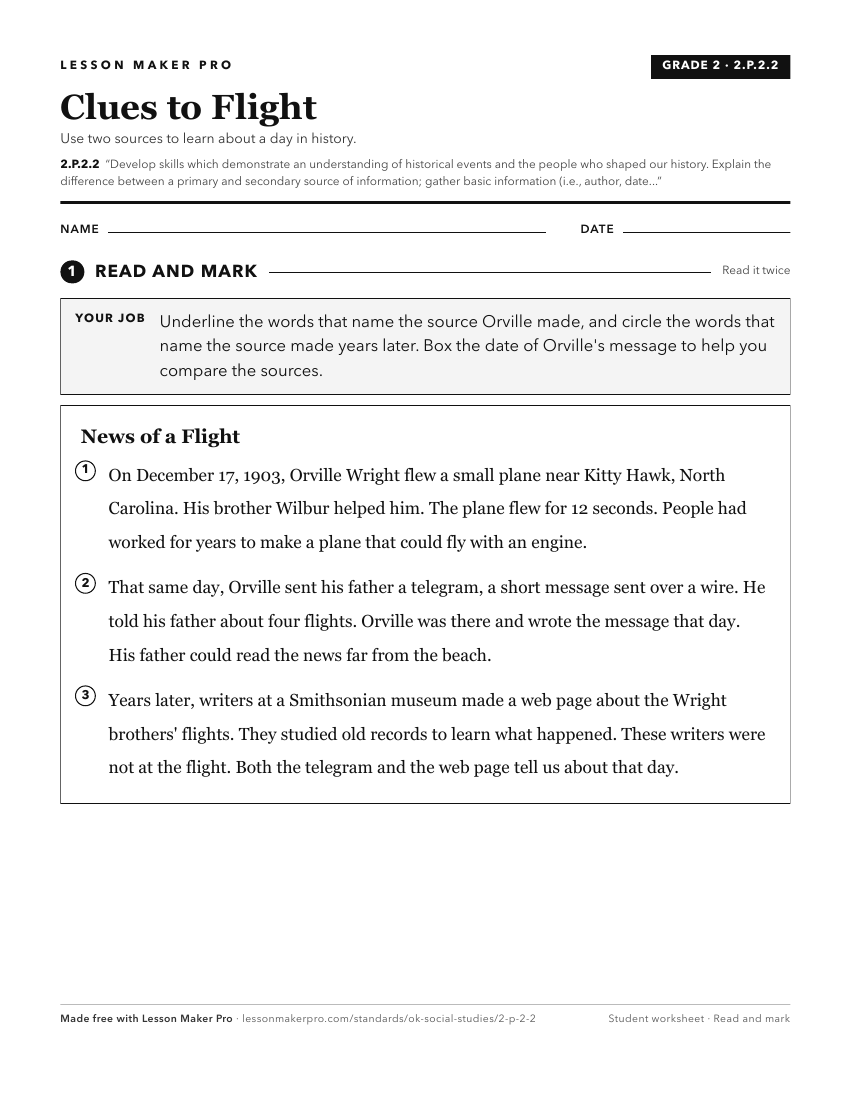
A ready-to-print activity worksheet aligned to 2.P.2.2, with an answer key for the teacher on its own page. No account needed.
PDF, US Letter, prints cleanly in black and white.
Download the worksheetKeep exploring
Related Standards
Turn this cluster into a lesson
Grade, subject, topic, and the complete cluster are prefilled. Create one free, no account needed.
Also for this cluster:Make a WorksheetMake a QuizMake a Sub Lesson