NY Next Generation ELA KL5.d
The Standard
Explore variations among verbs that describe the same general action (e.g., walk, march, gallop) by acting out the meanings.
New York State Next Generation English Language Arts Learning Standards
Teacher's field guide
What This Standard Means
What Students Need to Do
- Students explore differences among verbs that name the same general action. They act out words such as walk, march, and gallop to notice changes in manner, speed, rhythm, or purpose.
What Mastery Looks Like
- A student can demonstrate and name distinct versions of a general action. The student chooses the verb that best matches a movement shown in a picture, story, or play situation.
Common Misconceptions
- Students may perform the same movement for every related verb or choose based only on speed. They may explain the word without showing the manner that makes it distinct.
How to Assess It
- Ask the student to act out walk, march, and gallop, then match each action to a picture and explain one difference.
Lesson moves
Ways to Teach It
Draw action cards and act out variations while classmates choose the most precise verb and explain the movement clue.
Ask, ‘How does marching look and feel different from walking, even though both move us forward?’
Play Verb Variation Freeze, changing movement whenever a new related action word is called.
Choose precise action words while describing how people move through a playground, parade, or sports practice.
Free download
Printable KL5.d Worksheet
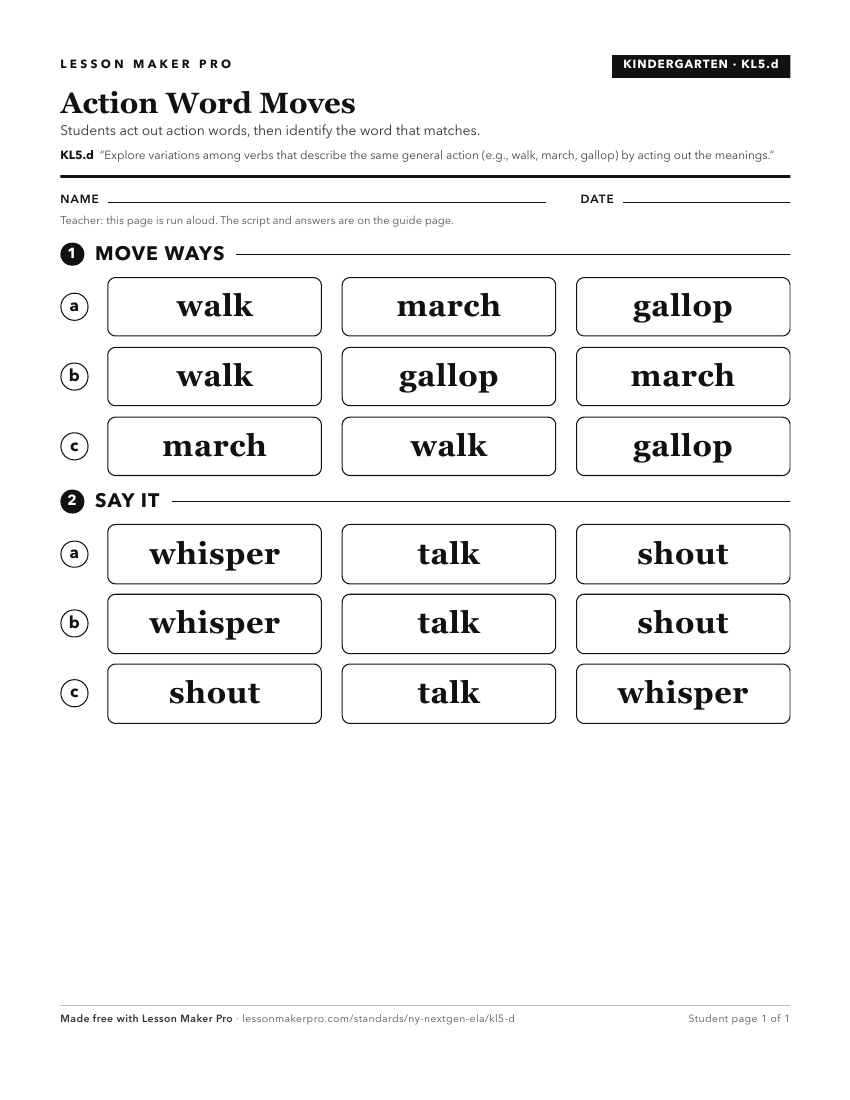
A ready-to-print activity worksheet aligned to KL5.d, with an answer key for the teacher on its own page. No account needed.
PDF, US Letter, prints cleanly in black and white.
Download the worksheetKeep exploring
Related Standards
- 1L5.d
Distinguish shades of meaning among verbs differing in manner (e.g., look, peek, glance, stare, glare, scowl) and adjectives differing in intensity (e.g., large...
- KL5.b
Demonstrate understanding of frequently occurring verbs and adjectives by relating them to their opposites (antonyms).
- 2L5.c
Distinguish shades of meaning among closely related verbs (e.g., toss, throw, hurl) and closely related adjectives (e.g., thin, slender, skinny, scrawny).
- 8L3.a
Use verbs in the active and passive voice and in the conditional and subjunctive mood to achieve particular effects (e.g., emphasizing the actor or the action; ...
Turn this exact standard into a lesson
Grade, subject, topic, and the complete standard are prefilled. Create one free, no account needed.
Also for this standard:Make a WorksheetMake a QuizMake a Sub Lesson