NY Next Generation ELA 8L3.a
The Standard
Use verbs in the active and passive voice and in the conditional and subjunctive mood to achieve particular effects (e.g., emphasizing the actor or the action; expressing uncertainty or describing a state contrary to fact).
New York State Next Generation English Language Arts Learning Standards
Teacher's field guide
What This Standard Means
What Students Need to Do
- Students choose active or passive voice and conditional or subjunctive mood to achieve a specific effect. They use these verb forms to control emphasis, express possibility, and describe contrary-to-fact situations.
What Mastery Looks Like
- A student can transform a sentence between active and passive voice and explain the shift in focus. The student uses conditional and subjunctive forms accurately for likely, uncertain, or unreal conditions.
Common Misconceptions
- Students may mistake passive voice for past tense or assume passive constructions are always weak. They may confuse would with formal subjunctive were or write a condition without a clear result.
How to Assess It
- Give students one active sentence and one unreal situation. Ask for a purposeful passive revision, a subjunctive sentence, and an explanation of each effect.
Lesson moves
Ways to Teach It
Rearrange actor, action, and receiver cards to create active and passive sentences, then label the shifted emphasis.
Ask, ‘If the speaker were certain instead of doubtful, which verb form and wording would change?’
Play Voice and Mood Director by drawing effect cards and revising sentences to match the assigned purpose.
Compare active and passive language in news reports, then discuss what each version highlights or obscures.
Free download
Printable 8L3.a Worksheet
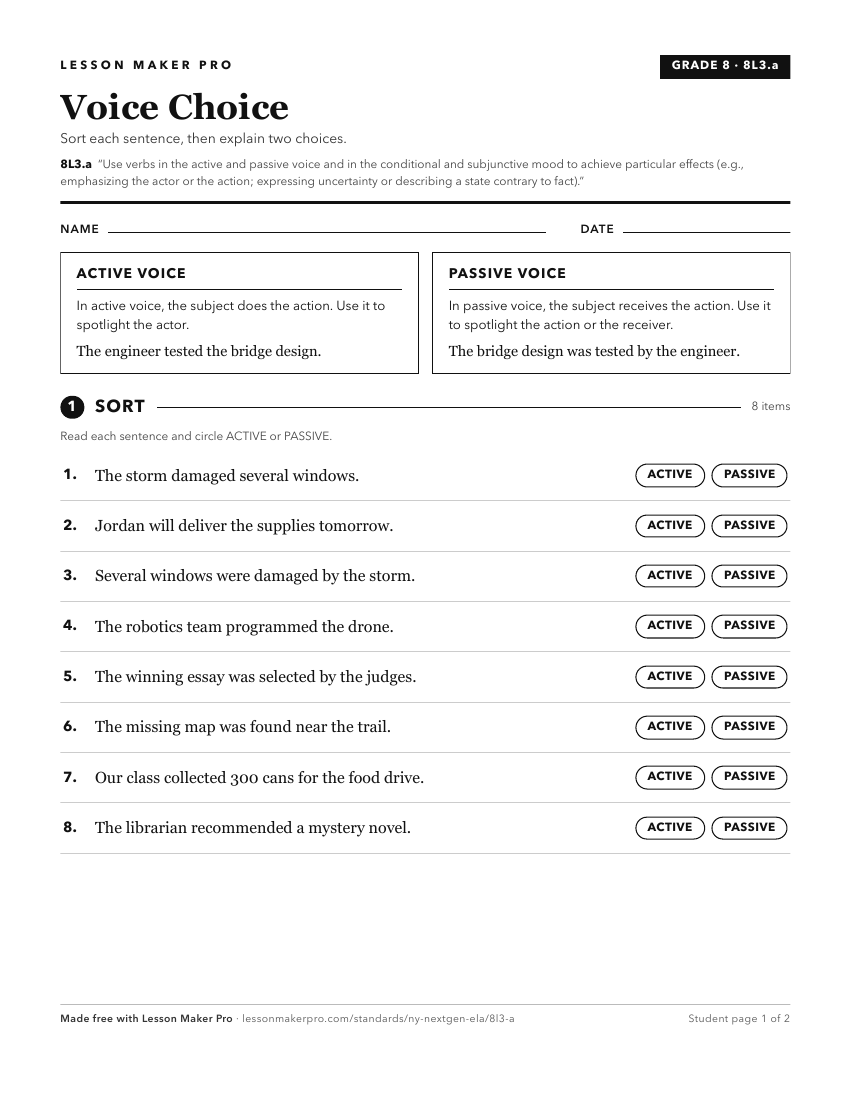
A ready-to-print activity worksheet aligned to 8L3.a, with an answer key for the teacher on its own page. No account needed.
PDF, US Letter, prints cleanly in black and white.
Download the worksheetKeep exploring
Related Standards
- KL5.d
Explore variations among verbs that describe the same general action (e.g., walk, march, gallop) by acting out the meanings.
- 6L3.a
Vary sentence patterns for meaning, reader/listener interest, and style.
- 1L5.d
Distinguish shades of meaning among verbs differing in manner (e.g., look, peek, glance, stare, glare, scowl) and adjectives differing in intensity (e.g., large...
- 3L3.a
Choose words and phrases for effect.
Turn this exact standard into a lesson
Grade, subject, topic, and the complete standard are prefilled. Create one free, no account needed.
Also for this standard:Make a WorksheetMake a QuizMake a Sub Lesson