NY Next Generation ELA 6L3.a
The Standard
Vary sentence patterns for meaning, reader/listener interest, and style.
New York State Next Generation English Language Arts Learning Standards
Teacher's field guide
What This Standard Means
What Students Need to Do
- Students vary sentence patterns to shape meaning, emphasis, interest, and style for readers or listeners. They change openings, lengths, structures, and relationships among ideas with a clear purpose.
What Mastery Looks Like
- A student can identify repetitive patterns and revise them without sacrificing clarity. The student explains how a chosen structure emphasizes an idea, improves flow, or creates a fitting rhythm.
Common Misconceptions
- Students may vary sentences by making each one longer or by changing words while keeping the same structure. They may create fragments or run-ons while trying to avoid repetition.
How to Assess It
- Give students a paragraph with four identical sentence openings. Ask them to revise two patterns and explain how one change improves meaning or style.
Lesson moves
Ways to Teach It
Cut a paragraph into clause strips; students recombine and reorder them to create purposeful sentence variety.
Ask, ‘Which idea deserves emphasis, and what sentence pattern would make it stand out?’
Play Pattern Tracker by marking repeated structures and drawing revision cards for opening, length, order, or combination.
Revise a public announcement so its sentence patterns keep listeners attentive and highlight the required action.
Free download
Printable 6L3.a Worksheet
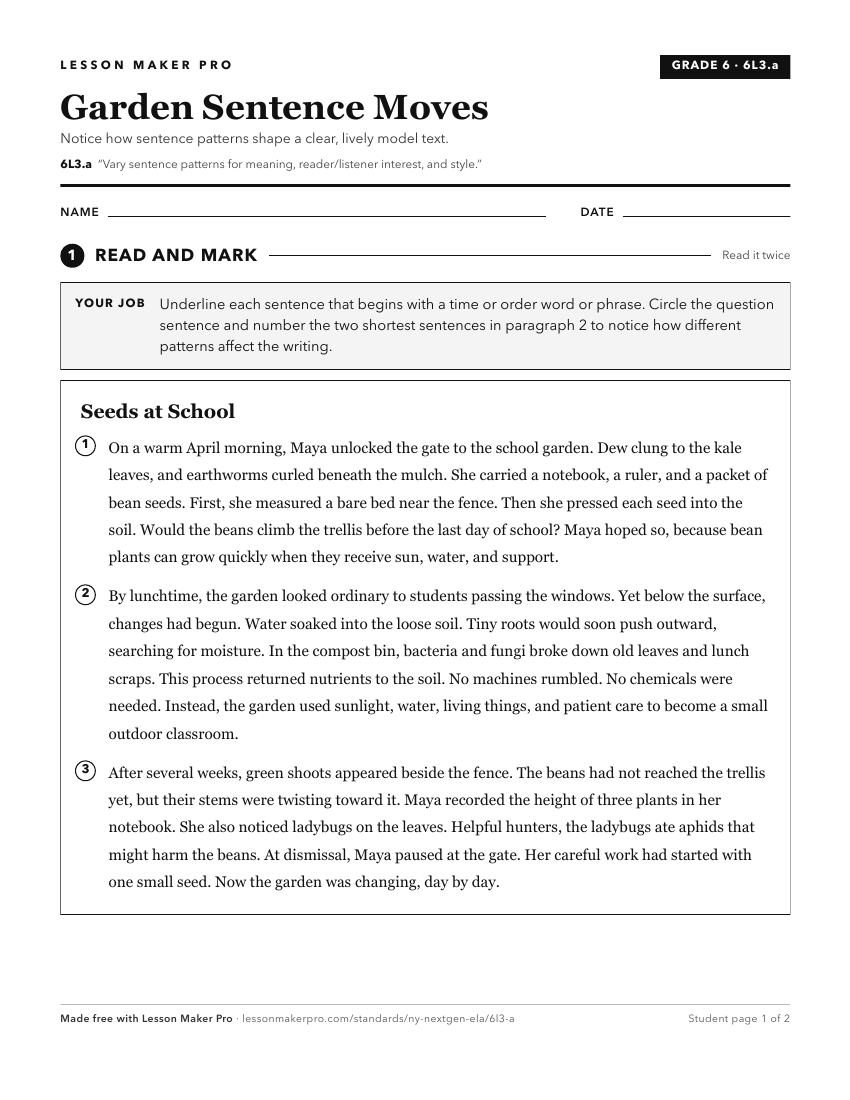
A ready-to-print activity worksheet aligned to 6L3.a, with an answer key for the teacher on its own page. No account needed.
PDF, US Letter, prints cleanly in black and white.
Download the worksheetKeep exploring
Related Standards
- 6W3.c
Use a variety of transitional words, phrases, and clauses to convey sequence and signal shifts from one time frame or setting to another.
- 8W3.c
Use a variety of transitional words, phrases, and clauses to convey sequence, signal shifts from one time frame or setting to another, and show the relationship...
- 7W3.c
Use a variety of transitional words, phrases, and clauses to convey sequence and signal shifts from one time frame or setting to another.
- 5L3.a
Expand, combine, and reduce sentences for meaning, reader/listener interest, and style.
Turn this exact standard into a lesson
Grade, subject, topic, and the complete standard are prefilled. Create one free, no account needed.
Also for this standard:Make a WorksheetMake a QuizMake a Sub Lesson