NY Next Generation ELA 4RF3.b
The Standard
Use combined knowledge of all letter-sound correspondences, syllabification patterns, and morphology (e.g. roots, prefixes, and suffixes) to read accurately unfamiliar multisyllabic words in and out of context.
New York State Next Generation English Language Arts Learning Standards · Phonics and Word Recognition
Teacher's field guide
What This Standard Means
What Students Need to Do
- Students use letter-sound correspondences, syllabification, roots, prefixes, and suffixes to decode unfamiliar multisyllabic words. They work both within sentences and with isolated words.
What Mastery Looks Like
- The student divides a word into useful sound and meaning units, then blends it accurately. The student checks the result against pronunciation and context.
Common Misconceptions
- Students may divide at every visible consonant or treat affixes as separate words. They may use context to guess while ignoring internal spelling evidence.
How to Assess It
- Present four unfamiliar multisyllabic words with varied roots and affixes, half in context. Ask students to segment, decode, and explain their approach.
Lesson moves
Ways to Teach It
Color-code roots, prefixes, suffixes, and syllable vowels before blending unfamiliar words.
Ask students when a morpheme boundary also helps locate a syllable boundary.
Play Decode Explain with multisyllabic word cards and strategy prompts.
Analyze unfamiliar words in authentic content-area reading before using a glossary.
Free download
Printable 4RF3.b Worksheet
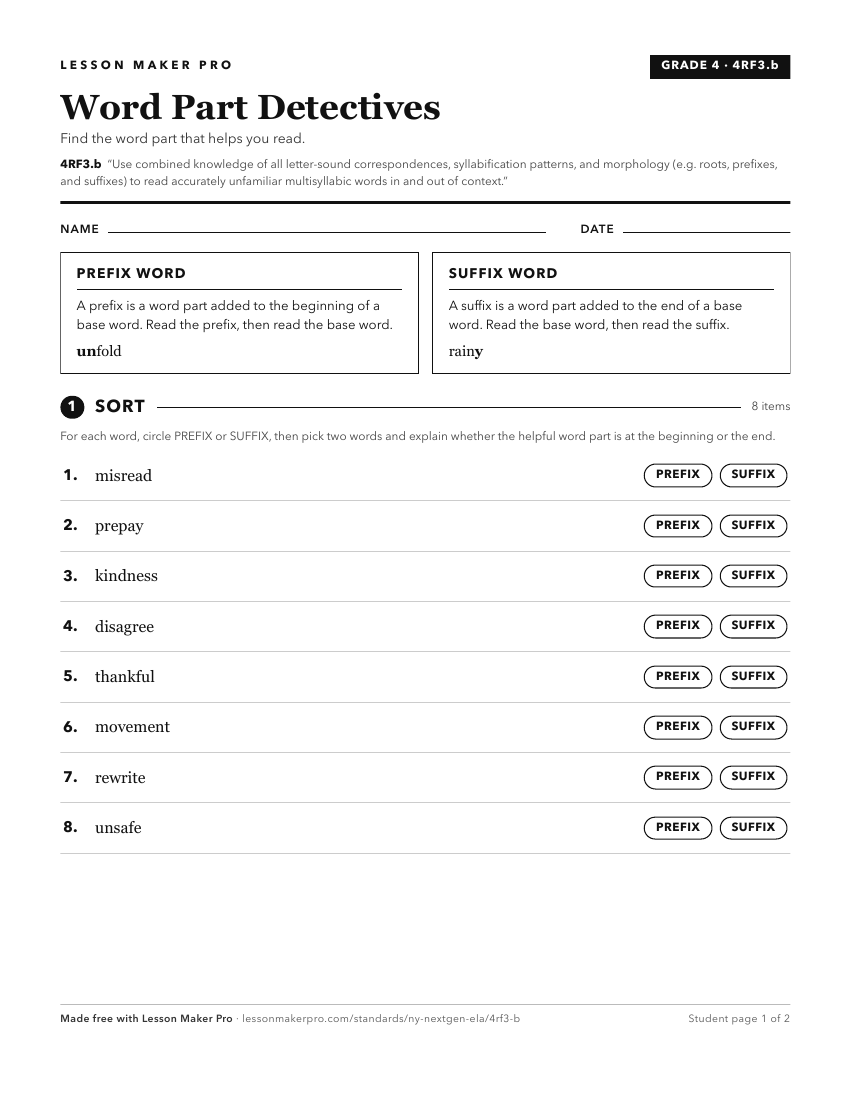
A ready-to-print activity worksheet aligned to 4RF3.b, with an answer key for the teacher on its own page. No account needed.
PDF, US Letter, prints cleanly in black and white.
Download the worksheetKeep exploring
Related Standards
- 1RF2
Demonstrate understanding of spoken words, syllables, and sounds (phonemes).
- KRF2
Demonstrate understanding of spoken words, syllables, and sounds (phonemes).
- 4RF3.a
Use combined knowledge of all letter-sound correspondences, syllabication patterns, and morphology (e.g., roots and affixes) to read accurately unfamiliar multi...
- 5RF3.a
Use combined knowledge of all letter-sound correspondences, syllabication patterns, and morphology (e.g., roots and affixes) to read accurately unfamiliar multi...
Turn this exact standard into a lesson
Grade, subject, topic, and the complete standard are prefilled. Create one free, no account needed.
Also for this standard:Make a WorksheetMake a QuizMake a Sub Lesson