NY Next Generation ELA 2L4.d
The Standard
Use knowledge of the meaning of individual words to predict the meaning of compound words (e.g., birdhouse, lighthouse, housefly; bookshelf, notebook, bookmark).
New York State Next Generation English Language Arts Learning Standards
Teacher's field guide
What This Standard Means
What Students Need to Do
- Students predict a compound word's meaning from the meanings of its smaller words. They combine the parts, then check whether the predicted meaning fits the actual word and sentence.
What Mastery Looks Like
- A student can separate a compound, explain each part, and state a sensible combined meaning. The student notices when a compound's established meaning is more specific than a literal combination.
Common Misconceptions
- Students may read the parts correctly but fail to connect their meanings. They may reverse the relationship between parts or assume every adjacent pair of words forms a compound.
How to Assess It
- Give students birdhouse, lighthouse, and housefly in sentences. Ask them to split each compound, predict the meaning, and check it in context.
Lesson moves
Ways to Teach It
Join picture and word cards to build compounds, then draw the combined meaning and explain each part.
Ask, ‘How do bird and house work together in birdhouse, and which part tells what kind?’
Play Compound Builder by matching word halves, defining each result, and rejecting combinations that are not real words.
Find compound words on classroom labels or schedules and use their parts to explain the items or activities.
Free download
Printable 2L4.d Worksheet
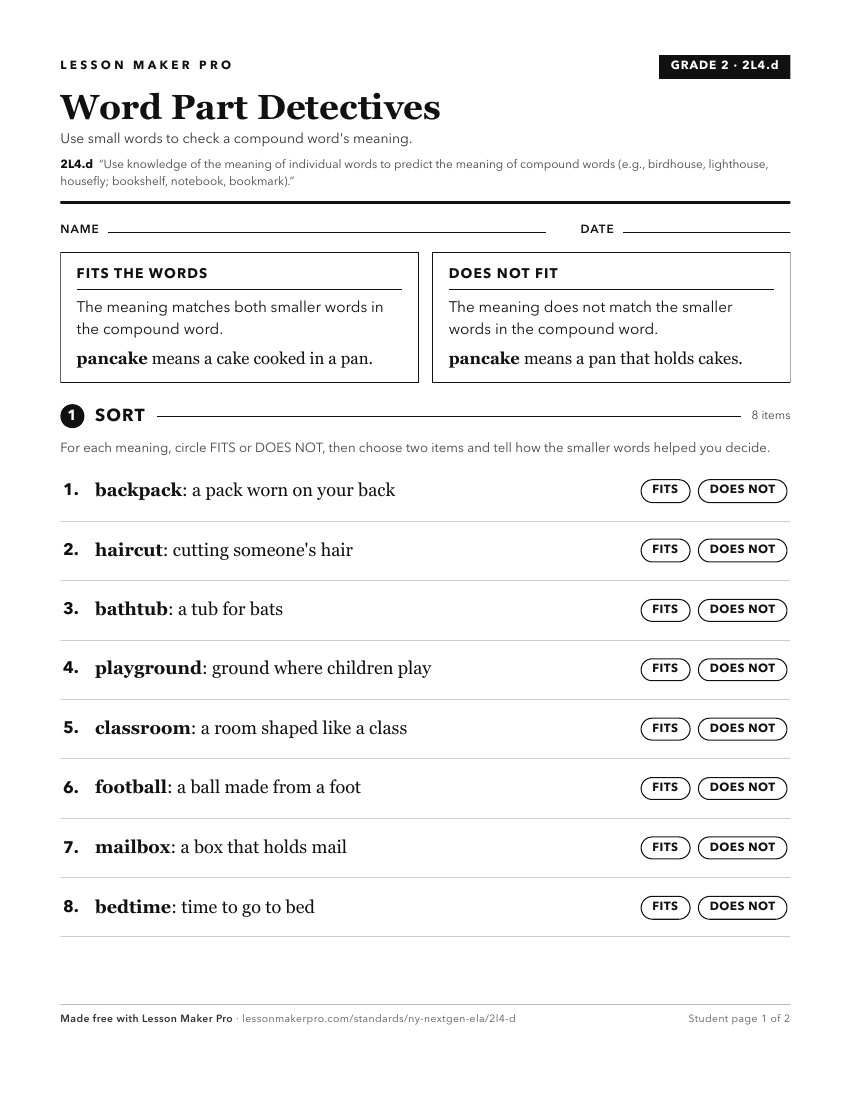
A ready-to-print activity worksheet aligned to 2L4.d, with an answer key for the teacher on its own page. No account needed.
PDF, US Letter, prints cleanly in black and white.
Download the worksheetKeep exploring
Related Standards
- 8L5.b
Use the relationship between particular words to better understand each of the words.
- 7L5.b
Use the relationship between particular words (e.g., synonym/antonym, analogy) to better understand each of the words.
- KL5.c
Use words to identify and describe the world, making connections between words and their use (e.g., places at home that are colorful).
- 5L5.c
Use the relationship between particular words (e.g., synonyms, antonyms, homographs) to better understand each of the words.
Turn this exact standard into a lesson
Grade, subject, topic, and the complete standard are prefilled. Create one free, no account needed.
Also for this standard:Make a WorksheetMake a QuizMake a Sub Lesson