NY Next Generation ELA 1RF3.d
The Standard
Determine the number of syllables in a printed word by using knowledge that every syllable must have a vowel sound.
New York State Next Generation English Language Arts Learning Standards · Phonics and Word Recognition
Teacher's field guide
What This Standard Means
What Students Need to Do
- Students determine how many syllables a printed word has by locating vowel sounds. They connect each spoken beat with a syllable containing a vowel sound.
What Mastery Looks Like
- The student says a printed word, counts its vowel sounds, and reports the syllable count. The student does not count silent vowel letters as separate syllables.
Common Misconceptions
- Students may count vowel letters instead of vowel sounds. They may count consonants, visual chunks, or silent e as extra syllables.
How to Assess It
- Show six familiar printed words with one or two syllables, including a final-e word. Ask students to read and count the syllables using vowel sounds.
Lesson moves
Ways to Teach It
Underline vowel spellings, say each word, and tap once per vowel sound.
Ask students why a word can contain more vowel letters than syllables.
Play Syllable Count Sort with printed word cards.
Count syllables in printed names, classroom labels, and schedule words.
Free download
Printable 1RF3.d Worksheet
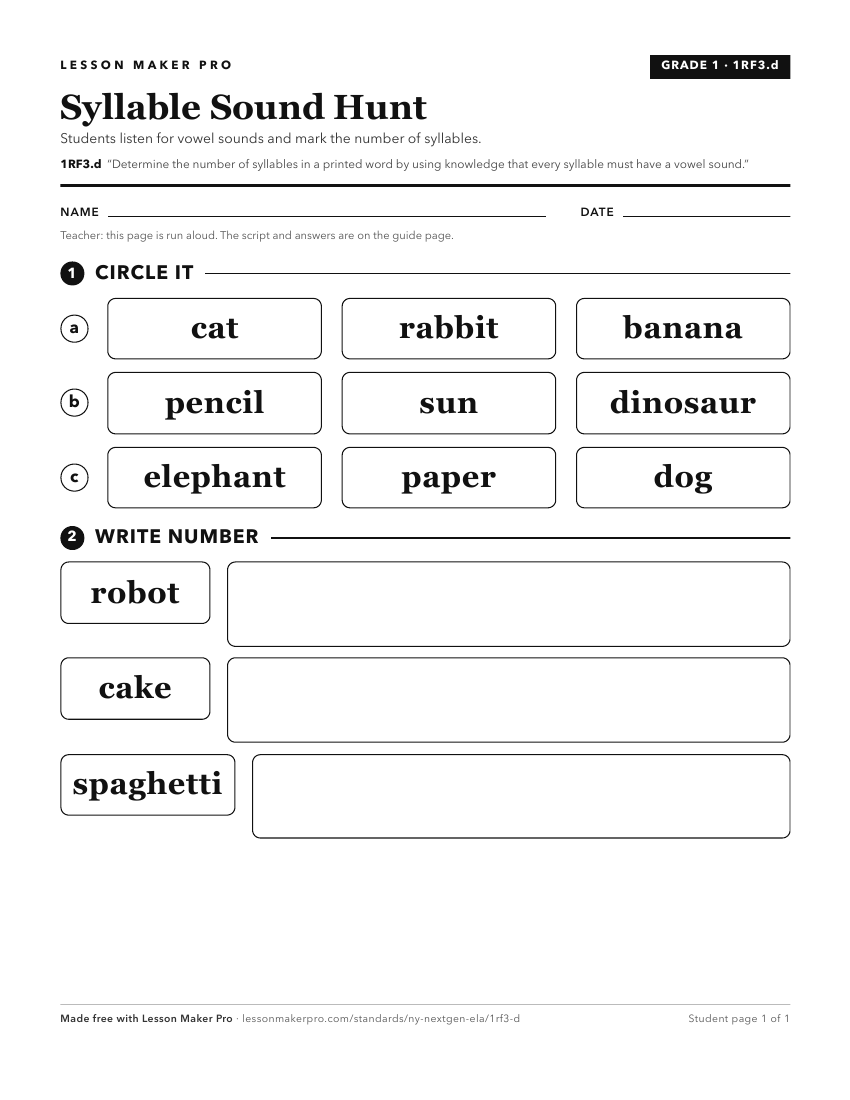
A ready-to-print activity worksheet aligned to 1RF3.d, with an answer key for the teacher on its own page. No account needed.
PDF, US Letter, prints cleanly in black and white.
Download the worksheetKeep exploring
Related Standards
- 2RF3.b
Decode short and long vowel sounds in two-syllable words.
- 2RF3.a
Distinguish long and short vowels when reading regularly spelled one-syllable words (including common vowel teams).
- 4RF3.b
Use combined knowledge of all letter-sound correspondences, syllabification patterns, and morphology (e.g. roots, prefixes, and suffixes) to read accurately unf...
- 4RF3.a
Use combined knowledge of all letter-sound correspondences, syllabication patterns, and morphology (e.g., roots and affixes) to read accurately unfamiliar multi...
Turn this exact standard into a lesson
Grade, subject, topic, and the complete standard are prefilled. Create one free, no account needed.
Also for this standard:Make a WorksheetMake a QuizMake a Sub Lesson