NGSS 2-ESS1-1
The Standard
Use information from several sources to provide evidence that Earth events can occur quickly or slowly.
Next Generation Science Standards
Teacher's field guide
What This Standard Means
What Students Need to Do
- Students gather information from several sources about events that change Earth. They use source details to explain whether each event happens quickly or slowly.
What Mastery Looks Like
- Students sort Earth events as quick or slow and explain their choices. They use details from at least two sources, such as photographs, short texts, videos, or diagrams.
Common Misconceptions
- Students may think all Earth changes happen at the same speed. They may also confuse how long an event lasts with how much damage it causes.
How to Assess It
- Show pictures of an earthquake, volcanic eruption, and weathered rock. Ask students to label each change quick or slow and cite one source detail.
Lesson moves
Ways to Teach It
Shake a tray of sand to model an earthquake, then drip water over a second sand mound to observe slower erosion.
Ask students to write which happens faster, an earthquake or rock erosion, and support their answer with details from two sources.
Play a quick or slow sorting game using cards showing landslides, earthquakes, volcanic eruptions, weathering, and erosion.
Examine local photos of cracked roads, worn rocks, or eroded soil, then discuss whether each change happened quickly or slowly.
Free download
Printable 2-ESS1-1 Worksheet
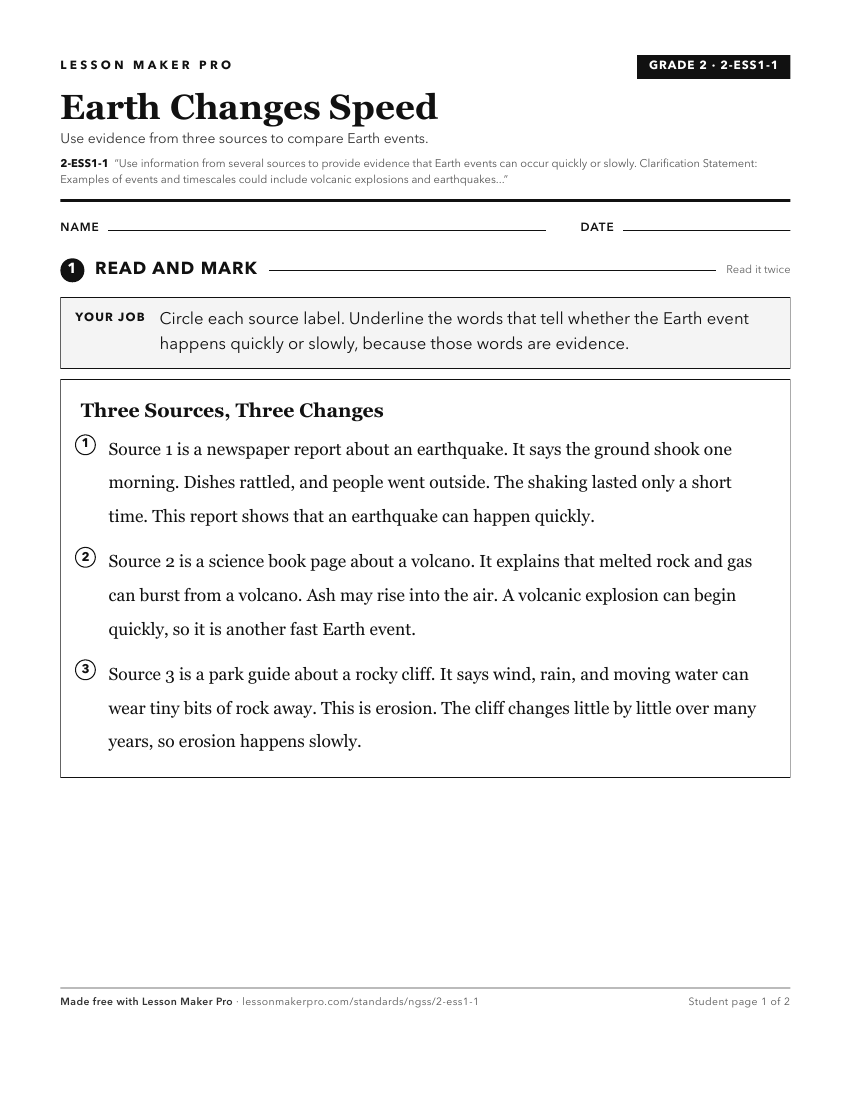
A ready-to-print activity worksheet aligned to 2-ESS1-1, with an answer key for the teacher on its own page. No account needed.
PDF, US Letter, prints cleanly in black and white.
Download the worksheetKeep exploring
Related Standards
- HS-ESS3-1
Construct an explanation based on evidence for how the availability of natural resources, occurrence of natural hazards, and changes in climate have influenced ...
- MS-ESS2-2
Construct an explanation based on evidence for how geoscience processes have changed Earth's surface at varying time and spatial scales.
- HS-ESS2-7
Construct an argument based on evidence about the simultaneous coevolution of Earth systems and life on Earth.
- HS-ESS1-6
Apply scientific reasoning and evidence from ancient Earth materials, meteorites, and other planetary surfaces to construct an account of Earth's formation and ...
Turn this exact standard into a lesson
Grade, subject, topic, and the complete standard are prefilled. Create one free, no account needed.
Also for this standard:Make a WorksheetMake a QuizMake a Sub Lesson