Montana Math MT.CORE.DATA.PROB.1
The Standard
Understand the concept of a sample space and describe events as subsets of a sample space.
2026 Montana Mathematics Content Standards · Data Reasoning and Probability
Teacher's field guide
What This Standard Means
What Students Need to Do
- Students list every possible outcome of a chance process. They describe an event by naming the outcomes that meet a given condition.
What Mastery Looks Like
- With two labeled coins, a student lists HH, HT, TH, and TT without repeats. They write the event 'exactly one head' as {HT, TH}.
Common Misconceptions
- Students may list only H and T for two coin flips. They may treat HT and TH as the same outcome, or name an event without listing its outcomes.
How to Assess It
- Exit ticket: Two labeled coins, A and B, are flipped. List every outcome in A, B order, then write the event 'exactly one head' as a set of outcomes.
Lesson moves
Ways to Teach It
Flip two labeled coins and record each result in A, B order, then circle the results with exactly one head.
Ask: Are HT and TH the same outcome when coins A and B are labeled? Explain with a sketch.
Give pairs cards marked HH, HT, TH, and TT; call out 'at least one head' and have them show every matching card.
For a two-day weather forecast, list the wet or dry sequences and mark those with exactly one wet day.
Free download
Printable MT.CORE.DATA.PROB.1 Worksheet
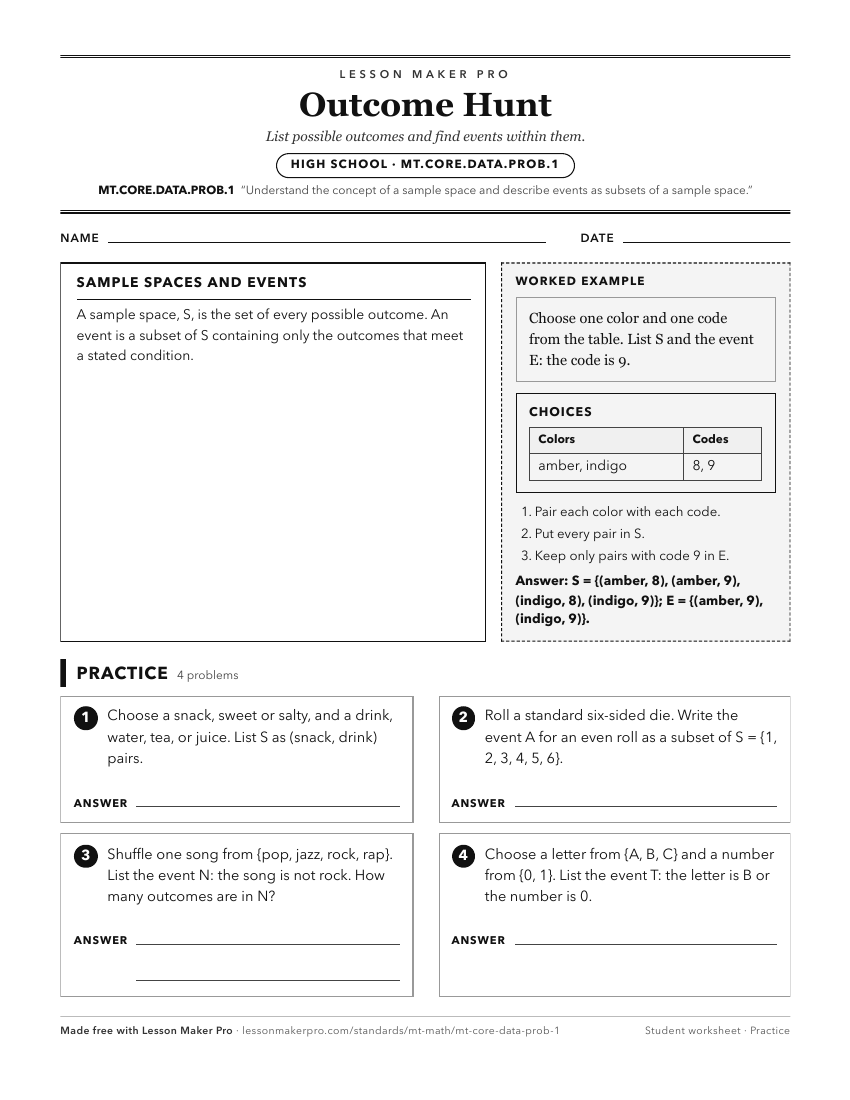
A ready-to-print activity worksheet aligned to MT.CORE.DATA.PROB.1, with an answer key for the teacher on its own page. No account needed.
PDF, US Letter, prints cleanly in black and white.
Download the worksheetKeep exploring
Related Standards
- MT.7.SP.8
Represent sample spaces for compound events, identify the desired outcomes in the sample spaces, and find probabilities of events using organized lists, tables,...
- MT.7.SP.1
Understand statistics can be used to gain information about a population by examining a representative sample of the population.
- MT.PLUS.DATA.DES.1
Describe the purposes of and differences among sample surveys, experiments, and observational studies and explain how randomization relates to each.
- MT.7.SP.5
Understand that the probability of a chance event is a number between 0 and 1 that expresses the likelihood of the event occurring.
Turn this exact standard into a lesson
Grade, subject, topic, and the complete standard are prefilled. Create one free, no account needed.
Also for this standard:Make a WorksheetMake a QuizMake a Sub Lesson