Montana Math MT.7.SP.5
The Standard
Understand that the probability of a chance event is a number between 0 and 1 that expresses the likelihood of the event occurring.
2026 Montana Mathematics Content Standards
Teacher's field guide
What This Standard Means
What Students Need to Do
- Students use numbers from 0 to 1 to describe how likely an event is. They explain why 0 means impossible, 1 means certain, and numbers between them show different chances.
What Mastery Looks Like
- Given a bag with four red tiles and one blue tile, a student assigns 0 to drawing green, 4/5 to drawing red, and 1 to drawing red or blue. They can explain why drawing red is likely but not certain.
Common Misconceptions
- Students may think 0 means very unlikely rather than impossible, or 1 means very likely rather than certain. Some use numbers above 1 for events they think are highly likely.
How to Assess It
- Exit ticket: For one roll of a fair six-sided die, give the probability of rolling 7, rolling an even number, and rolling less than 7. Explain one answer.
Lesson moves
Ways to Teach It
Put four red and one blue tile in a bag, then have students assign probabilities to drawing red, green, or either color.
Ask students, 'Why does rolling a 7 on a six-sided die have probability 0, but rolling under 7 has probability 1?'
Have partners match die events (7, 1, odd, less than 6, less than 7) to 0, 1/6, 1/2, 5/6, and 1.
Show forecasts of 20% rain on Monday and 80% rain on Tuesday, then have students write 0.2 and 0.8 and compare.
Free download
Printable MT.7.SP.5 Worksheet
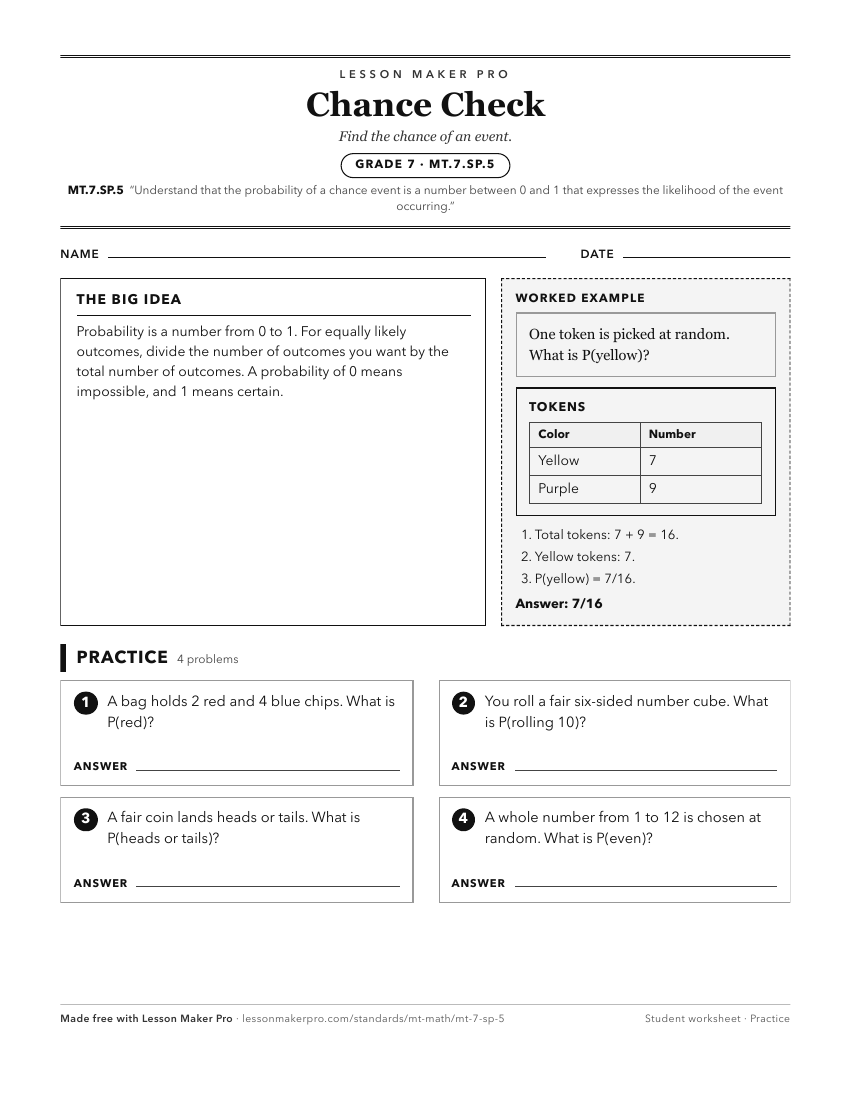
A ready-to-print activity worksheet aligned to MT.7.SP.5, with an answer key for the teacher on its own page. No account needed.
PDF, US Letter, prints cleanly in black and white.
Download the worksheetKeep exploring
Related Standards
- MT.7.SP.8
Represent sample spaces for compound events, identify the desired outcomes in the sample spaces, and find probabilities of events using organized lists, tables,...
- MT.7.SP.6
Find the experimental probability of a chance event by collecting data on the chance process that produces it and observing its long-run relative frequency. Thi...
- MT.7.SP.7
Develop a theoretical probability model and use it to find probabilities of events, compare theoretical and experimental probabilities, and explain possible sou...
Turn this exact standard into a lesson
Grade, subject, topic, and the complete standard are prefilled. Create one free, no account needed.
Also for this standard:Make a WorksheetMake a QuizMake a Sub Lesson