Montana Math MT.7.SP.7
The Standard
Develop a theoretical probability model and use it to find probabilities of events, compare theoretical and experimental probabilities, and explain possible sources of discrepancy, if any exist.
2026 Montana Mathematics Content Standards
Teacher's field guide
What This Standard Means
What Students Need to Do
- Students list possible outcomes and decide which are equally likely. They use those outcomes to calculate chances, then compare their predictions with trial results and explain differences.
What Mastery Looks Like
- A student lists all 36 equally likely outcomes for two dice and finds that the chance of a sum of 7 is 6/36. They compare that prediction with actual rolls without expecting an exact match.
Common Misconceptions
- Students may treat the 11 possible sums of two dice as equally likely, even though some sums have more ways to occur. They may also think 20 rolls must match the predicted probability exactly.
How to Assess It
- Two fair dice are rolled 20 times, with four sums of 7. Ask students to list the winning pairs, find the predicted and observed probabilities, and explain the difference.
Lesson moves
Ways to Teach It
Roll two dice 30 times, tally sums of 7, then build a 6-by-6 grid to compare the observed fraction with the predicted chance.
Have pairs write why a sum of 7 is more likely than a sum of 2, using their 6-by-6 grid as evidence.
Give pairs a spinner marked red, red, blue, green; have them calculate each color's chance before racing to tally 20 spins.
Show a carnival game that pays for rolling a 6; have students calculate the chance of winning and test it with 24 rolls.
Free download
Printable MT.7.SP.7 Worksheet
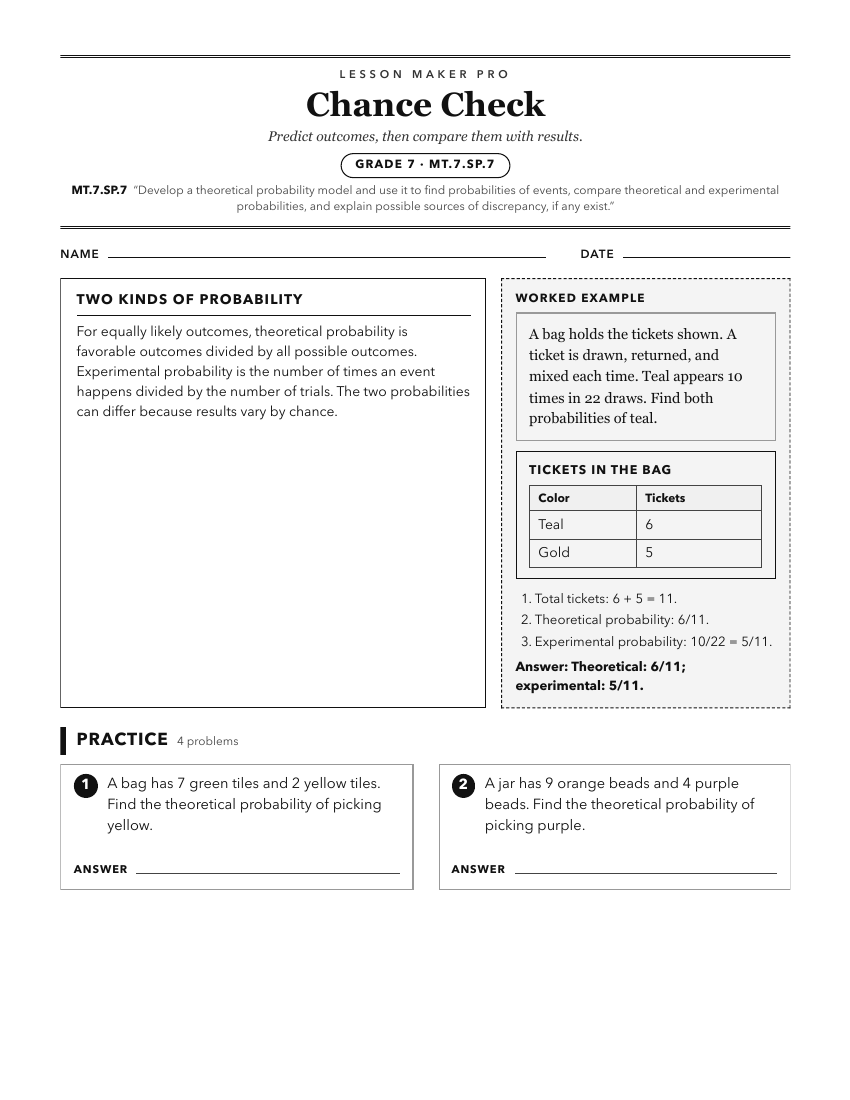
A ready-to-print activity worksheet aligned to MT.7.SP.7, with an answer key for the teacher on its own page. No account needed.
PDF, US Letter, prints cleanly in black and white.
Download the worksheetKeep exploring
Related Standards
- MT.7.SP.8
Represent sample spaces for compound events, identify the desired outcomes in the sample spaces, and find probabilities of events using organized lists, tables,...
- MT.7.SP.6
Find the experimental probability of a chance event by collecting data on the chance process that produces it and observing its long-run relative frequency. Thi...
- MT.7.SP.5
Understand that the probability of a chance event is a number between 0 and 1 that expresses the likelihood of the event occurring.
Turn this exact standard into a lesson
Grade, subject, topic, and the complete standard are prefilled. Create one free, no account needed.
Also for this standard:Make a WorksheetMake a QuizMake a Sub Lesson