Montana Math MT.7.SP.8
The Standard
Represent sample spaces for compound events, identify the desired outcomes in the sample spaces, and find probabilities of events using organized lists, tables, tree diagrams, and simulations.
2026 Montana Mathematics Content Standards
Teacher's field guide
What This Standard Means
What Students Need to Do
- Students list every possible result when two chance actions happen together. They mark the results that fit a question and use them to find the probability. They also run trials to estimate that probability.
What Mastery Looks Like
- A student can show every coin-and-spinner pair once in a list, table, or tree. They divide the number of matching pairs by the total number of equally likely pairs. They know trial results may not match that fraction exactly.
Common Misconceptions
- Students may leave out pairs or count the same pair twice. They may divide by the outcomes from just one action instead of all possible pairs. They may expect a small set of trials to match the calculated probability exactly.
How to Assess It
- Exit ticket: Flip a coin and spin a spinner with three equal sections labeled 1, 2, and 3. List all possible pairs, circle those with heads and an even number, and give the probability.
Lesson moves
Ways to Teach It
Flip a coin and spin a three-section paper-clip spinner 30 times; tally the pairs, then compare the tally with a six-cell table.
Draw a tree for a coin flip and a three-section spinner; explain why getting heads and 2 has a one-in-six chance.
Play Pair Hunt: roll a die and flip a coin, list all 12 pairs, then circle every pair with tails and an even number.
Make six lunch raffle tickets pairing turkey or cheese with fruit, carrots, or chips; find the chance of drawing turkey and fruit.
Free download
Printable MT.7.SP.8 Worksheet
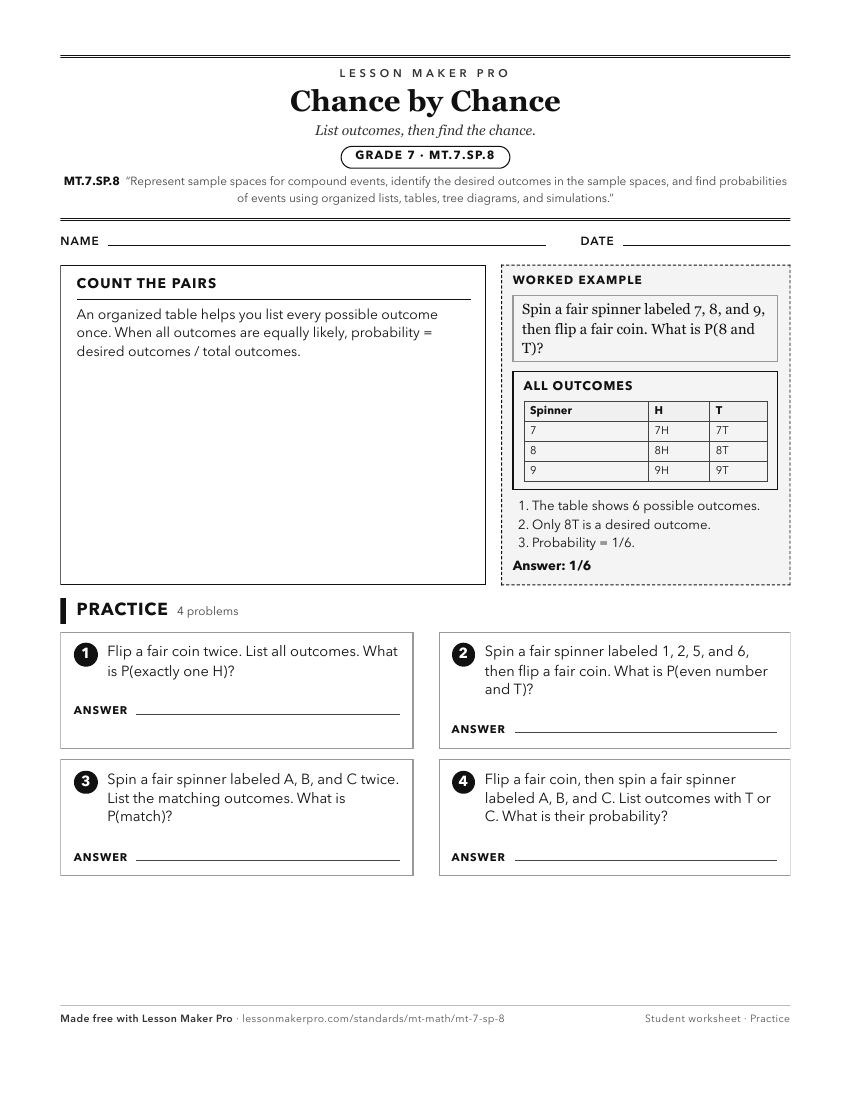
A ready-to-print activity worksheet aligned to MT.7.SP.8, with an answer key for the teacher on its own page. No account needed.
PDF, US Letter, prints cleanly in black and white.
Download the worksheetKeep exploring
Related Standards
- MT.5.OA.3
Generate two numerical patterns using given rules and complete an input-output table for the data, identify apparent relationships between corresponding terms, ...
- MT.7.SP.6
Find the experimental probability of a chance event by collecting data on the chance process that produces it and observing its long-run relative frequency. Thi...
- MT.7.SP.7
Develop a theoretical probability model and use it to find probabilities of events, compare theoretical and experimental probabilities, and explain possible sou...
- MT.7.SP.5
Understand that the probability of a chance event is a number between 0 and 1 that expresses the likelihood of the event occurring.
Turn this exact standard into a lesson
Grade, subject, topic, and the complete standard are prefilled. Create one free, no account needed.
Also for this standard:Make a WorksheetMake a QuizMake a Sub Lesson