Montana Math MT.PLUS.DATA.DES.1
The Standard
Describe the purposes of and differences among sample surveys, experiments, and observational studies and explain how randomization relates to each.
2026 Montana Mathematics Content Standards · Data Reasoning
Teacher's field guide
What This Standard Means
What Students Need to Do
- Students tell apart asking a sample questions, assigning a treatment, and recording what people already do. They explain how random selection helps a sample represent a larger group and how random assignment helps make treatment groups comparable. An observational study can use random selection, but researchers do not assign treatments.
What Mastery Looks Like
- Given a lunch poll, a coin-flip menu trial, and a record of students' usual lunch choices, students can label each design and say what it can answer. They can tell whether people were randomly selected, randomly assigned, or neither. They do not claim an observational comparison proves that one factor caused another.
Common Misconceptions
- Students may call a survey an experiment because it asks people about an experience. They may confuse randomly choosing participants with randomly assigning treatments. They may assume a difference between two observed groups was caused by the factor being studied.
How to Assess It
- Exit ticket: Label these studies: randomly select students for a breakfast poll; flip coins to assign breakfasts before a quiz; record students' usual breakfasts and quiz scores. For each, say what was randomized, if anything, and what the study can tell you.
Lesson moves
Ways to Teach It
Have students write sleep hours on cards, draw five for a survey, flip coins to assign mock study plans, and tally existing habits.
Ask pairs to write why comparing quiz scores from students who chose different study apps cannot prove that either app works.
Play Method Match: read six school research scenarios and have teams hold up survey, experiment, or observation cards and name any random step.
Write the headline 'Phones hurt sleep' on the board; ask students to sketch a survey, an experiment, and an observational study behind it.
Free download
Printable MT.PLUS.DATA.DES.1 Worksheet
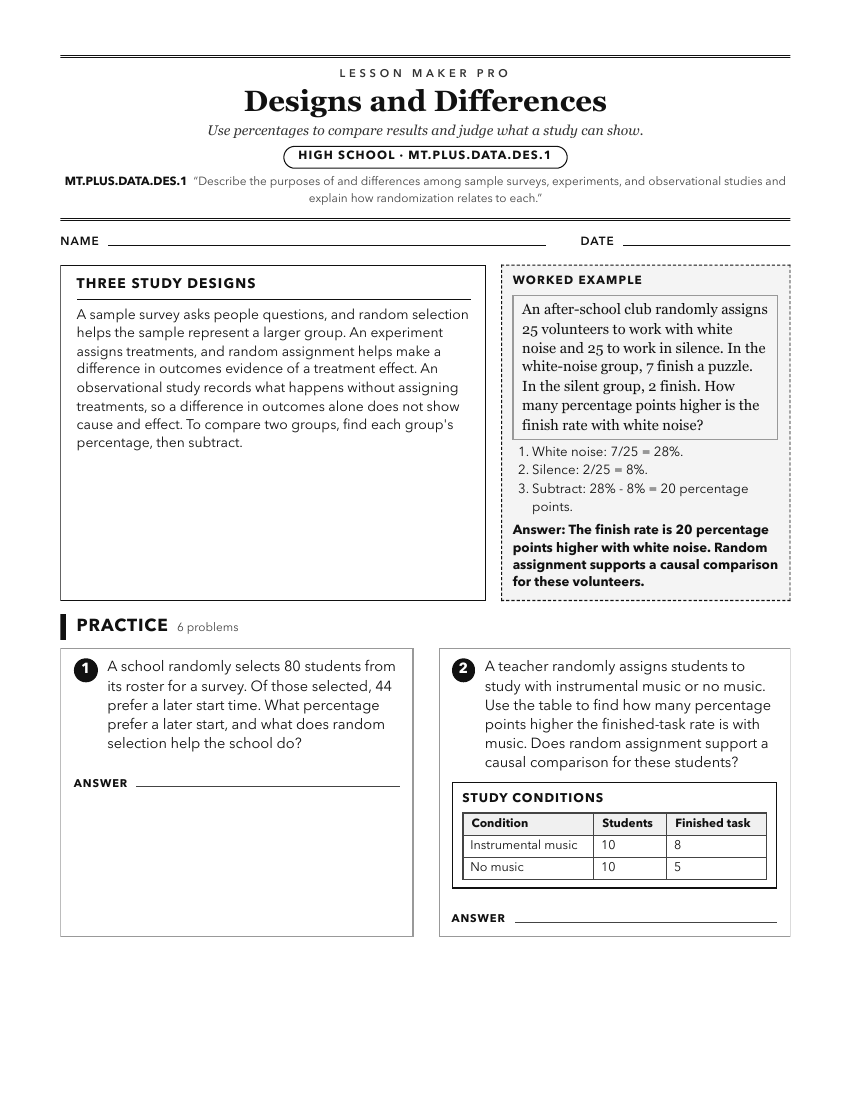
A ready-to-print activity worksheet aligned to MT.PLUS.DATA.DES.1, with an answer key for the teacher on its own page. No account needed.
PDF, US Letter, prints cleanly in black and white.
Download the worksheetKeep exploring
Related Standards
- MT.7.SP.2
Use data from a random sample to draw inferences about a population with an unknown characteristic of interest and generate or simulate multiple samples of the ...
- MT.PLUS.DATA.INF.3.b
Understanding that an observed effect may be due to randomization and using a randomization test (repeatedly reshuffling the observed data into new groups) to d...
- MT.PLUS.DATA.DES.2
Describe differences between randomly selecting samples and randomly assigning subjects to experimental treatment groups in terms of inferences drawn regarding ...
- MT.PLUS.DATA.INF.3
Use data from a randomized experiment to test the hypothesis that two groups are equal by: Interpreting the difference or ratio between the group means as the o...
Turn this exact standard into a lesson
Grade, subject, topic, and the complete standard are prefilled. Create one free, no account needed.
Also for this standard:Make a WorksheetMake a QuizMake a Sub Lesson