Mississippi Science ZOO.1
Standard Cluster
Students will develop a model of evolutionary change over time. Develop and use dichotomous keys to distinguish animals from protists, plants, and fungi. Describe how fossil records document the history of life on Earth. Recognize that the classification of living organisms is based on their evolutionary history and/or similarities in fossils and living organisms. Construct cladograms or phylogenetic trees to show the evolutionary branches of an ancestral species and its descendants. Design models to illustrate the interaction between changing environments and genetic variation in natural selection leading to adaptations in populations and differential success of populations. Enrichment: Use an engineering design process to develop an artificial habitat to meet the requirements of a population that has been impacted by human activity. *
2026 Mississippi College- and Career-Readiness Standards for Science · Evolution
Cluster contents
Standards in This Cluster
ZOO.1 is a cluster heading. These are the individual standards under it.
- ZOO.1.1
Develop and use dichotomous keys to distinguish animals from protists, plants, and fungi.
- ZOO.1.2
Describe how fossil records document the history of life on Earth.
- ZOO.1.3
Recognize that the classification of living organisms is based on their evolutionary history and/or similarities in fossils and living organisms.
- ZOO.1.4
Construct cladograms or phylogenetic trees to show the evolutionary branches of an ancestral species and its descendants.
- ZOO.1.5
Design models to illustrate the interaction between changing environments and genetic variation in natural selection leading to adaptations in populations and d...
- ZOO.1.6
Enrichment: Use an engineering design process to develop an artificial habitat to meet the requirements of a population that has been impacted by human activity...
Teacher's field guide
What This Cluster Means
What Students Need to Do
- Students use two-choice keys to separate animals from protists, plants, and fungi. They use fossils and shared traits to draw branching trees. They model how inherited differences affect populations when environments change.
What Mastery Looks Like
- A student writes clear choices for a key and uses it to identify an unknown organism. They use fossil ages and shared traits to support branches on a tree. They explain how an inherited trait becomes more common when its carriers survive and reproduce.
Common Misconceptions
- Students may classify fungi as plants or assume every moving microorganism is an animal. They may draw evolution as a straight line from simple to advanced organisms. They may think an animal develops a needed trait because its habitat changes.
How to Assess It
- Exit ticket: Show dark and light beetles on dark bark. Ask students to predict their numbers after three generations of bird hunting and explain why.
Lesson moves
Ways to Teach It
Give pairs picture cards of an amoeba, fern, mushroom, worm, and beetle; have them build and swap two-choice keys to identify each.
Show fossil sketches of a fish, early tetrapod, frog, and lizard with labeled traits; ask students to draw and defend a branching tree.
Scatter light and dark paper dots on dark cloth; after each predator round, double survivors and graph color counts across three generations.
Give groups a wetland drained for a road; sketch a replacement frog habitat with water, shelter, and a way frogs reach it.
Free download
Printable ZOO.1 Worksheet
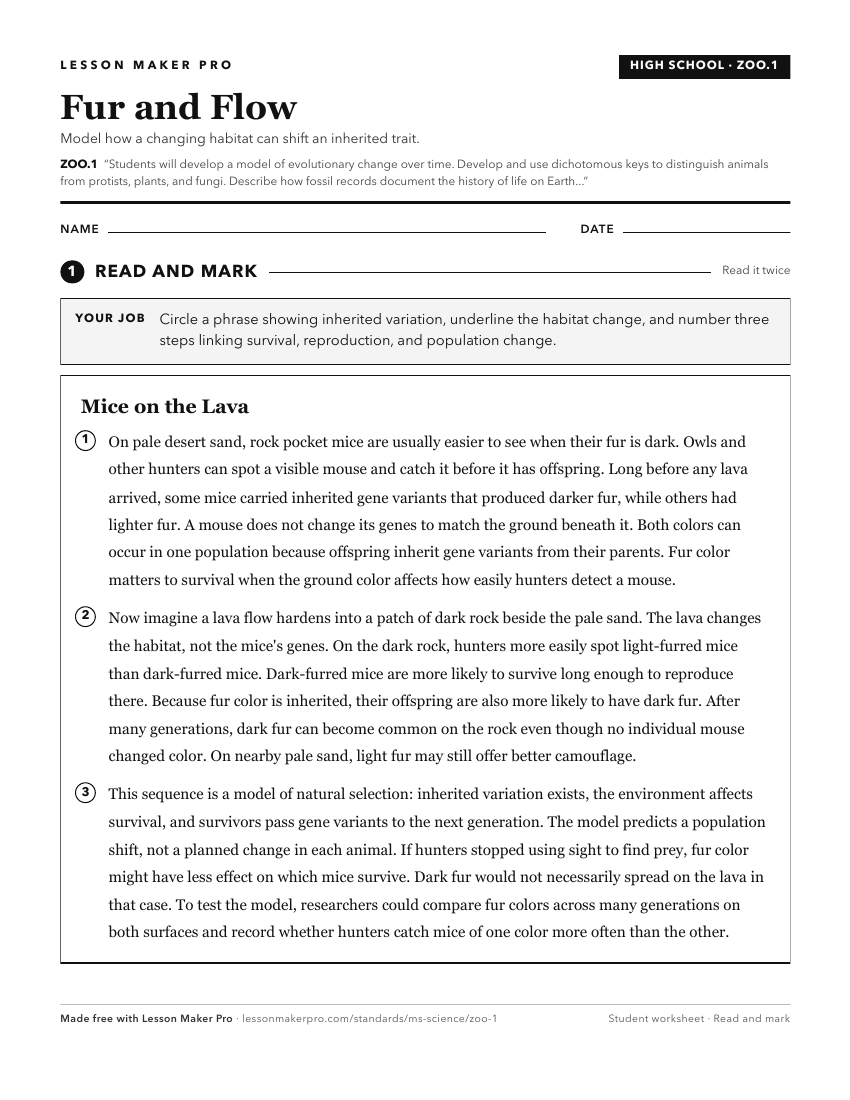
A ready-to-print activity worksheet aligned to ZOO.1, with an answer key for the teacher on its own page. No account needed.
PDF, US Letter, prints cleanly in black and white.
Download the worksheetKeep exploring
Related Standards
- ZOO.7.1
Students will understand why evolutionary changes lead to the diversity of fish and how they have adapted to the different aquatic environments.
- ESS.2B
Students will develop an understanding of the history and evolution of the earth.
- E.8.7
Students will demonstrate an understanding of geological evidence to analyze patterns in Earth’s major events, processes, and evolution in history.
- FB.5
Students will demonstrate an understanding of Earth’s fossil record and its indication of the diversity of life over time.
Turn this cluster into a lesson
Grade, subject, topic, and the complete cluster are prefilled. Create one free, no account needed.
Also for this cluster:Make a WorksheetMake a QuizMake a Sub Lesson