Mississippi Science ZOO.1.3
The Standard
- ZOO.1
- Students will develop a model of evolutionary change over time.
Recognize that the classification of living organisms is based on their evolutionary history and/or similarities in fossils and living organisms.
2026 Mississippi College- and Career-Readiness Standards for Science · Evolution
Teacher's field guide
What This Standard Means
What Students Need to Do
- Students compare traits in living animals and fossils. They use shared traits to group animals and place them on a branching family tree.
What Mastery Looks Like
- Given pictures and a trait chart, a student can place a fossil near its living relatives and point to the evidence. They can explain that close relatives share a more recent common ancestor, even when they look different.
Common Misconceptions
- Students may group whales with fish because both swim. They may also assume every fossil is a direct ancestor, or that one shared feature proves two animals are close relatives.
How to Assess It
- Show pictures of a pigeon, a lizard, and an Archaeopteryx fossil. Ask: “Which living animal is more closely related to Archaeopteryx? What feature supports your answer?”
Lesson moves
Ways to Teach It
Give groups pigeon, lizard, and Archaeopteryx image cards; have them mark feathers, teeth, and wings, then place the cards on a branching tree.
Ask partners, “Why is a whale grouped with mammals, not fish?” Have them compare whale, cat, and fish skeleton pictures.
Play “place the fossil”: give pairs a tree labeled lizard and pigeon, then have them place Archaeopteryx using its feathers and teeth.
Show whale and bat skeleton photos; have students write a museum label explaining why their forelimbs contain the same bones despite different jobs.
Free download
Printable ZOO.1.3 Worksheet
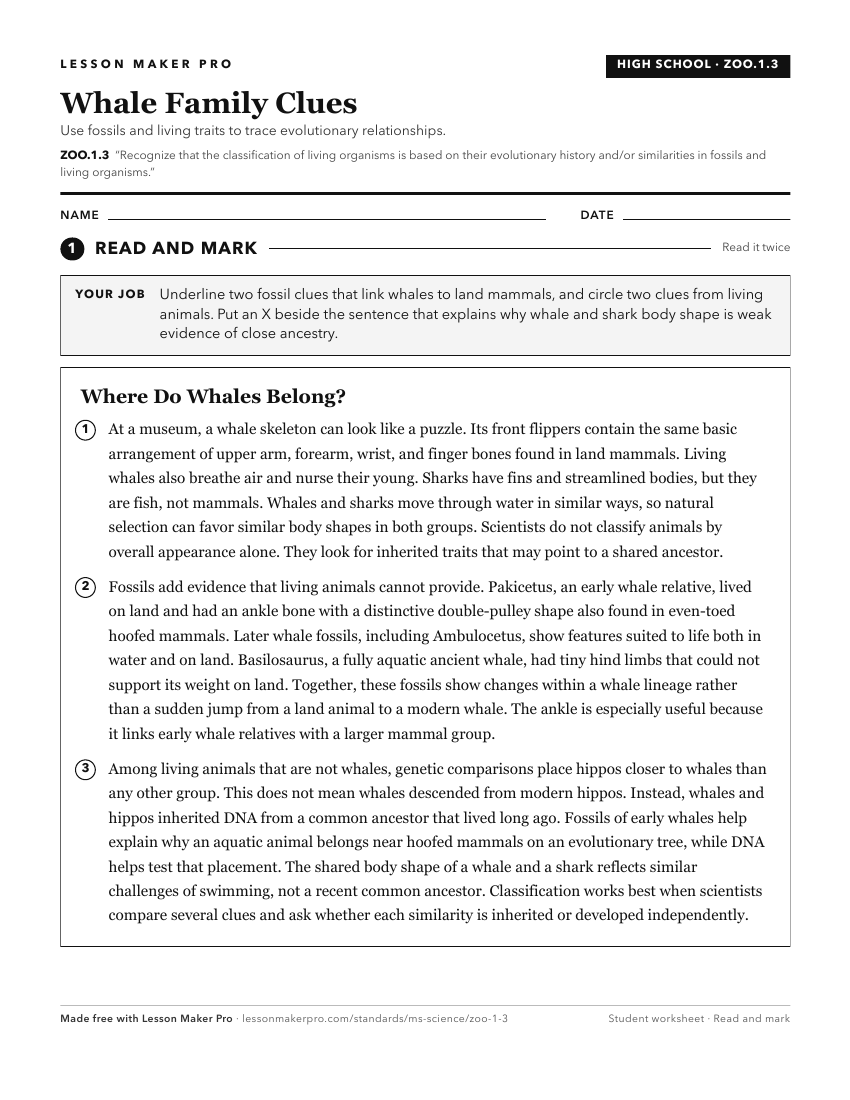
A ready-to-print activity worksheet aligned to ZOO.1.3, with an answer key for the teacher on its own page. No account needed.
PDF, US Letter, prints cleanly in black and white.
Download the worksheetKeep exploring
Related Standards
- MAQ.5.3
Recognize characteristics that are shared and derived using graphical representations of primary-producer evolution and develop cladograms/phylogenetic trees.
- BIO.4.2
Evaluate empirical evidence of common ancestry and biological evolution, including comparative anatomy (e.g., homologous structures and embryological similariti...
- L.8.4B
Students will demonstrate an understanding of how similarities and differences among living and extinct species provide evidence that changes have occurred in o...
- L.6.4.2
Use classification methods to explore the diversity of organisms in kingdoms (animals, plants, fungi, protists, bacteria). Support claims that organisms have sh...
Turn this exact standard into a lesson
Grade, subject, topic, and the complete standard are prefilled. Create one free, no account needed.
Also for this standard:Make a WorksheetMake a QuizMake a Sub Lesson