Kentucky Reading and Writing C.7.3
Standard Cluster
Compose narratives to develop real or imagined experiences or multiple events, memories or ideas using effective technique, relevant descriptive details and well-structured event sequences. Produce clear and coherent writing in which the development, organization and style are appropriate to task, purpose and audience. Engage the reader by establishing a context and point of view and introducing a narrator and/or characters; organize an event sequence that unfolds naturally and logically. Use narrative techniques, such as dialogue, pacing and description, to develop experiences, events and/or characters. Use a variety of transition words to convey sequence and signal shifts from one time frame or setting to another. Use precise words, relevant descriptive details and sensory language to capture the action and convey experiences and events. Provide a conclusion that follows from and reflects on the narrated experiences or events. With guidance, develop and strengthen writing as needed by planning, revising, editing, rewriting or trying a new approach.
Kentucky Academic Standards for Reading and Writing (2025) · Text Types and Purpose
Cluster contents
Standards in This Cluster
C.7.3 is a cluster heading. These are the individual standards under it.
- C.7.3.b
Engage the reader by establishing a context and point of view and introducing a narrator and/or characters; organize an event sequence that unfolds naturally an...
- C.7.3.d
Use a variety of transition words to convey sequence and signal shifts from one time frame or setting to another.
- C.7.3.e
Use precise words, relevant descriptive details, and sensory language to capture the action and convey experiences and events.
- C.7.3.g
With guidance, develop and strengthen writing as needed by planning, revising, editing, rewriting or trying a new approach.
Teacher's field guide
What This Cluster Means
What Students Need to Do
- Students write a true or invented story with a clear narrator and connected events. They use dialogue, details, and time cues to help readers follow the story. They end by showing what the experience meant to the narrator.
What Mastery Looks Like
- A reader can tell who is speaking, when the scene changes, and why one event leads to the next. The student slows down a key moment with dialogue and specific details. They revise confusing jumps and give the ending a reason to be there.
Common Misconceptions
- Students may link every event with “then” without showing why events connect. They may add dialogue that changes nothing or switch time and place without warning. Some end with “The end” rather than showing what changed.
How to Assess It
- Give students eight minutes to write about a small mistake that led to a surprise, real or invented. Ask for one line of dialogue, a clear time shift, and a final sentence showing what the narrator learned.
Lesson moves
Ways to Teach It
Have pairs write five events from a lost-backpack story on index cards, shuffle them, then trade and sequence another pair’s cards.
Have partners read each other’s drafts and discuss which line of dialogue changes a character’s next move.
Play a transition swap: replace repeated uses of “then” in a four-sentence draft with time or place cues.
Write a first-person account of a surprising moment at a school event for the school newsletter, with one sensory detail and a reflective ending.
Free download
Printable C.7.3 Worksheet
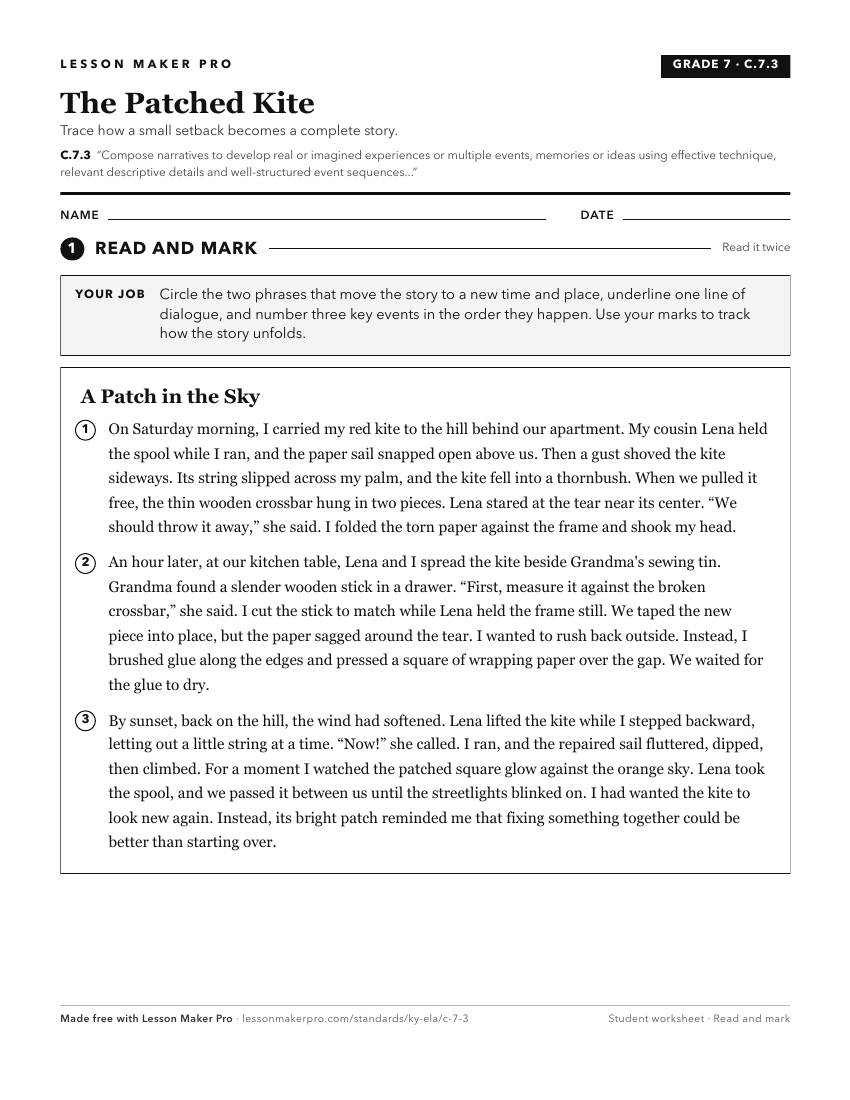
A ready-to-print activity worksheet aligned to C.7.3, with an answer key for the teacher on its own page. No account needed.
PDF, US Letter, prints cleanly in black and white.
Download the worksheetKeep exploring
Related Standards
- C.5.3
Compose narratives, using writing and digital resources, to develop real or imagined experiences or multiple events or ideas, using effective technique, descrip...
- C.3.3
Compose narratives, using writing and digital resources, to develop real or imagined experiences or multiple events or ideas using effective technique, descript...
- C.2.3
Compose narratives, using writing and digital resources, to develop real or imagined experiences or multiple events or ideas, using effective technique, descrip...
- C.6.3
Compose narratives to develop real or imagined experiences or multiple events, memories or ideas, using effective technique, relevant descriptive details and we...
Turn this cluster into a lesson
Grade, subject, topic, and the complete cluster are prefilled. Create one free, no account needed.
Also for this cluster:Make a WorksheetMake a QuizMake a Sub Lesson