Kentucky Reading and Writing C.6.3
Standard Cluster
Compose narratives to develop real or imagined experiences or multiple events, memories or ideas, using effective technique, relevant descriptive details and well-structured event sequences. Produce clear and coherent writing in which the development, organization and style are appropriate to task, purpose and audience. Engage the reader by establishing a context and introducing a narrator and/or characters; organize an event sequence that unfolds naturally and logically. Use narrative techniques, such as dialogue, pacing and description, to develop experiences, events and/or characters. Use a variety of transition words to convey sequence and signal shifts from one time frame or setting to another. Use precise words and phrases, relevant descriptive details and sensory language to convey experiences and events. Provide a conclusion that follows from the narrated experiences or events. With guidance, develop and strengthen writing as needed by planning, revising, editing, rewriting or trying a new approach.
Kentucky Academic Standards for Reading and Writing (2025) · Text Types and Purpose
Cluster contents
Standards in This Cluster
C.6.3 is a cluster heading. These are the individual standards under it.
- C.6.3.b
Engage the reader by establishing a context and introducing a narrator and/or characters; organize an event sequence that unfolds naturally and logically.
- C.6.3.d
Use a variety of transition words to convey sequence and signal shifts from one time frame or setting to another.
- C.6.3.g
With guidance, develop and strengthen writing as needed by planning, revising, editing, rewriting or trying a new approach.
Teacher's field guide
What This Cluster Means
What Students Need to Do
- Write a real or imagined story with a clear opening, events in a sensible order, and an ending that fits. Use dialogue, specific details, and time or place cues to help readers follow what happens. Revise parts that confuse a reader.
What Mastery Looks Like
- A reader can tell who is telling the story, where it happens, and why the events matter. The writer slows down at key moments with dialogue and sensory details, then makes shifts in time or place clear. The ending follows from the events.
Common Misconceptions
- Students may list events without showing how one leads to the next. Dialogue may repeat what the narration already says, or a new day may begin without a time cue. Some add an ending that has little to do with the story's problem.
How to Assess It
- Give students this opening: "When the bus pulled away, I saw my backpack on the curb." Ask for six to eight more sentences with a line of dialogue, a sensory detail, a clear time shift, and an ending that fits.
Lesson moves
Ways to Teach It
Give pairs six event cards from a lost-dog story; have them arrange the cards, add a cause between events, and write an ending.
Prompt students to write three sentences about which moment in their story should slow down and what the narrator would notice or say there.
Run a transition swap: give teams a paragraph that jumps from morning at home to afternoon at school, then award points for clear rewrites.
Write a first-day story for incoming sixth graders to read at orientation, showing one real challenge and how it ended.
Free download
Printable C.6.3 Worksheet
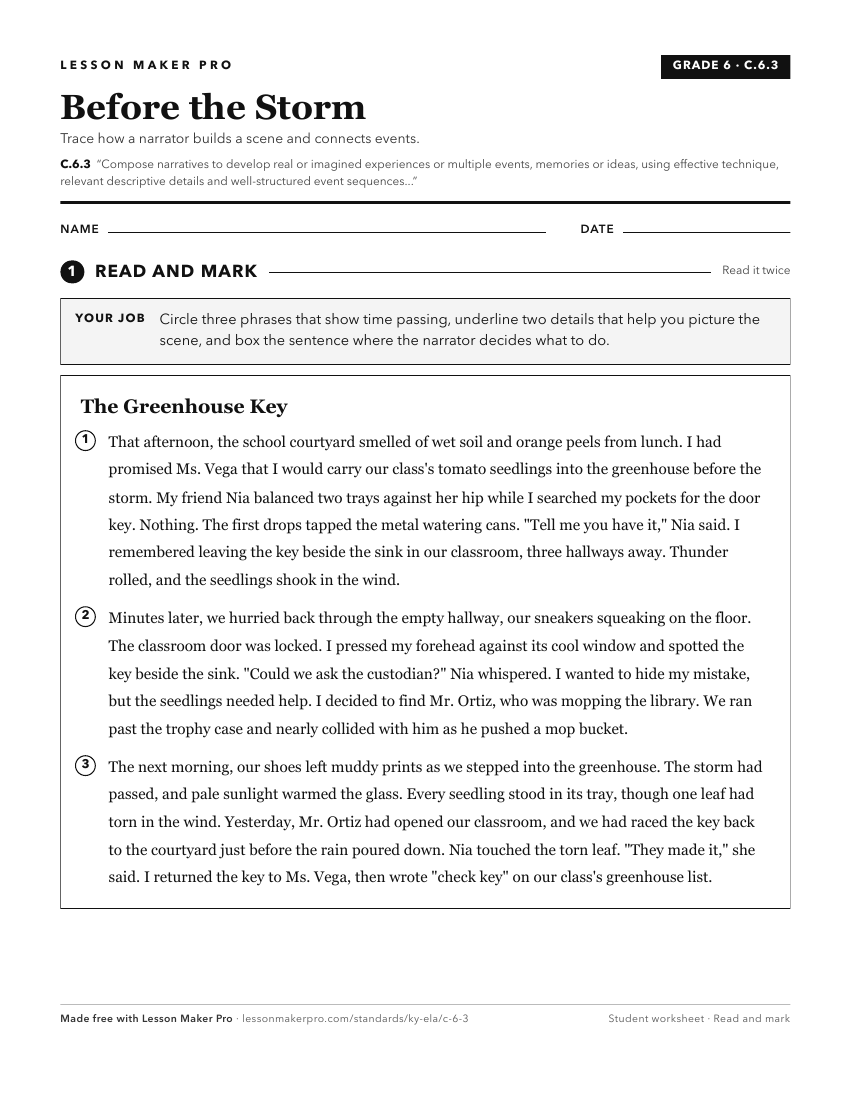
A ready-to-print activity worksheet aligned to C.6.3, with an answer key for the teacher on its own page. No account needed.
PDF, US Letter, prints cleanly in black and white.
Download the worksheetKeep exploring
Related Standards
- C.5.3
Compose narratives, using writing and digital resources, to develop real or imagined experiences or multiple events or ideas, using effective technique, descrip...
- C.4.3
Compose narratives, using writing and digital resources, to develop real or imagined experiences or multiple events or ideas, using effective technique, descrip...
- C.2.3
Compose narratives, using writing and digital resources, to develop real or imagined experiences or multiple events or ideas, using effective technique, descrip...
- C.7.3
Compose narratives to develop real or imagined experiences or multiple events, memories or ideas using effective technique, relevant descriptive details and wel...
Turn this cluster into a lesson
Grade, subject, topic, and the complete cluster are prefilled. Create one free, no account needed.
Also for this cluster:Make a WorksheetMake a QuizMake a Sub Lesson