Kentucky Reading and Writing C.4.3
Standard Cluster
Compose narratives, using writing and digital resources, to develop real or imagined experiences or multiple events or ideas, using effective technique, descriptive details and clear sequences. Produce clear and coherent writing in which the development and organization are appropriate to task, purpose and audience. Orient the reader by establishing a situation and introducing a narrator and/or characters; organize an event sequence that reflects linear, nonlinear or circular structure. Use dialogue and description to develop experiences and events or show the responses of characters to situations. Use a variety of conjunctions and transitional words and phrases to manage the sequence of events. Use concrete words and phrases and sensory details to convey experiences and events precisely. Provide a conclusion that follows the narrated experiences or events. With guidance and support from peers and adults, develop and strengthen writing as needed by planning, revising, editing and rewriting.
Kentucky Academic Standards for Reading and Writing (2025) · Text Types and Purpose
Cluster contents
Standards in This Cluster
C.4.3 is a cluster heading. These are the individual standards under it.
- C.4.3.b
Orient the reader by establishing a situation and introducing a narrator and/or characters; organize an event sequence that reflects linear, nonlinear or circul...
- C.4.3.d
Use a variety of conjunctions and transitional words and phrases to manage the sequence of events.
- C.4.3.f
Provide a conclusion that follows the narrated experiences or events.
- C.4.3.g
With guidance and support from peers and adults, develop and strengthen writing as needed by planning, revising, editing and rewriting.
Teacher's field guide
What This Cluster Means
What Students Need to Do
- Students write a true or made-up story with a clear situation, characters, and connected events. They use dialogue, sensory details, and words that show when and why things happen. They revise with feedback, on paper or in a digital document.
What Mastery Looks Like
- A reader can tell who is speaking, what happens, and why the ending fits. The student can tell events in order, use a flashback, or return to the opening without losing the reader. They can fix a confusing spot after feedback.
Common Misconceptions
- Students may list events without showing how a character reacts. They may jump in time without a signal or write dialogue that leaves the speaker unclear. Some add an ending that does not follow from the story.
How to Assess It
- Write a six-sentence story about finding a lost key, with dialogue, a sensory detail, a time transition, and an ending that fits. Have a partner mark one confusing spot, then revise it.
Lesson moves
Ways to Teach It
Give pairs six event cards about a missing backpack; have them arrange a timeline, then move the ending to the opening.
Ask students to write two lines of dialogue between a child and a bus driver that show worry without using the word worried.
Play Transition Swap: show four scrambled story sentences and have teams place 'meanwhile,' 'afterward,' and 'because' where they make sense.
Open a photo from a school event in a shared document and write a short account for families with two sensory details.
Free download
Printable C.4.3 Worksheet
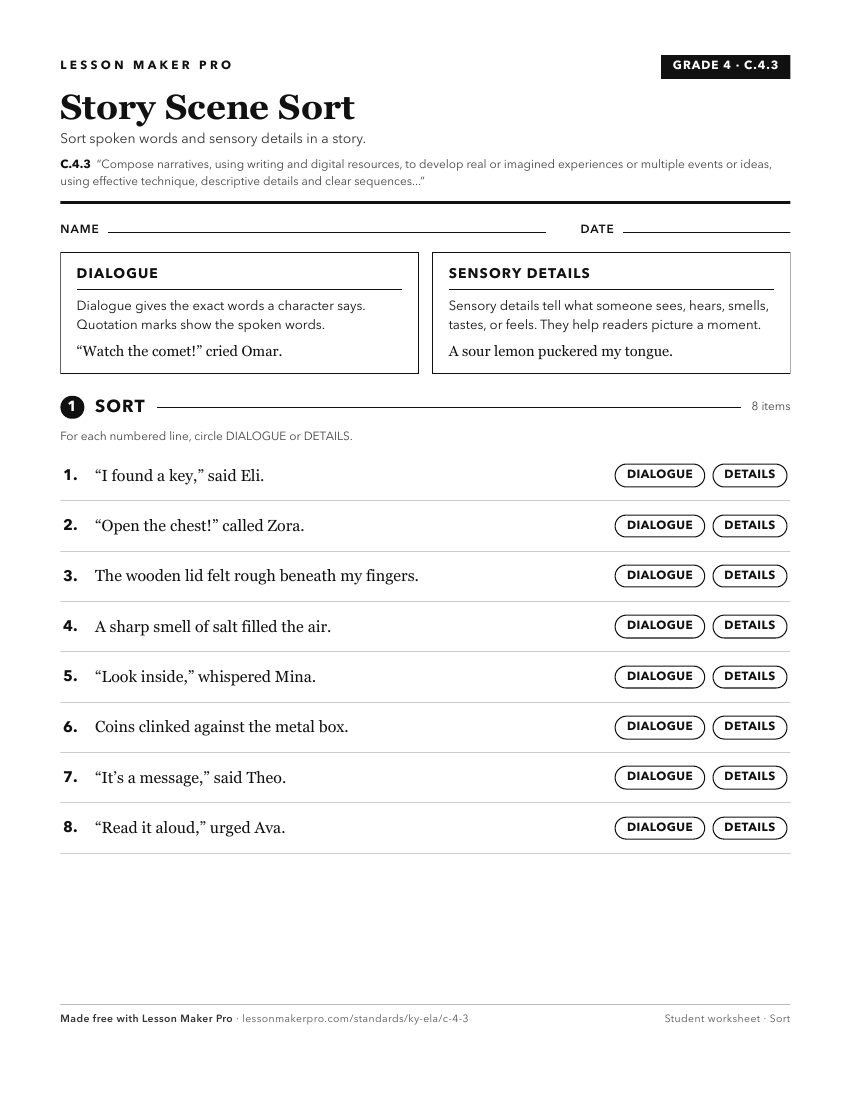
A ready-to-print activity worksheet aligned to C.4.3, with an answer key for the teacher on its own page. No account needed.
PDF, US Letter, prints cleanly in black and white.
Download the worksheetKeep exploring
Related Standards
- C.5.3
The 5th Grade version of this standard.
- C.1.3
Compose narratives, using a combination of drawing, dictating, writing and digital resources, to develop real or imagined experiences or multiple events or idea...
- C.3.3
Compose narratives, using writing and digital resources, to develop real or imagined experiences or multiple events or ideas using effective technique, descript...
- C.2.3
The 2nd Grade version of this standard.
Turn this cluster into a lesson
Grade, subject, topic, and the complete cluster are prefilled. Create one free, no account needed.
Also for this cluster:Make a WorksheetMake a QuizMake a Sub Lesson