Kentucky Reading and Writing C.3.3
Standard Cluster
Compose narratives, using writing and digital resources, to develop real or imagined experiences or multiple events or ideas using effective technique, descriptive details and clear sequences. With guidance and support from adults, produce writing in which the development and organization are appropriate to task and purpose. Establish a situation, and introduce a narrator and/or characters; organize an event sequence that reflects linear, nonlinear and/or circular structure. Use dialogue and descriptions of actions, thoughts and feelings to develop experiences and events or show the response of characters to situations. Use temporal words and phrases to signal event order. Create a sense of closure that follows the narrated experiences or events. With guidance and support from peers and adults, develop and strengthen writing as needed by planning, revising and editing.
Kentucky Academic Standards for Reading and Writing (2025) · Text Types and Purpose
Cluster contents
Standards in This Cluster
C.3.3 is a cluster heading. These are the individual standards under it.
Teacher's field guide
What This Cluster Means
What Students Need to Do
- Students write a true or made-up story with connected events and an ending that fits. They introduce a narrator or characters, use dialogue and details to show actions and feelings, and add time clues. With help, they plan, revise, and edit on paper or in a document.
What Mastery Looks Like
- The story has a clear sequence, even if it includes a flashback or returns to the opening scene. Dialogue, actions, feelings, and time clues help readers follow what happens. The student writes a fitting ending and fixes unclear details after feedback.
Common Misconceptions
- Students may list events without showing what anyone says, does, or feels. They may use 'then' for every transition or jump back in time without signaling it. Some write 'The End' instead of showing how the situation turned out.
How to Assess It
- Exit ticket: Write six sentences about a missing library book. Introduce a character, add one line of dialogue and two time clues, and show how the search ends.
Lesson moves
Ways to Teach It
Give pairs four index cards labeled 'lost dog,' 'search,' 'found collar,' and 'reunion'; have them arrange the cards and write a story.
Read two lost-dog story endings, 'The End' and 'Milo slept beside my bed again,' then ask which fits and why.
Play transition swap: write 'then' in three places in a sample story, and have teams replace each with a clearer time phrase.
Have students write about a recent recess game for the class newsletter, including a player's words and how the game ended.
Free download
Printable C.3.3 Worksheet
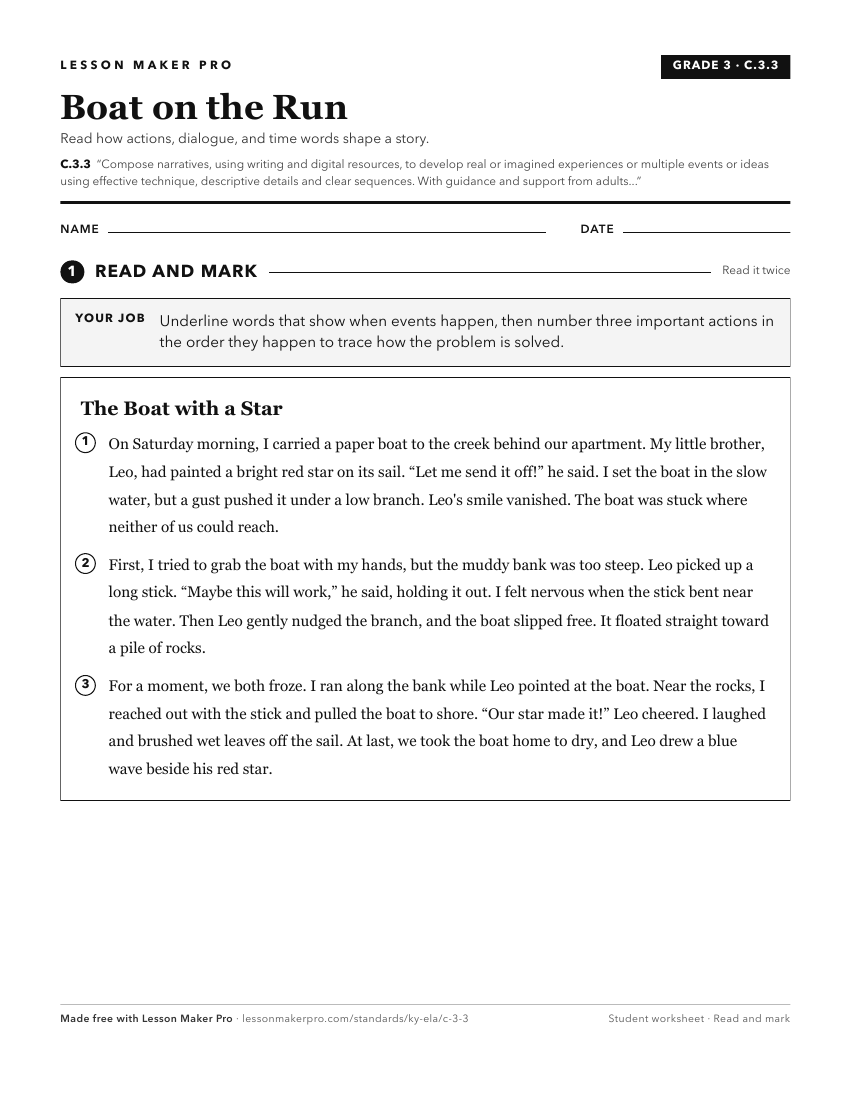
A ready-to-print activity worksheet aligned to C.3.3, with an answer key for the teacher on its own page. No account needed.
PDF, US Letter, prints cleanly in black and white.
Download the worksheetKeep exploring
Related Standards
- C.5.3
Compose narratives, using writing and digital resources, to develop real or imagined experiences or multiple events or ideas, using effective technique, descrip...
- C.1.3
Compose narratives, using a combination of drawing, dictating, writing and digital resources, to develop real or imagined experiences or multiple events or idea...
- C.4.3
Compose narratives, using writing and digital resources, to develop real or imagined experiences or multiple events or ideas, using effective technique, descrip...
- C.2.3
Compose narratives, using writing and digital resources, to develop real or imagined experiences or multiple events or ideas, using effective technique, descrip...
Turn this cluster into a lesson
Grade, subject, topic, and the complete cluster are prefilled. Create one free, no account needed.
Also for this cluster:Make a WorksheetMake a QuizMake a Sub Lesson