Indiana Social Studies P.2.1
The Standard
Describe the structure and function of the major regions of the brain; specifically the forebrain, hindbrain, midbrain, and the four lobes of the cerebral cortex, and explain how these parts of the brain influence human behavior and mental processes.
2026 Indiana Academic Standards: K-12 Social Studies
Teacher's field guide
What This Standard Means
What Students Need to Do
- Students locate the forebrain, midbrain, hindbrain, and four cortex lobes on brain diagrams. They describe each part’s basic job and explain how brain parts work together when someone acts, senses, or thinks.
What Mastery Looks Like
- Students can label all three regions and four lobes and give a basic job for each. When describing someone catching a ball, they connect vision to the occipital lobe, judging its position to the parietal lobe, and balance to the hindbrain.
Common Misconceptions
- Students may think the four lobes are separate from the forebrain, rather than parts of its cortex. They may swap the occipital lobe’s role in vision with the temporal lobe’s role in hearing. They may also assume one brain part handles a whole behavior by itself.
How to Assess It
- Give students a side-view and cutaway brain diagram. Ask them to label the three major regions and four lobes, write one job for each, and name two parts used when catching a ball.
Lesson moves
Ways to Teach It
Give pairs printed brain diagrams, region labels, and behavior cards; have them place each label and card, then check their choices against a key.
Ask students to write what happens when they hear a car horn and step back, naming the temporal lobe, midbrain, and frontal lobe.
Read clues such as “processes vision” and “helps keep you breathing”; students hold up an occipital lobe or hindbrain card.
Show a soccer save clip; students tag vision, ball location, planned movement, and balance with the occipital, parietal, frontal lobes, and hindbrain.
Free download
Printable P.2.1 Worksheet
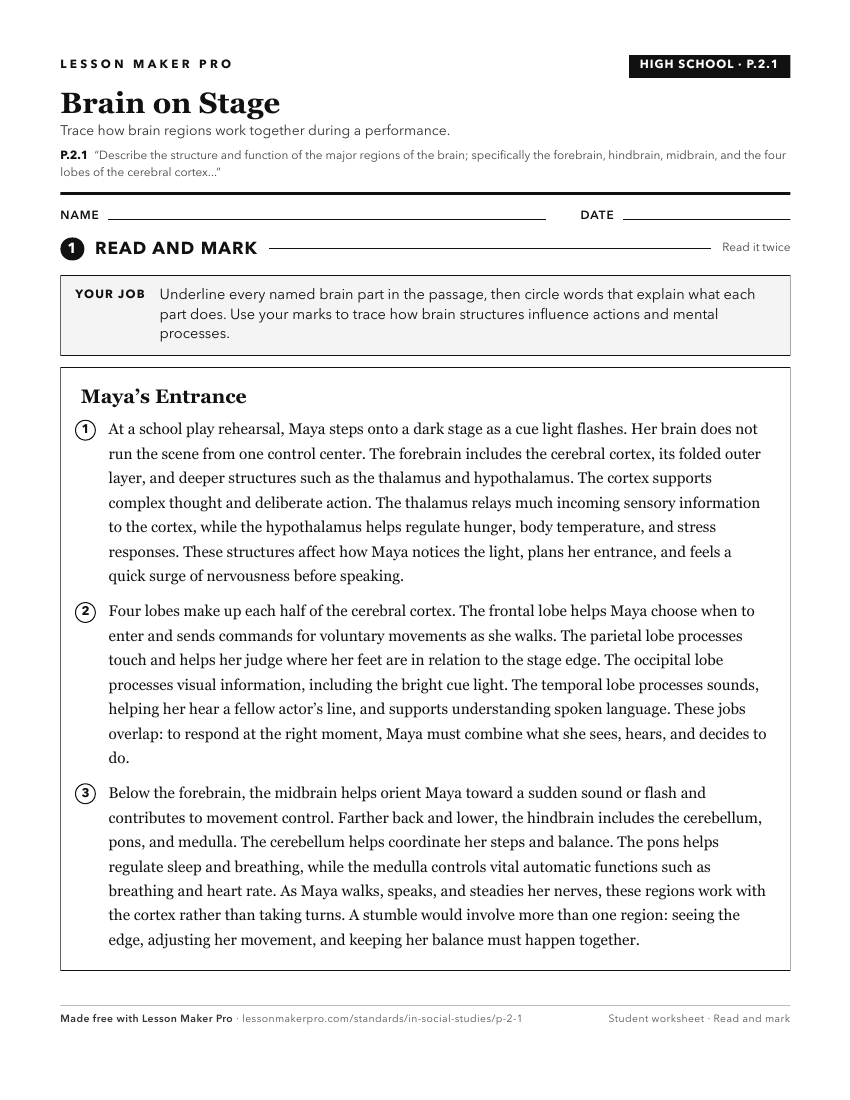
A ready-to-print activity worksheet aligned to P.2.1, with an answer key for the teacher on its own page. No account needed.
PDF, US Letter, prints cleanly in black and white.
Download the worksheetKeep exploring
Related Standards
- P.2.6
Analyze the structure and function of the endocrine system and its effect on human behavior.
- P.2.5
Identify the major divisions and subdivisions of the nervous system and describe how they function, and their effect on human behavior.
- P.2.3
Describe the structure and function of the neuron and the basic process of neurotransmission, including the effect of neurotransmitters (e.g., serotonin, dopami...
- P.2.2
Compare and contrast between the left and right hemispheres of the brain and identify how vision, motor, language, and other functions are regulated by each hem...
Turn this exact standard into a lesson
Grade, subject, topic, and the complete standard are prefilled. Create one free, no account needed.
Also for this standard:Make a WorksheetMake a QuizMake a Sub Lesson