Indiana Social Studies P.2.2
The Standard
Compare and contrast between the left and right hemispheres of the brain and identify how vision, motor, language, and other functions are regulated by each hemisphere.
2026 Indiana Academic Standards: K-12 Social Studies
Teacher's field guide
What This Standard Means
What Students Need to Do
- Students map each visual field and side of the body to the hemisphere that processes it or controls its movement. They compare each hemisphere's usual roles in language, spatial attention, and interpreting tone.
What Mastery Looks Like
- On a blank diagram, students connect the left visual field and left hand to the right hemisphere. They place speech mainly on the left and spatial attention mostly on the right, while recognizing that the hemispheres work together.
Common Misconceptions
- Students often think each eye sends information to only one hemisphere, rather than both eyes sending information to both sides by visual field. They may also think people are purely left-brained or right-brained.
How to Assess It
- Ask: A ball appears in a person's left visual field as they raise their right hand. Which hemisphere processes the ball, which controls the hand, and where is speech usually centered?
Lesson moves
Ways to Teach It
Give pairs a blank brain diagram and colored pencils; have them trace visual fields and hand movements to the opposite hemispheres.
Ask students to write two sentences explaining why losing one visual field can affect what a person sees through both eyes.
Run a card sort with left visual field, right hand movement, speech production, and spatial attention; students match each to its usual hemisphere.
Give students two stroke symptom cards, speech difficulty and left-side weakness; ask which hemisphere is likely injured in each case.
Free download
Printable P.2.2 Worksheet
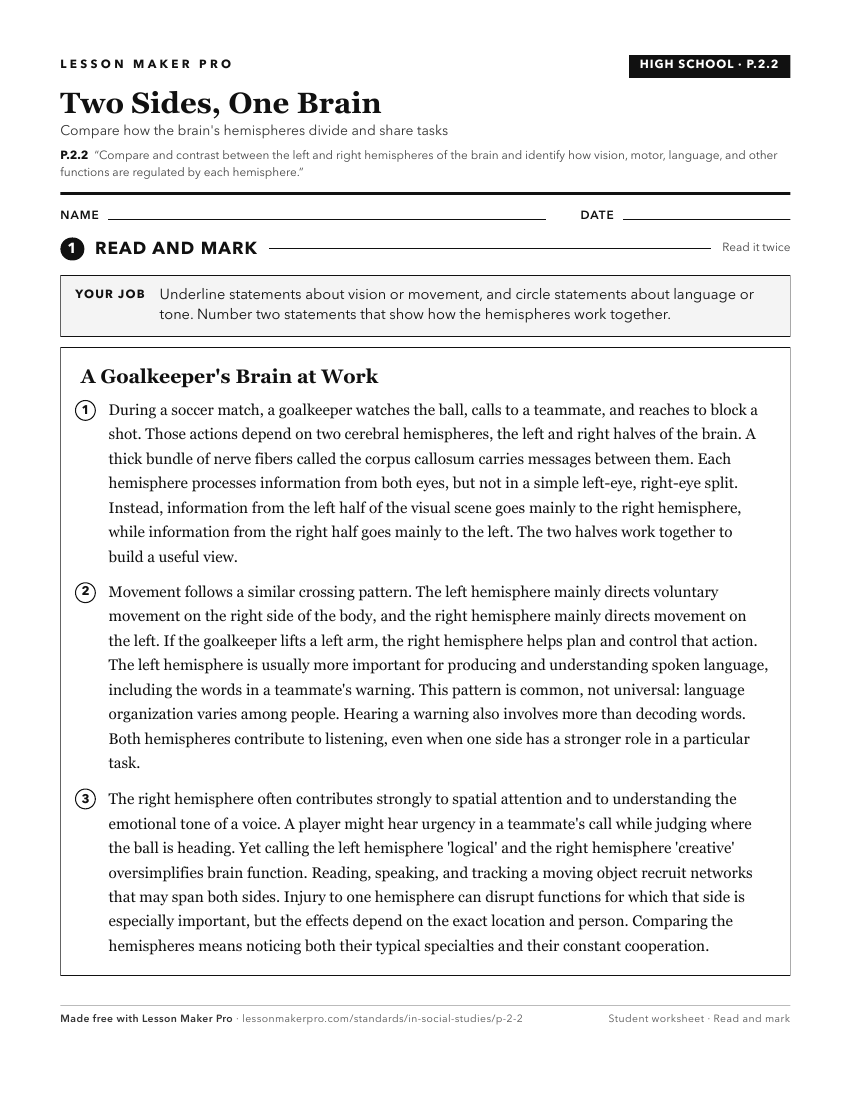
A ready-to-print activity worksheet aligned to P.2.2, with an answer key for the teacher on its own page. No account needed.
PDF, US Letter, prints cleanly in black and white.
Download the worksheetKeep exploring
Related Standards
- P.2.1
Describe the structure and function of the major regions of the brain; specifically the forebrain, hindbrain, midbrain, and the four lobes of the cerebral corte...
- P.2.7
Identify and analyze the mechanisms for sensory input and the process of transduction which informs the brain of environmental stimuli; and, explain how the bra...
- P.2.5
Identify the major divisions and subdivisions of the nervous system and describe how they function, and their effect on human behavior.
- P.2.4
Compare and contrast the methods for studying the brain (e.g., MRI, EEG, CT, FMRI, PET scan, lesion studies) and explain their strengths and limitations.
Turn this exact standard into a lesson
Grade, subject, topic, and the complete standard are prefilled. Create one free, no account needed.
Also for this standard:Make a WorksheetMake a QuizMake a Sub Lesson