Indiana Social Studies P.2.4
The Standard
Compare and contrast the methods for studying the brain (e.g., MRI, EEG, CT, FMRI, PET scan, lesion studies) and explain their strengths and limitations.
2026 Indiana Academic Standards: K-12 Social Studies
Teacher's field guide
What This Standard Means
What Students Need to Do
- Students compare what MRI, CT, EEG, fMRI, PET, and lesion studies show. They choose a method for a question about brain structure, activity, or behavior and explain what that method cannot tell them.
What Mastery Looks Like
- They pick CT for a fast look at an injury, MRI for detailed anatomy without radiation, and EEG for split-second electrical changes. They explain that fMRI tracks slower blood flow, PET maps metabolism using radioactive tracers, and lesion studies link damage to lost abilities but may involve several brain areas.
Common Misconceptions
- Students often treat MRI and fMRI as the same test or think a bright fMRI spot proves that one area causes a behavior. They may think EEG pinpoints an exact location or that PET uses no radiation.
How to Assess It
- Exit ticket: A researcher wants to track split-second changes during a memory task and map which brain areas are active. Choose EEG or fMRI for each goal, and give one limit of each.
Lesson moves
Ways to Teach It
Give pairs six method cards and mats labeled structure, activity, and damage; have them place each card and attach a strength and limit.
Ask: Which tool would you use to study seizure timing versus tumor location, and why would the other tool fall short?
Play Method Match: hand out six method cards, read four research questions, and award points for a justified choice and stated limitation.
Give students an emergency room head injury note; ask whether a fast CT or slower MRI is the better first scan and why.
Free download
Printable P.2.4 Worksheet
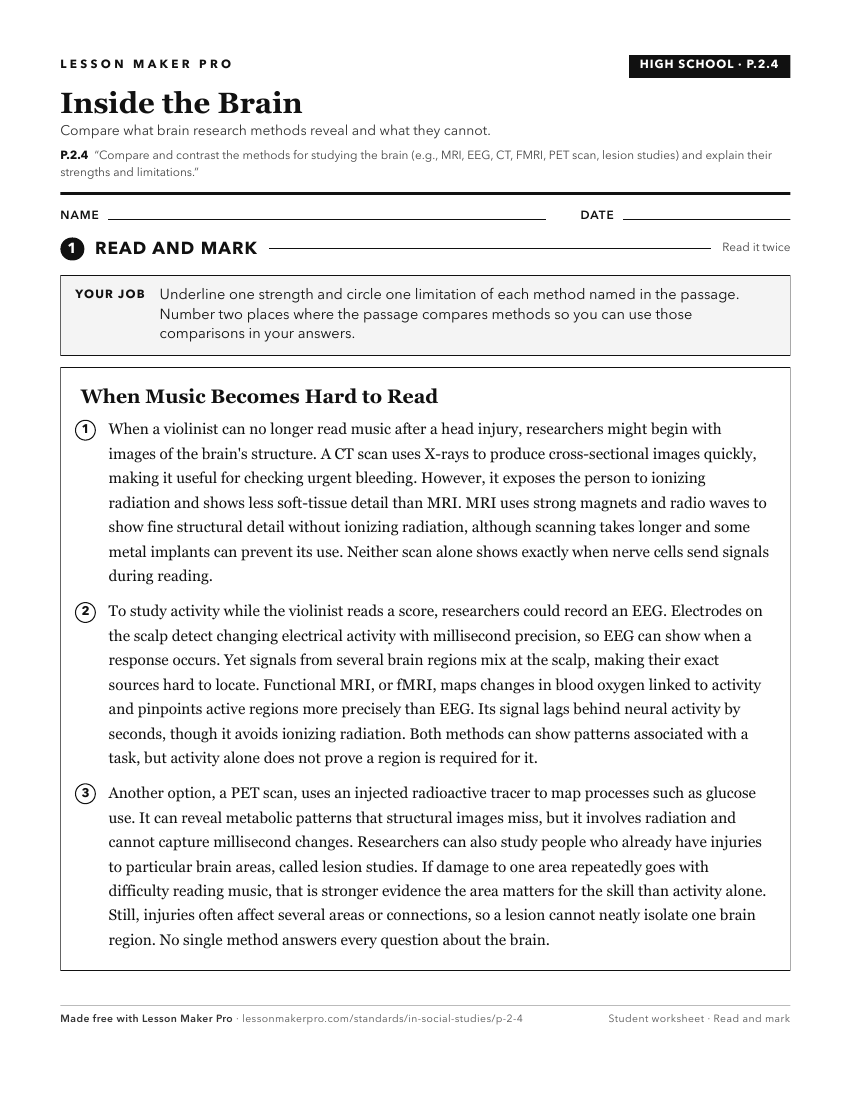
A ready-to-print activity worksheet aligned to P.2.4, with an answer key for the teacher on its own page. No account needed.
PDF, US Letter, prints cleanly in black and white.
Download the worksheetKeep exploring
Related Standards
- P.2.1
Describe the structure and function of the major regions of the brain; specifically the forebrain, hindbrain, midbrain, and the four lobes of the cerebral corte...
- P.1.11
Locate and analyze primary sources of landmark experiments in psychology and other counter arguments.
- S.1.5
Identify the research methods commonly used by sociologists including survey research, content/historical analysis, secondary analysis, controlled experiments, ...
- P.2.2
Compare and contrast between the left and right hemispheres of the brain and identify how vision, motor, language, and other functions are regulated by each hem...
Turn this exact standard into a lesson
Grade, subject, topic, and the complete standard are prefilled. Create one free, no account needed.
Also for this standard:Make a WorksheetMake a QuizMake a Sub Lesson