Indiana Social Studies P.2.5
The Standard
Identify the major divisions and subdivisions of the nervous system and describe how they function, and their effect on human behavior.
2026 Indiana Academic Standards: K-12 Social Studies
Teacher's field guide
What This Standard Means
What Students Need to Do
- Students identify the brain and spinal cord as central, and the nerves outside them as peripheral. They explain how the somatic branch controls voluntary movement and how the autonomic branch changes body functions. They connect sympathetic and parasympathetic activity to behavior during and after a scare.
What Mastery Looks Like
- Given a loud crash, a student traces the sound signal through peripheral nerves to the brain. They identify turning toward the sound as somatic and a faster heartbeat as sympathetic. They explain how parasympathetic activity helps slow the heartbeat afterward.
Common Misconceptions
- Students may leave out the spinal cord and peripheral nerves when describing the nervous system. They may call a racing heart a voluntary action. Some think parasympathetic activity turns the nervous system off rather than helping the body settle.
How to Assess It
- Exit ticket: A student hears a fire alarm, runs outside, then notices their heart slow down. Name the central and peripheral parts involved, then label the running, racing heart, and slowing heart rate by branch.
Lesson moves
Ways to Teach It
In pairs, catch a falling ruler, then sketch the signal path through peripheral nerves, brain, spinal cord, and hand muscles.
Ask students to write: A car horn blares while you cross the street. What makes you step back, speeds your heart, and slows it afterward?
Give teams cards labeled brain, spinal cord, sensory nerves, hand movement, fast heartbeat, and slowing heartbeat; have them sort and explain each placement.
Have students check their pulse before and after 30 seconds of marching, then name the autonomic branch that helps their pulse settle.
Free download
Printable P.2.5 Worksheet
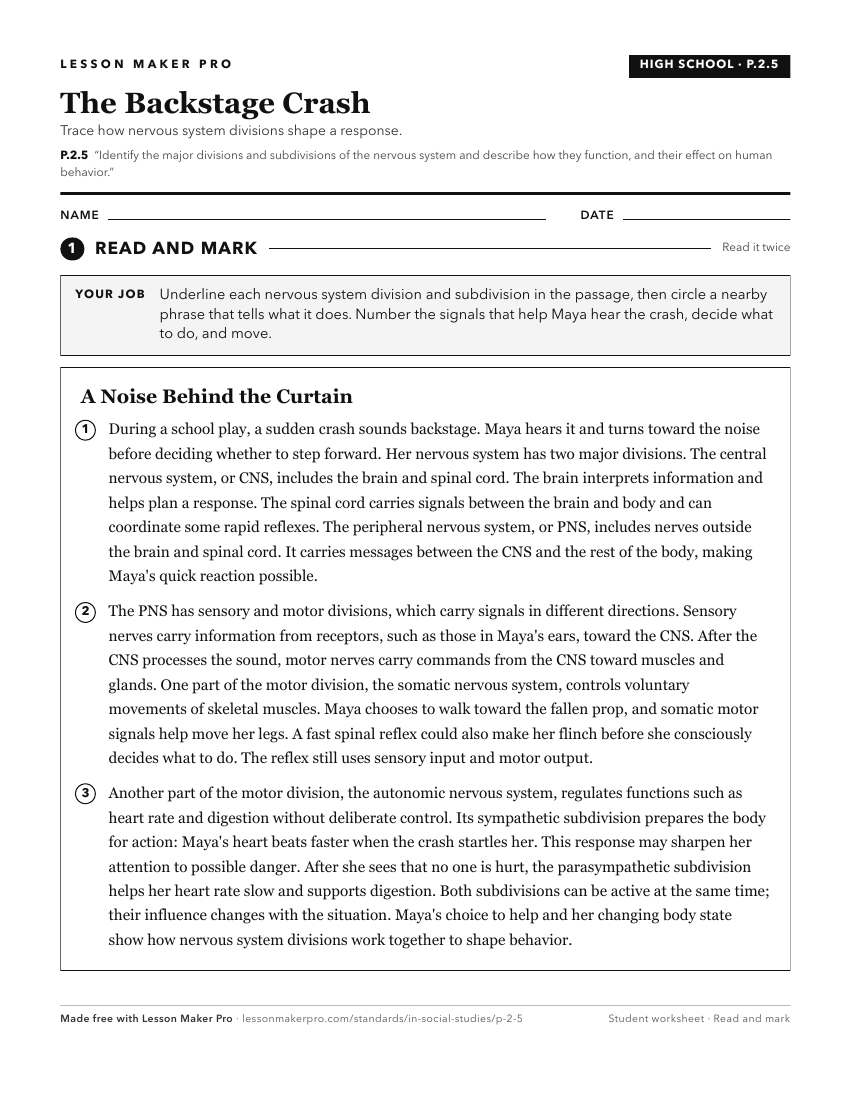
A ready-to-print activity worksheet aligned to P.2.5, with an answer key for the teacher on its own page. No account needed.
PDF, US Letter, prints cleanly in black and white.
Download the worksheetKeep exploring
Related Standards
- P.2.1
Describe the structure and function of the major regions of the brain; specifically the forebrain, hindbrain, midbrain, and the four lobes of the cerebral corte...
- P.2.6
Analyze the structure and function of the endocrine system and its effect on human behavior.
- P.3.1
Explain the roles, effects, and outcomes of prenatal and postnatal development on human behavior.
- P.2.3
Describe the structure and function of the neuron and the basic process of neurotransmission, including the effect of neurotransmitters (e.g., serotonin, dopami...
Turn this exact standard into a lesson
Grade, subject, topic, and the complete standard are prefilled. Create one free, no account needed.
Also for this standard:Make a WorksheetMake a QuizMake a Sub Lesson