Indiana Social Studies P.2.6
The Standard
Analyze the structure and function of the endocrine system and its effect on human behavior.
2026 Indiana Academic Standards: K-12 Social Studies
Teacher's field guide
What This Standard Means
What Students Need to Do
- Students locate major endocrine glands and name hormones they release. They explain how hormones travel through the blood and may affect sleep, stress, or energy.
What Mastery Looks Like
- A student can locate the adrenal glands and explain how they release cortisol into the blood during stress. They can describe a possible effect on attention without claiming cortisol controls every choice.
Common Misconceptions
- Students may think hormones travel through nerves rather than the bloodstream. They may confuse a gland with the hormone it releases, or assume one hormone always produces the same behavior.
How to Assess It
- On an exit ticket, have students label the adrenal glands on a body outline. Ask them how cortisol travels through the body and how it might affect someone during a stressful test.
Lesson moves
Ways to Teach It
Give pairs a body outline and gland cards; have them place each gland and draw arrows showing hormones entering the bloodstream.
Ask students to write three sentences explaining how melatonin might relate to feeling sleepy during a late class.
Play a matching relay with cards for glands, hormones, and jobs; require pairs to explain each match.
Give students a test-day stress scenario and ask them to mark the adrenal glands and describe one possible change in attention.
Free download
Printable P.2.6 Worksheet
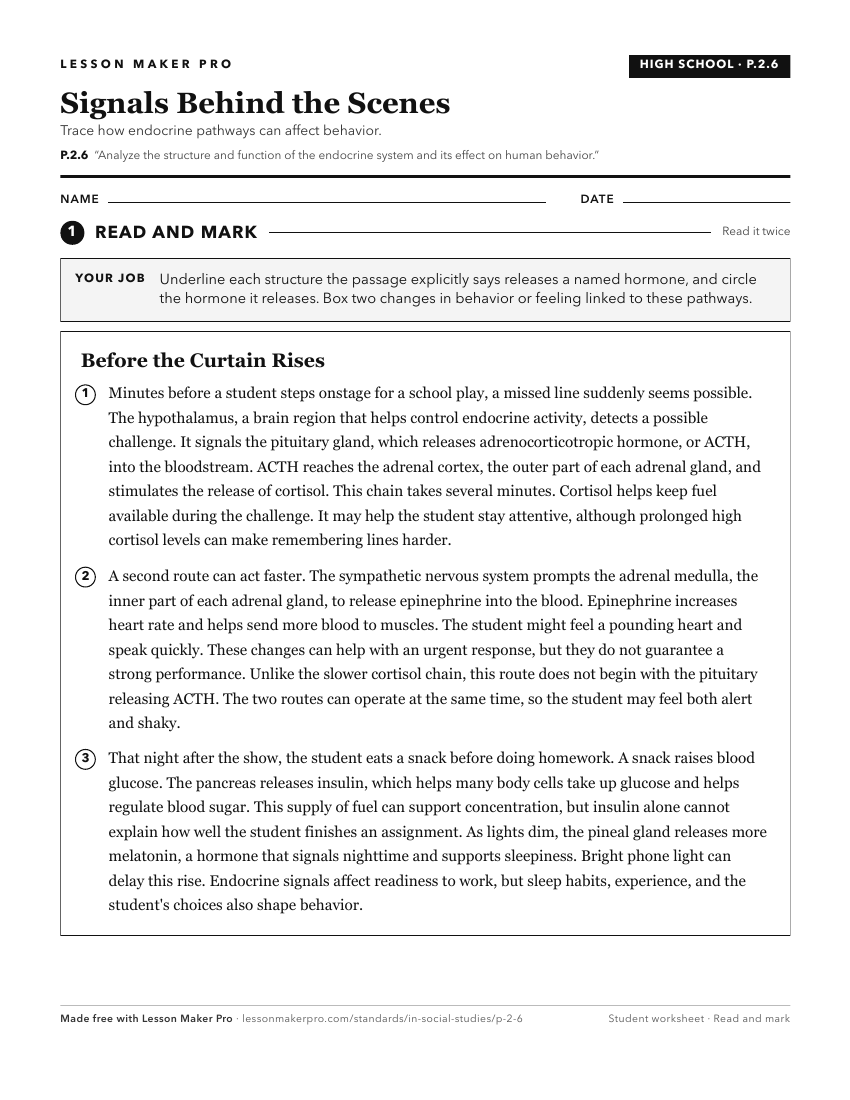
A ready-to-print activity worksheet aligned to P.2.6, with an answer key for the teacher on its own page. No account needed.
PDF, US Letter, prints cleanly in black and white.
Download the worksheetKeep exploring
Related Standards
- P.2.5
Identify the major divisions and subdivisions of the nervous system and describe how they function, and their effect on human behavior.
- P.3.1
Explain the roles, effects, and outcomes of prenatal and postnatal development on human behavior.
- P.2.3
Describe the structure and function of the neuron and the basic process of neurotransmission, including the effect of neurotransmitters (e.g., serotonin, dopami...
- P.1.7
Analyze human behavior (biological, evolutionary, behavioral, cognitive, humanistic, psychodynamic, sociocultural, biopsychosocial) from contemporary perspectiv...
Turn this exact standard into a lesson
Grade, subject, topic, and the complete standard are prefilled. Create one free, no account needed.
Also for this standard:Make a WorksheetMake a QuizMake a Sub Lesson