Indiana Social Studies P.1.7
The Standard
Analyze human behavior (biological, evolutionary, behavioral, cognitive, humanistic, psychodynamic, sociocultural, biopsychosocial) from contemporary perspectives in psychology.
2026 Indiana Academic Standards: K-12 Social Studies
Teacher's field guide
What This Standard Means
What Students Need to Do
- Students explain one action through biological, evolutionary, behavioral, cognitive, humanistic, psychodynamic, and sociocultural perspectives. They combine several factors in a biopsychosocial explanation and identify what evidence each claim needs.
What Mastery Looks Like
- For phone checking, they link notifications to learned rewards, fear of missing messages to thoughts, and group chats to social pressure. They treat claims about inherited tendencies or hidden motives as possibilities, not proven facts.
Common Misconceptions
- Students may assume a biological explanation rules out choices or social pressure. They may confuse rewards with beliefs, or present guesses about evolution or hidden motives as facts.
How to Assess It
- Exit ticket: A student checks their phone while studying. Explain the behavior using two different psychology perspectives, then name one fact you would check for each explanation.
Lesson moves
Ways to Teach It
Give pairs eight cause cards about checking a phone while studying; have them sort each card under a labeled psychology perspective.
Ask, 'Can two different explanations for checking a phone both be right?' Have students defend their answers using a short case.
Play perspective match: read eight brief explanations aloud, and have teams hold up a matching perspective card and explain their choice.
Give students a fictional teen's screen-time log and homework schedule; ask how rewards, beliefs, and group-chat rules might explain late-night phone use.
Free download
Printable P.1.7 Worksheet
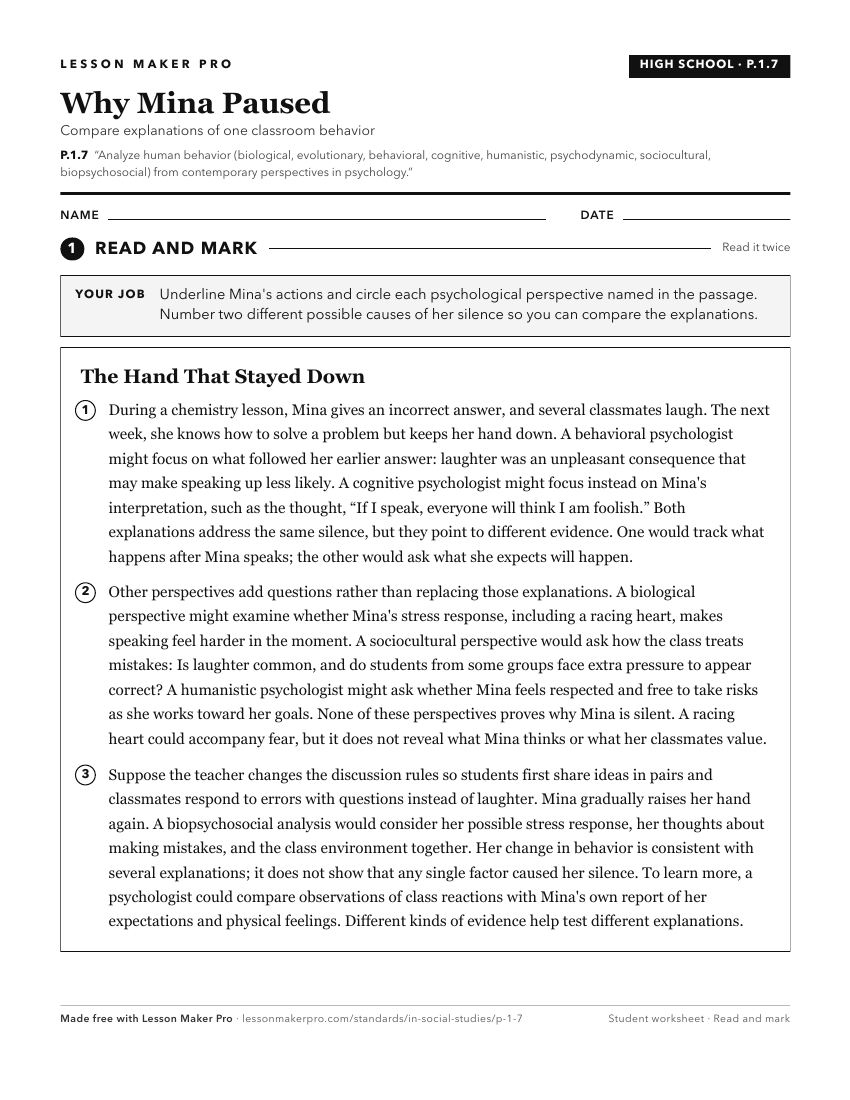
A ready-to-print activity worksheet aligned to P.1.7, with an answer key for the teacher on its own page. No account needed.
PDF, US Letter, prints cleanly in black and white.
Download the worksheetKeep exploring
Related Standards
- P.2.6
Analyze the structure and function of the endocrine system and its effect on human behavior.
- P.5.6
Evaluate the influences of variables, such as culture (belonging to an individualist or collectivist culture), family, and genetics, on personality development ...
- USH.6.2
Analyze key economic, cultural, political, and social changes in post-World War II American life.
- S.1.4
Explain the major theoretical perspectives (paradigms) common to sociology including structural functional, symbolic interaction, and conflict theory. Demonstra...
Turn this exact standard into a lesson
Grade, subject, topic, and the complete standard are prefilled. Create one free, no account needed.
Also for this standard:Make a WorksheetMake a QuizMake a Sub Lesson