Indiana Social Studies S.1.4
The Standard
Explain the major theoretical perspectives (paradigms) common to sociology including structural functional, symbolic interaction, and conflict theory. Demonstrate how each perspective sheds light on human social behavior.
2026 Indiana Academic Standards: K-12 Social Studies
Teacher's field guide
What This Standard Means
What Students Need to Do
- Students explain the same situation in three ways: how it helps a group run, what people think it means, and who has power. They use details from the situation to support each explanation.
What Mastery Looks Like
- Given a school dress code, a student explains how it sets expectations, how clothing signals identity, and whose preferences shape the rules. They match those explanations to functionalism, symbolic interactionism, and conflict theory.
Common Misconceptions
- Students may treat conflict theory as any argument between two people, rather than a question of unequal power. They may think symbolic interaction covers only spoken words, or that functionalism means every rule benefits everyone.
How to Assess It
- Exit ticket: A school bans phones during lunch. Name each lens and write one explanation for the ban from each lens.
Lesson moves
Ways to Teach It
Give groups a sketched cafeteria seating chart with a staff-only table; use colored sticky notes to mark routines, status signals, and unequal access.
Ask pairs to explain cafeteria friend groups three ways: through routine, shared meanings, and power over who feels welcome.
Read six explanations of school rules aloud; teams hold up F, I, or C cards and name the clue in each explanation.
Use a restaurant's posted dress code; students explain its purpose, what outfits signal, and who sets the rules.
Free download
Printable S.1.4 Worksheet
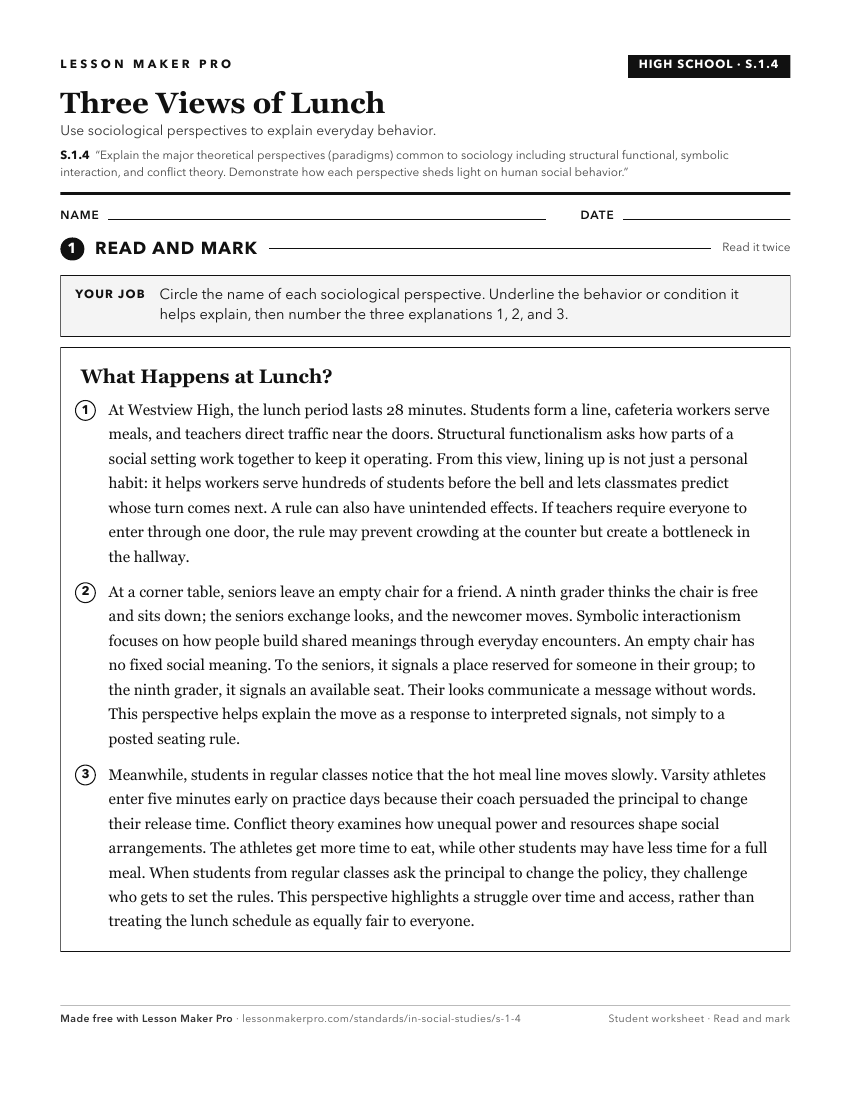
A ready-to-print activity worksheet aligned to S.1.4, with an answer key for the teacher on its own page. No account needed.
PDF, US Letter, prints cleanly in black and white.
Download the worksheetKeep exploring
Related Standards
- S.8.7
Discuss theories that attempt to explain collective behavior.
- S.1.5
Identify the research methods commonly used by sociologists including survey research, content/historical analysis, secondary analysis, controlled experiments, ...
- S.1.3
Illustrate the relationship of sociology to the other social science disciplines, including history, economics, psychology, and political science.
- S.5.5
Compare and contrast various sociological perspectives of gender role socialization.
Turn this exact standard into a lesson
Grade, subject, topic, and the complete standard are prefilled. Create one free, no account needed.
Also for this standard:Make a WorksheetMake a QuizMake a Sub Lesson