Indiana Social Studies S.8.7
The Standard
Discuss theories that attempt to explain collective behavior.
2026 Indiana Academic Standards: K-12 Social Studies
Teacher's field guide
What This Standard Means
What Students Need to Do
- Students explain why people act together in crowds or follow a spreading rumor. They use three theories to explain what people do and point to details that support each explanation.
What Mastery Looks Like
- Given a short crowd story, a student can explain whether people copied others, arrived with a shared goal, or formed a new rule. They name the theory that fits best and cite a clue.
Common Misconceptions
- Students may assume crowds always act without thinking. They may confuse copying others with joining a crowd because they already share its goal. They may overlook rules that form during an event.
How to Assess It
- After a train station closes, one rider starts a sign-up list for shared taxis, and others use it. Which theory best explains how the group organized? Name one clue.
Lesson moves
Ways to Teach It
Give pairs three printed crowd stories and three theory cards; have them sort the stories and circle a supporting clue in each.
Ask: Did concertgoers join a refund chant because they already wanted refunds, or because they copied others? Defend your answer.
Read clues such as 'panic spreads' or 'a new queue forms'; have teams hold up the matching theory card.
Describe a cafeteria register failing and students forming a new line; ask how the line began and why others followed.
Free download
Printable S.8.7 Worksheet
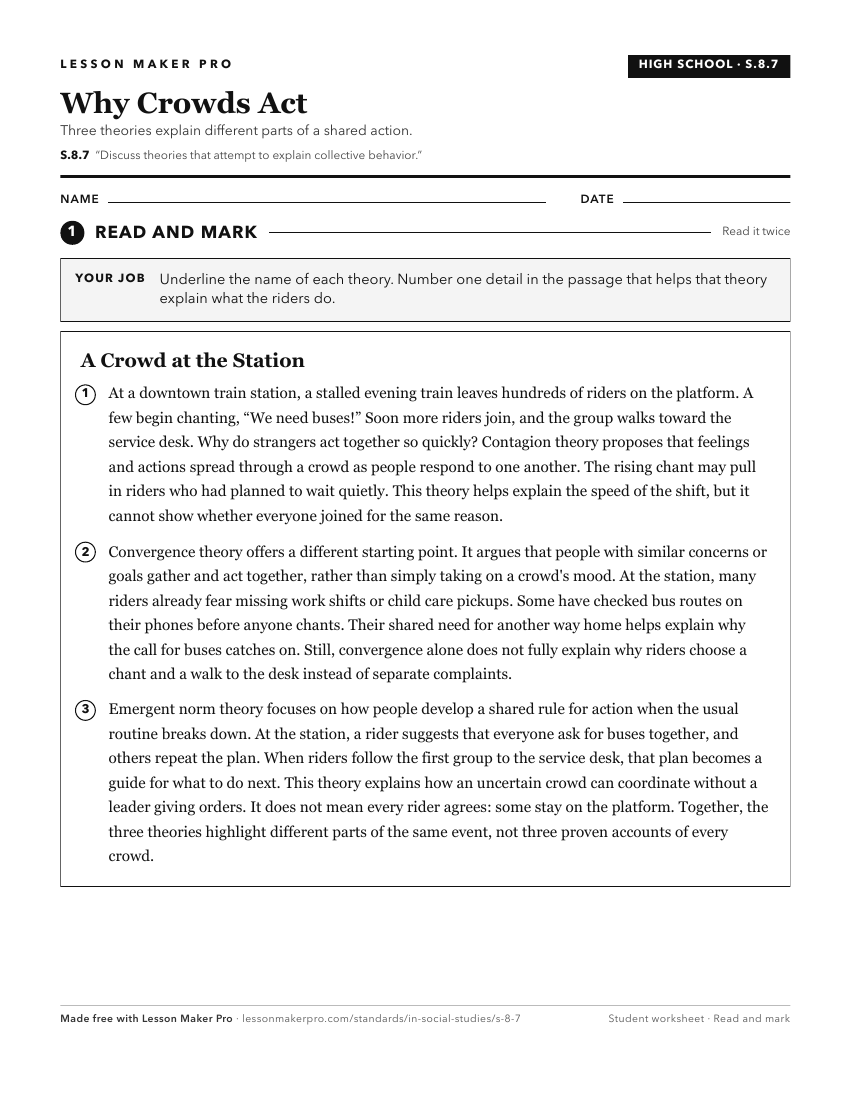
A ready-to-print activity worksheet aligned to S.8.7, with an answer key for the teacher on its own page. No account needed.
PDF, US Letter, prints cleanly in black and white.
Download the worksheetKeep exploring
Related Standards
- S.8.5
Distinguish major differences between social movements and collective behavior with examples.
- S.8.10
Discuss both the benefits and social costs of collective behavior in society.
- S.10.3
Explore explanations of deviance such as the Strain Theory, the Differential Association Theory, and the Control Theory.
- S.8.3
Describe how collective behavior can influence and change society.
Turn this exact standard into a lesson
Grade, subject, topic, and the complete standard are prefilled. Create one free, no account needed.
Also for this standard:Make a WorksheetMake a QuizMake a Sub Lesson