Indiana Social Studies S.10.3
The Standard
Explore explanations of deviance such as the Strain Theory, the Differential Association Theory, and the Control Theory.
2026 Indiana Academic Standards: K-12 Social Studies
Teacher's field guide
What This Standard Means
What Students Need to Do
- Students explain why someone might break a social rule using three ideas: blocked paths to a goal, behavior learned from others, and weak social ties. They use details from a case to support each explanation.
What Mastery Looks Like
- Given a cheating scenario, a student can match specific facts to each explanation and explain the link. They can also say when there is not enough evidence to choose one.
Common Misconceptions
- Students may think deviance always means crime. They may mistake strain for everyday stress or assume that being near rule breakers proves someone learned from them. They may think social control means punishment alone.
How to Assess It
- Give this exit ticket: A student wants a scholarship, cannot get tutoring, learns to copy answers from friends, and feels disconnected from school. Match each detail to an explanation of cheating and explain your choices.
Lesson moves
Ways to Teach It
Give pairs case cards about cheating, graffiti, and skipping class; have them sort evidence slips into blocked goals, learned behavior, and weak ties.
Ask students to write: Two students copy homework for different reasons. What facts would help you explain each student's choice?
Play four rounds of Which Explanation? Read a short case, then have students hold up a theory card and name their evidence.
Read your school's academic honesty policy, then have students write three possible reasons someone might break one rule, one per explanation.
Free download
Printable S.10.3 Worksheet
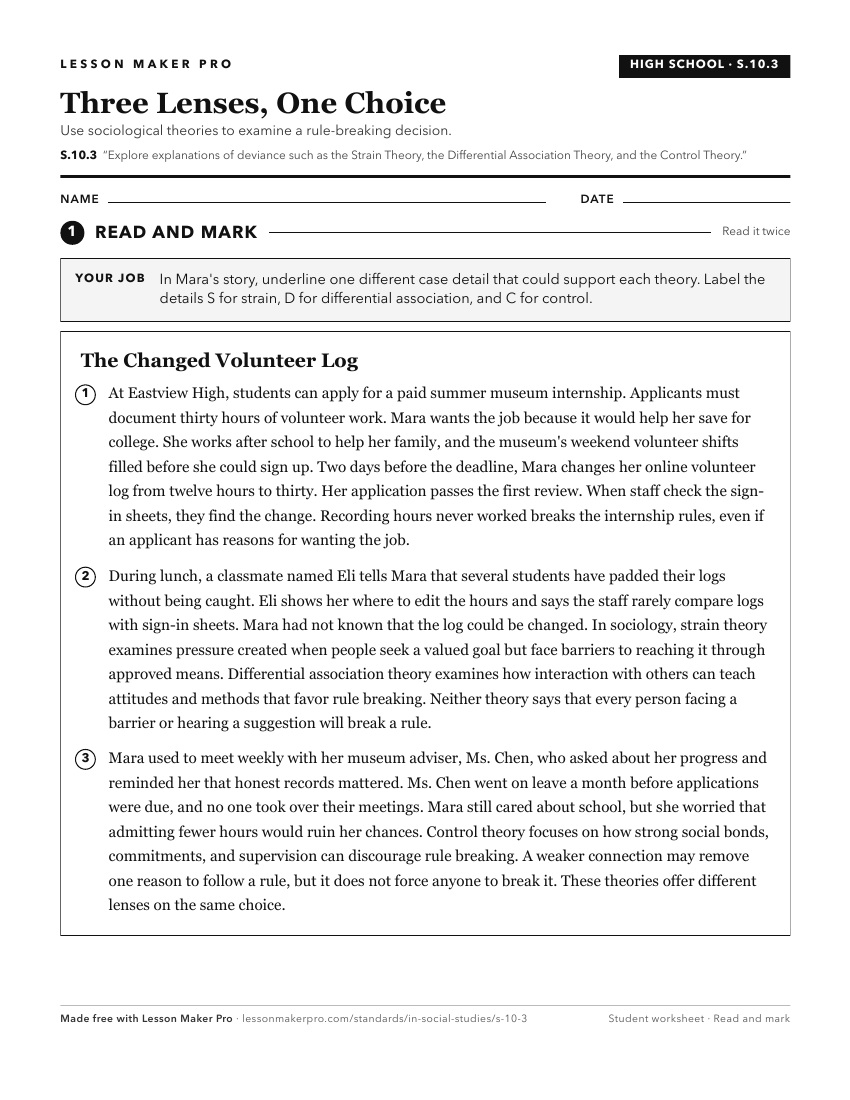
A ready-to-print activity worksheet aligned to S.10.3, with an answer key for the teacher on its own page. No account needed.
PDF, US Letter, prints cleanly in black and white.
Download the worksheetKeep exploring
Related Standards
- S.8.7
Discuss theories that attempt to explain collective behavior.
- S.10.7
Identify the consequences of the medicalization of deviance.
- S.10.8
Explore theoretical foundations of punishment including retributive, rehabilitative, and deterrent.
- S.10.1
Define deviance and explore the functions deviance serves as identified by Emile Durkheim.
Turn this exact standard into a lesson
Grade, subject, topic, and the complete standard are prefilled. Create one free, no account needed.
Also for this standard:Make a WorksheetMake a QuizMake a Sub Lesson