Indiana Social Studies S.10.8
The Standard
Explore theoretical foundations of punishment including retributive, rehabilitative, and deterrent.
2026 Indiana Academic Standards: K-12 Social Studies
Teacher's field guide
What This Standard Means
What Students Need to Do
- Students explain why a penalty might address a past wrong, change a person's behavior, or discourage future offenses. They compare these purposes and recognize that one penalty can serve more than one.
What Mastery Looks Like
- Given a shoplifting case, a student can propose three responses and explain the purpose of each. They can spot overlapping purposes and discuss a tradeoff, such as a sentence that fits the offense but offers little treatment.
Common Misconceptions
- Students may treat retribution as revenge rather than a penalty tied to the offense. They may assume rehabilitation means no consequences, or that harsher penalties always deter more people. They may also think every penalty has just one purpose.
How to Assess It
- Exit ticket: A teen damages a bus stop. Give three possible responses, each with a different purpose, and explain what each response is meant to accomplish.
Lesson moves
Ways to Teach It
Give pairs three goal mats and cards describing a proportionate sentence, counseling, and a publicized fine; have them sort the cards and explain overlaps.
Ask students to write which response to bus stop vandalism they would choose, a fine, repair work, or counseling, and why.
Play a matching game with case cards and response cards; students earn a point only when they explain the purpose behind each match.
Hand out the school handbook's discipline page; students label the purpose of one consequence and suggest how to check whether it works.
Free download
Printable S.10.8 Worksheet
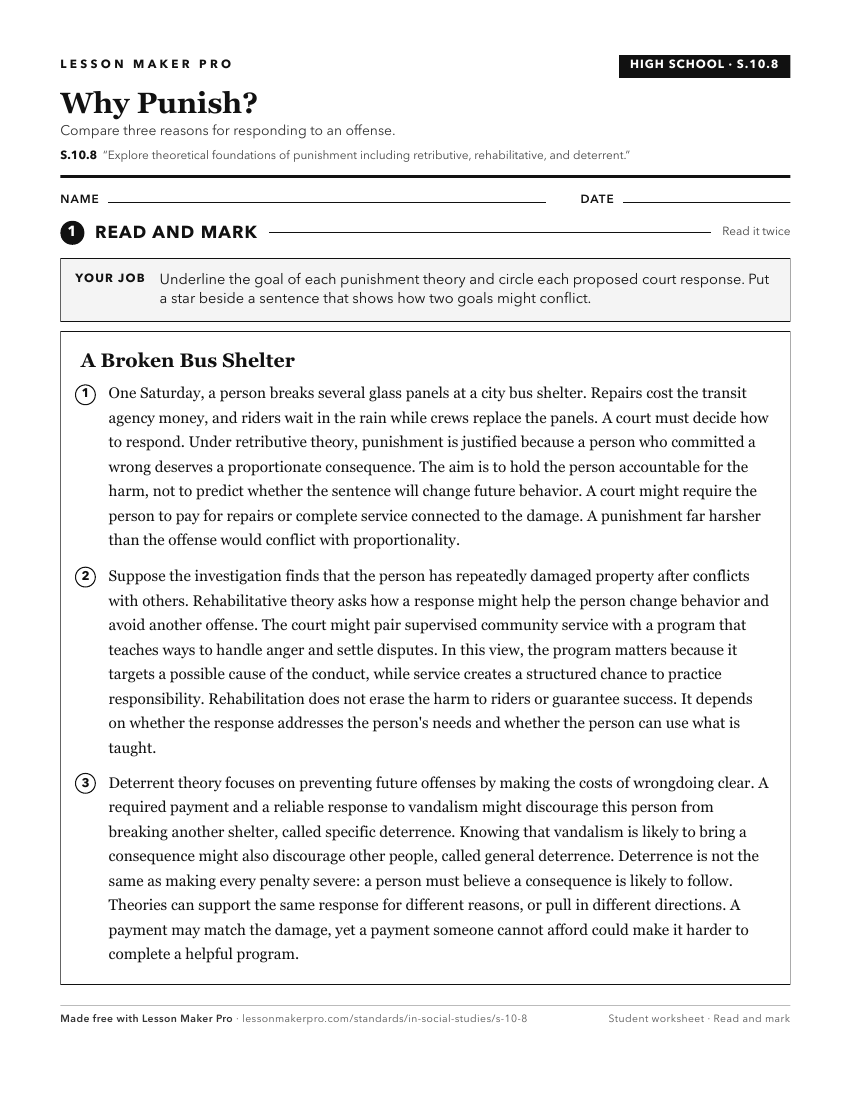
A ready-to-print activity worksheet aligned to S.10.8, with an answer key for the teacher on its own page. No account needed.
PDF, US Letter, prints cleanly in black and white.
Download the worksheetKeep exploring
Related Standards
- S.8.7
Discuss theories that attempt to explain collective behavior.
- S.10.6
Identify types of crime and their consequences.
- S.10.3
Explore explanations of deviance such as the Strain Theory, the Differential Association Theory, and the Control Theory.
- P.6.3
Identify and describe the theories of maladaptive behaviors.
Turn this exact standard into a lesson
Grade, subject, topic, and the complete standard are prefilled. Create one free, no account needed.
Also for this standard:Make a WorksheetMake a QuizMake a Sub Lesson