Indiana Social Studies S.10.1
The Standard
Define deviance and explore the functions deviance serves as identified by Emile Durkheim.
2026 Indiana Academic Standards: K-12 Social Studies
Teacher's field guide
What This Standard Means
What Students Need to Do
- Students define deviance as behavior a group treats as breaking its norms. They explain how responses can reinforce values, mark boundaries, bring people together, or prompt change.
What Mastery Looks Like
- Given a case, students can name the norm broken and explain why the behavior may be seen differently in another setting. They can connect specific reactions to group unity, clearer rules, or social change.
Common Misconceptions
- Students often equate deviance with crime or assume it always harms people. They may think an act is deviant everywhere, regardless of who sees it or where it happens. Some assume every rule violation leads to change.
How to Assess It
- Exit ticket: A student interrupts an assembly to protest a dress code. Define deviance, name the norm broken, and explain two possible social effects of the reaction.
Lesson moves
Ways to Teach It
Give pairs cards showing a cut in the lunch line, a silent protest, and a dress code challenge; sort them by norm broken and likely reaction.
Ask: Why did a 1960 lunch counter sit-in challenge a social norm, and how did public reactions help change that norm?
Play reaction match: teams match responses on scenario cards to affirmed values, clearer boundaries, group unity, or changed rules.
Use your school's phone policy; ask students how a petition to change it might unite classmates or shift the rule.
Free download
Printable S.10.1 Worksheet
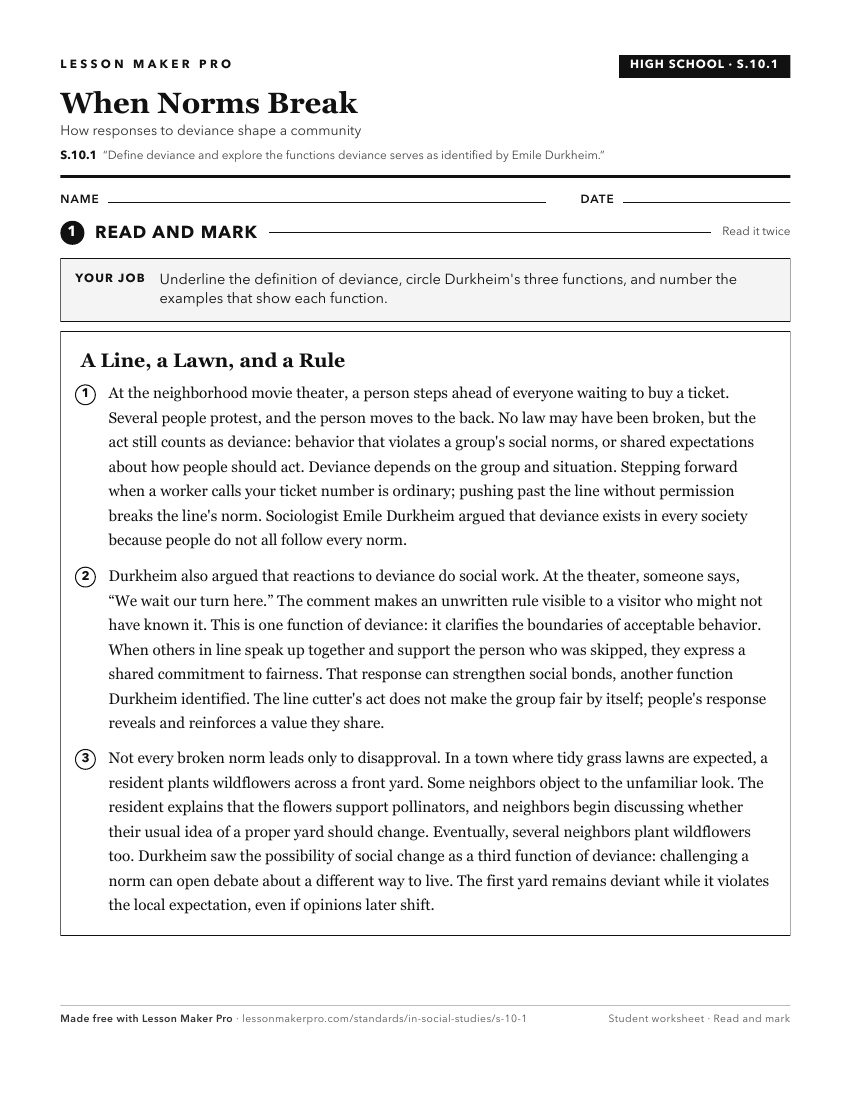
A ready-to-print activity worksheet aligned to S.10.1, with an answer key for the teacher on its own page. No account needed.
PDF, US Letter, prints cleanly in black and white.
Download the worksheetKeep exploring
Related Standards
- S.4.3
Explore stratification from both functionalist and conflict perspectives.
- S.10.4
Identify deviant subcultures.
- S.10.7
Identify the consequences of the medicalization of deviance.
- S.10.3
Explore explanations of deviance such as the Strain Theory, the Differential Association Theory, and the Control Theory.
Turn this exact standard into a lesson
Grade, subject, topic, and the complete standard are prefilled. Create one free, no account needed.
Also for this standard:Make a WorksheetMake a QuizMake a Sub Lesson