Indiana Social Studies 8.H.20
The Standard
Describe the Abolitionist Movement and identify figures and organizations involved in the debate over slavery, including leaders of the Underground Railroad, and how the movement affected the division between the North and South.
2026 Indiana Academic Standards: K-12 Social Studies
Teacher's field guide
What This Standard Means
What Students Need to Do
- Students explain how people fought slavery through speeches, newspapers, petitions, and escape networks. They identify key people and groups, then explain how abolitionism increased conflict between the North and South.
What Mastery Looks Like
- A student can connect Harriet Tubman to guiding people to freedom, Frederick Douglass to speeches and writing, and the American Anti-Slavery Society to organized campaigns. They can explain how resistance to the Fugitive Slave Act sharpened the divide between North and South.
Common Misconceptions
- Some students think the Underground Railroad was a train or one fixed route, rather than a network of people and hiding places. Others assume everyone in the North opposed slavery, or that enslaved people played no part in their own escapes.
How to Assess It
- On an exit ticket, ask students what Harriet Tubman, Frederick Douglass, and the American Anti-Slavery Society each did. Then ask how the Fugitive Slave Act sharpened conflict between North and South.
Lesson moves
Ways to Teach It
Give groups a map of slave and free states; use yarn to sketch possible routes from Maryland to Canada and mark two capture risks.
Read a short excerpt from the Fugitive Slave Act; ask students why its enforcement could divide neighbors in a Northern town.
Hand out cards naming Tubman, Douglass, Garrison, and the American Anti-Slavery Society; students match each to an action and explain their matches.
Draft a petition to the principal about a school policy, then compare its audience and request with an abolitionist petition.
Free download
Printable 8.H.20 Worksheet
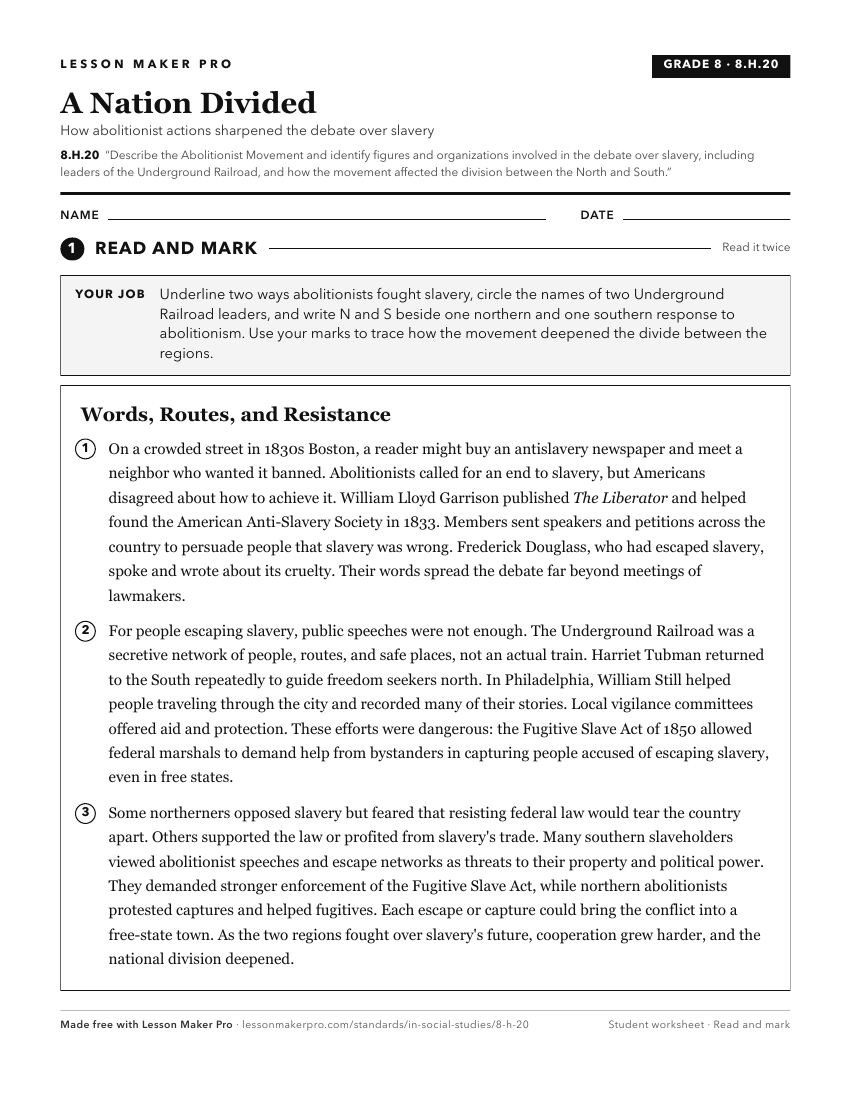
A ready-to-print activity worksheet aligned to 8.H.20, with an answer key for the teacher on its own page. No account needed.
PDF, US Letter, prints cleanly in black and white.
Download the worksheetKeep exploring
Related Standards
- 8.H.21
Analyze the influence of early individual social reformers and movements such as the abolitionist, feminist, and social reform movements.
- USH.1.2
Identify and summarize the causes and effects of slavery, the Civil War, abolitionism, social reform movements, and Reconstruction.
- 4.H.5
Explain the roles of various individuals, groups, and movements in the social conflicts leading to the Civil War.
- IS.1.5
Explain the significance of slavery, abolition, and social reform movements and their impact on the state of Indiana.
Turn this exact standard into a lesson
Grade, subject, topic, and the complete standard are prefilled. Create one free, no account needed.
Also for this standard:Make a WorksheetMake a QuizMake a Sub Lesson