Indiana Social Studies USH.1.2
The Standard
Identify and summarize the causes and effects of slavery, the Civil War, abolitionism, social reform movements, and Reconstruction.
2026 Indiana Academic Standards: K-12 Social Studies · Students are expected to trace and analyze chronological periods and examine the significant themes and concepts in U.S. History. Students develop historical thinking and research skills using primary and secondary sources to explore topical issues to understand the cause for changes in the nation over time.
Teacher's field guide
What This Standard Means
What Students Need to Do
- Students explain why slavery expanded and how it shaped work and politics. They trace the growth of abolitionism and women's rights reform, the causes of the Civil War, and the changes made during Reconstruction.
What Mastery Looks Like
- Students connect cotton profits to slavery's expansion and secession over slavery to the Civil War. They explain how abolitionists and women's rights activists organized, and how Reconstruction changed citizenship without ending racial violence.
Common Misconceptions
- Students may treat slavery as a minor cause of secession or assume emancipation ended discrimination. They may confuse abolitionism with Reconstruction or think women's rights reform quickly won women the vote.
How to Assess It
- On an exit ticket, ask: Why did slavery expand, and how did it help cause the Civil War? Name one effect each of abolitionism, women's rights reform, and Reconstruction.
Lesson moves
Ways to Teach It
Give pairs cards for cotton expansion, The Liberator, Seneca Falls, secession, emancipation, and the Fourteenth Amendment; have them arrange the cards and draw cause-and-effect arrows.
Read short excerpts from South Carolina's secession declaration and Frederick Douglass's 1852 speech, then ask what each says about slavery.
Play three rounds: read 'cotton profits,' 'secession,' or 'Black Codes'; teams name one effect and support it with a fact.
Project your state's voter registration page; have students compare its eligibility rules with the Fifteenth Amendment's ban on race-based voting restrictions.
Free download
Printable USH.1.2 Worksheet
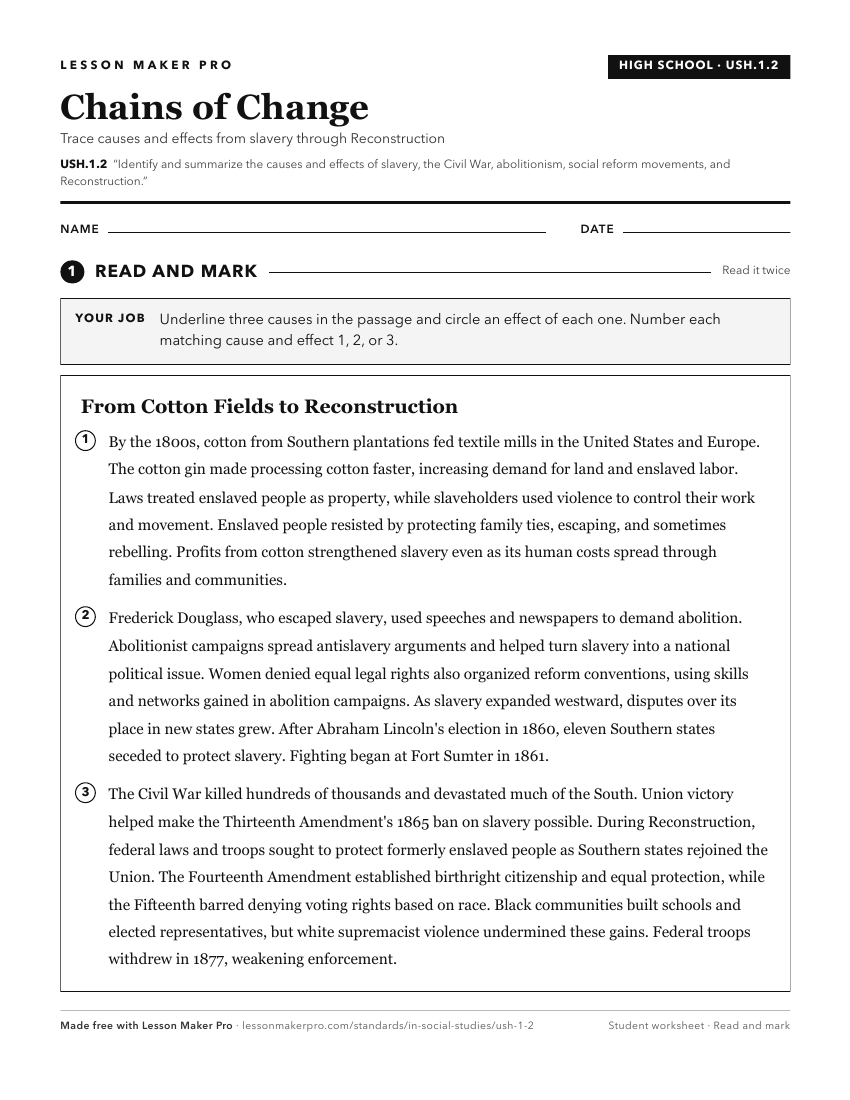
A ready-to-print activity worksheet aligned to USH.1.2, with an answer key for the teacher on its own page. No account needed.
PDF, US Letter, prints cleanly in black and white.
Download the worksheetKeep exploring
Related Standards
- 8.H.21
Analyze the influence of early individual social reformers and movements such as the abolitionist, feminist, and social reform movements.
- 8.H.22
Analyze the causes and effects of events leading to the Civil War, and evaluate the impact issues such as states’ rights and slavery had in developing America’s...
- 8.H.25
Describe causes and lasting effects of the Civil War and Reconstruction as well as the political controversies surrounding this time, such as Andrew Johnson’s i...
- IS.1.6
Describe causes and lasting effects of the Civil War and Reconstruction as well as the political controversies surrounding this time.
Turn this exact standard into a lesson
Grade, subject, topic, and the complete standard are prefilled. Create one free, no account needed.
Also for this standard:Make a WorksheetMake a QuizMake a Sub Lesson