Indiana Social Studies 4.H.5
The Standard
Explain the roles of various individuals, groups, and movements in the social conflicts leading to the Civil War.
2026 Indiana Academic Standards: K-12 Social Studies
Teacher's field guide
What This Standard Means
What Students Need to Do
- Students explain how people took different positions on slavery before the Civil War. They use actions by freedom seekers, abolitionists, slaveholders, and lawmakers to show why conflict grew.
What Mastery Looks Like
- A student can explain that Harriet Tubman helped people escape slavery while Frederick Douglass used speeches and writing to oppose it. They can describe how slaveholders defended slavery and how the Fugitive Slave Act sharpened disagreements.
Common Misconceptions
- Students may think everyone in the North opposed slavery or everyone in the South owned enslaved people. They may think the Underground Railroad was a train or that enslaved people waited for others to free them.
How to Assess It
- Exit ticket: How did Harriet Tubman, slaveholders, and Congress each act as conflict over slavery grew? Give one action for each.
Lesson moves
Ways to Teach It
Have pairs match cards for Tubman, Douglass, slaveholders, and Congress with cards describing escape routes, speeches, defense of slavery, and federal laws.
Ask students to write two sentences: How did Tubman and Douglass oppose slavery differently, and why did slaveholders oppose their work?
Play a card game: draw a person or group, name one action, and explain how it affected conflict over slavery.
Locate Levi Coffin's home in Fountain City on an Indiana map, then discuss how a safe house helped people escaping slavery.
Free download
Printable 4.H.5 Worksheet
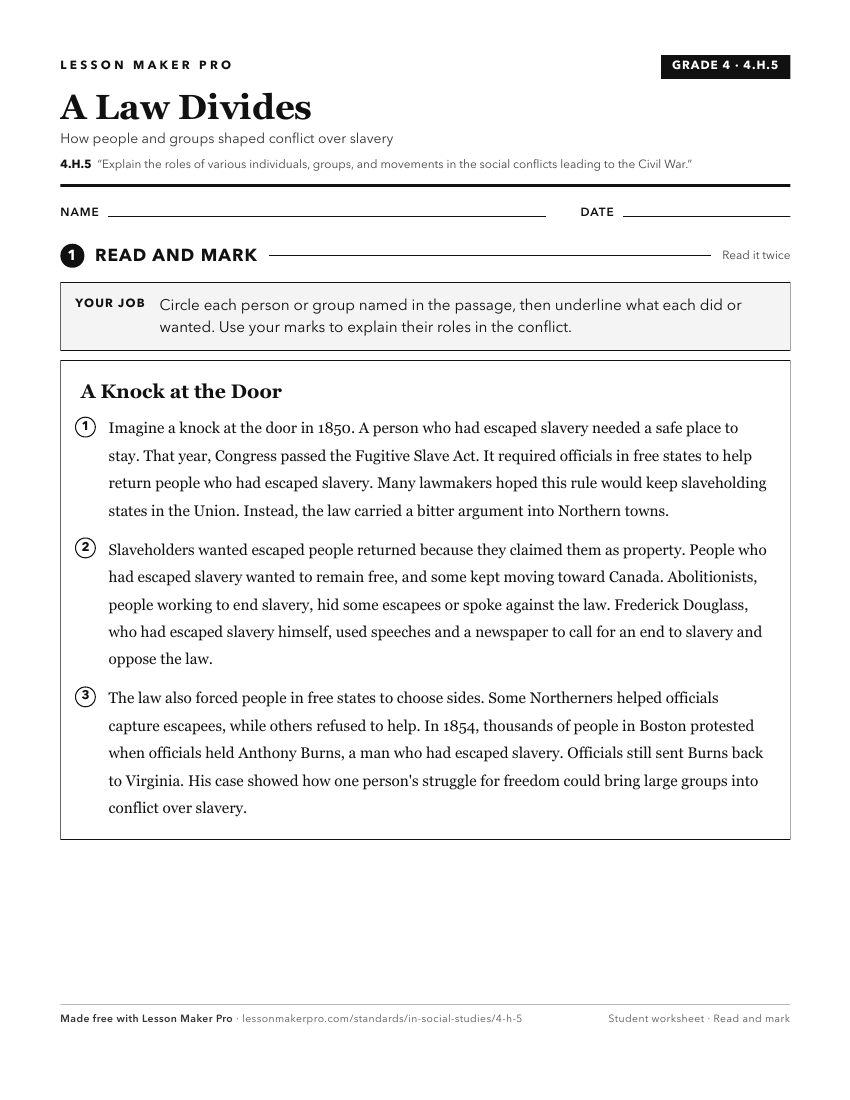
A ready-to-print activity worksheet aligned to 4.H.5, with an answer key for the teacher on its own page. No account needed.
PDF, US Letter, prints cleanly in black and white.
Download the worksheetKeep exploring
Related Standards
- 8.H.23
Identify the factors and individuals which influenced the outcome of the Civil War, and explain the significance of each.
- USH.1.2
Identify and summarize the causes and effects of slavery, the Civil War, abolitionism, social reform movements, and Reconstruction.
- 8.H.22
Analyze the causes and effects of events leading to the Civil War, and evaluate the impact issues such as states’ rights and slavery had in developing America’s...
- IS.1.6
Describe causes and lasting effects of the Civil War and Reconstruction as well as the political controversies surrounding this time.
Turn this exact standard into a lesson
Grade, subject, topic, and the complete standard are prefilled. Create one free, no account needed.
Also for this standard:Make a WorksheetMake a QuizMake a Sub Lesson