Indiana Social Studies IS.1.5
The Standard
Explain the significance of slavery, abolition, and social reform movements and their impact on the state of Indiana.
2026 Indiana Academic Standards: K-12 Social Studies · Territorial and Early Statehood: 1800 to 1850
Teacher's field guide
What This Standard Means
What Students Need to Do
- Students explain how slavery, abolition, and other reform efforts shaped Indiana before 1850. They connect laws and actions by residents to changes in people's lives.
What Mastery Looks Like
- A student can explain how Indiana's 1816 slavery ban changed state law and how Levi Coffin helped people escaping slavery. They can describe a school reform effort while noting that a later bond law still restricted Black newcomers.
Common Misconceptions
- Students may assume that banning slavery ended discrimination in Indiana. They may also mistake the Underground Railroad for a train or think abolition was the only reform effort of the period.
How to Assess It
- Exit ticket: Name one effect each of Indiana's slavery ban, abolition work, and school reform. Then give one example showing that freedom remained unequal.
Lesson moves
Ways to Teach It
Give pairs cards on the 1816 constitution, Levi Coffin, an early school law, and the 1831 bond law; sort them by who was affected.
Ask: How could Indiana ban slavery yet restrict Black newcomers? Have students answer using the 1816 constitution and 1831 bond law.
Play timeline match: students pair event cards with dates and explain one effect of each event on Indiana.
Show a photo of the Levi Coffin House historical marker; ask whose work it honors and whose experiences it leaves out.
Free download
Printable IS.1.5 Worksheet
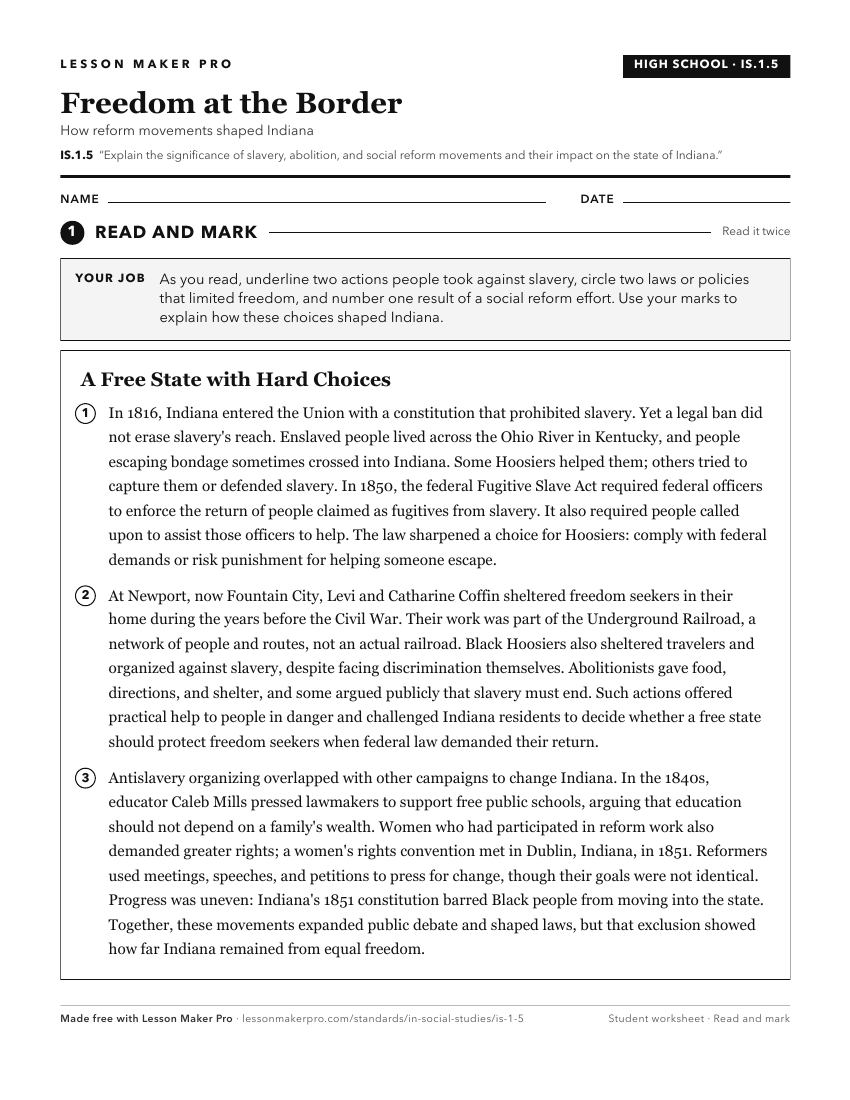
A ready-to-print activity worksheet aligned to IS.1.5, with an answer key for the teacher on its own page. No account needed.
PDF, US Letter, prints cleanly in black and white.
Download the worksheetKeep exploring
Related Standards
- 4.H.3
Explain the importance of the Revolutionary War and other key events and people that impacted the development of Indiana.
- IS.1.17
Identify the social, political, economic, and cultural movements of the 1920s and analyze how these movements reflected and shaped Indiana society.
- IS.1.14
Explain the origins, goals, achievements, and limitations of the Progressive Movement in addressing political, economic, and social reform in Indiana.
- IS.4.10
Summarize the impact of industrialization and immigration on social movements in Indiana from 1870-1900, including contributions of specific individuals and gro...
Turn this exact standard into a lesson
Grade, subject, topic, and the complete standard are prefilled. Create one free, no account needed.
Also for this standard:Make a WorksheetMake a QuizMake a Sub Lesson