Indiana Science HS-PSII-9.3
The Standard
Develop graphical and mathematical representations that describe the relationship between the frequency of a photon and the kinetic energy of an electron emitted through the photoelectric effect and apply those representations to qualitatively and quantitatively describe how changing the frequency or intensity of light affect the current produced in the photoelectric effect.
Indiana Academic Standards for Science (2023) · Particle and Wave Nature of Light
Teacher's field guide
What This Standard Means
What Students Need to Do
- Students graph the maximum kinetic energy of emitted electrons against light frequency. They use the graph and an equation to find the cutoff frequency and predict how changes in frequency or intensity affect the current.
What Mastery Looks Like
- They draw a straight energy-versus-frequency line and calculate electron energy with K = hf − φ. They calculate current from the number of electrons emitted per second. They explain that brighter light raises current above the cutoff, while higher frequency at fixed light power can lower it because fewer photons arrive.
Common Misconceptions
- Students may think brighter light gives each electron more energy, or that light below the cutoff will eject electrons if it is bright enough. They may assume higher frequency always means more current, without checking whether light power or photon arrival rate stays fixed.
How to Assess It
- A metal has a cutoff frequency of 5.0 × 10^14 Hz. Using h = 4.14 × 10^-15 eV·s, have students sketch the energy graph, find the electron energy at 8.0 × 10^14 Hz, and predict what doubling the photon arrival rate does to current.
Lesson moves
Ways to Teach It
Use a photoelectric-effect simulator to change frequency and intensity separately, then record electron energy and current after each change.
Ask students to write why brighter light below the cutoff produces no current, but dimmer light above it can.
Give pairs frequency and work-function cards; have them calculate electron energy and sort the cards into emission and no emission.
Show a phototube light-meter diagram and ask students to predict how a brighter lamp changes its current without changing electron energy.
Free download
Printable HS-PSII-9.3 Worksheet
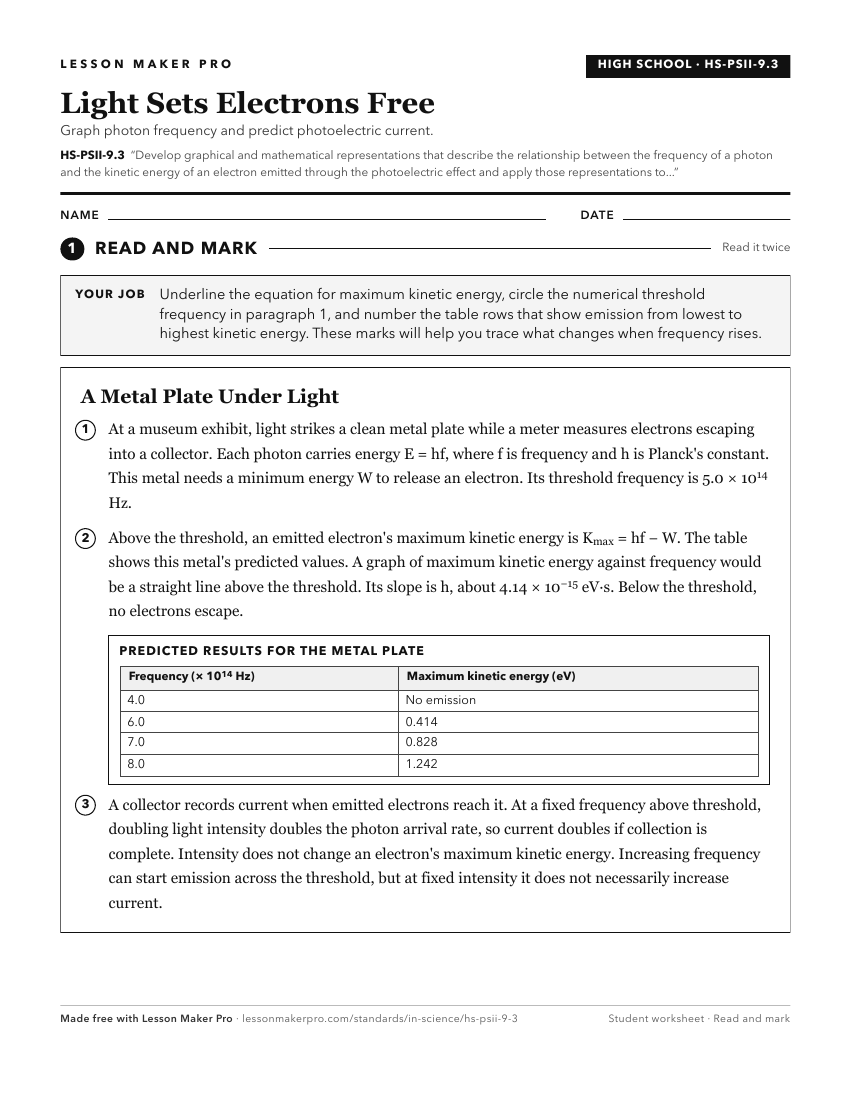
A ready-to-print activity worksheet aligned to HS-PSII-9.3, with an answer key for the teacher on its own page. No account needed.
PDF, US Letter, prints cleanly in black and white.
Download the worksheetKeep exploring
Related Standards
- HS-PSII-5.2
Develop graphical and mathematical representations that describe the relationship between the between the amount of current passing through an ohmic device and ...
- HS-PSII-2.1
Develop graphical and mathematical representations that describe the relationship among the temperature, thermal energy, and thermal energy transfer (i.e., heat...
- HS-PSII-9.6
Develop graphical and mathematical representations that describe the relationship between the angle between two polarizing filters and the intensity of light pa...
- HS-PSII-9.5
Develop graphical and mathematical representations that describe the relationship between the wavelength of monochromatic light, spacing between slits, distance...
Turn this exact standard into a lesson
Grade, subject, topic, and the complete standard are prefilled. Create one free, no account needed.
Also for this standard:Make a WorksheetMake a QuizMake a Sub Lesson