Indiana Science HS-PSII-2.1
The Standard
Develop graphical and mathematical representations that describe the relationship among the temperature, thermal energy, and thermal energy transfer (i.e., heat) in the kinetic molecular theory and apply those representations to qualitatively and quantitatively describe how changing the temperature of a substance affects the motion of the molecules.
Indiana Academic Standards for Science (2023) · Temperature and Thermal Energy Transfer
Teacher's field guide
What This Standard Means
What Students Need to Do
- Students graph how heat added changes a sample's temperature and calculate energy transferred when no phase change occurs. They use temperature in kelvins to predict changes in average molecular kinetic energy and speed. They distinguish temperature from a sample's total thermal energy.
What Mastery Looks Like
- A student can graph temperature against heat added and use Q = mcΔT to calculate the heat needed for a given temperature rise. They can explain that doubling a gas's kelvin temperature doubles its molecules' average kinetic energy but raises their typical speed by about 1.4 times.
Common Misconceptions
- Students may treat heat as energy stored in an object, rather than energy transferred between objects. They may think equal temperatures mean equal total thermal energy, or that doubling temperature in kelvins doubles molecular speed.
How to Assess It
- Exit ticket: For 100 g of water at 20°C, use c = 4.18 J/(g·°C) to find the heat needed to reach 30°C, then plot the starting and ending temperatures against heat added. Explain how molecular motion changes and why 200 g needs twice as much heat for the same rise.
Lesson moves
Ways to Teach It
Press sealed bags of warm and cool water together, record both temperatures each minute, then sketch molecular motion before and after.
Ask students to explain why 200 g of water at 40°C has more thermal energy than 100 g at 40°C.
Give pairs 150 K, 300 K, and 600 K cards to match with kinetic energy ratios 1:2:4 and speed ratios 1:√2:2.
Compare a 250 g mug and a 1,000 g kettle of 80°C water; calculate heat each releases cooling to 60°C.
Free download
Printable HS-PSII-2.1 Worksheet
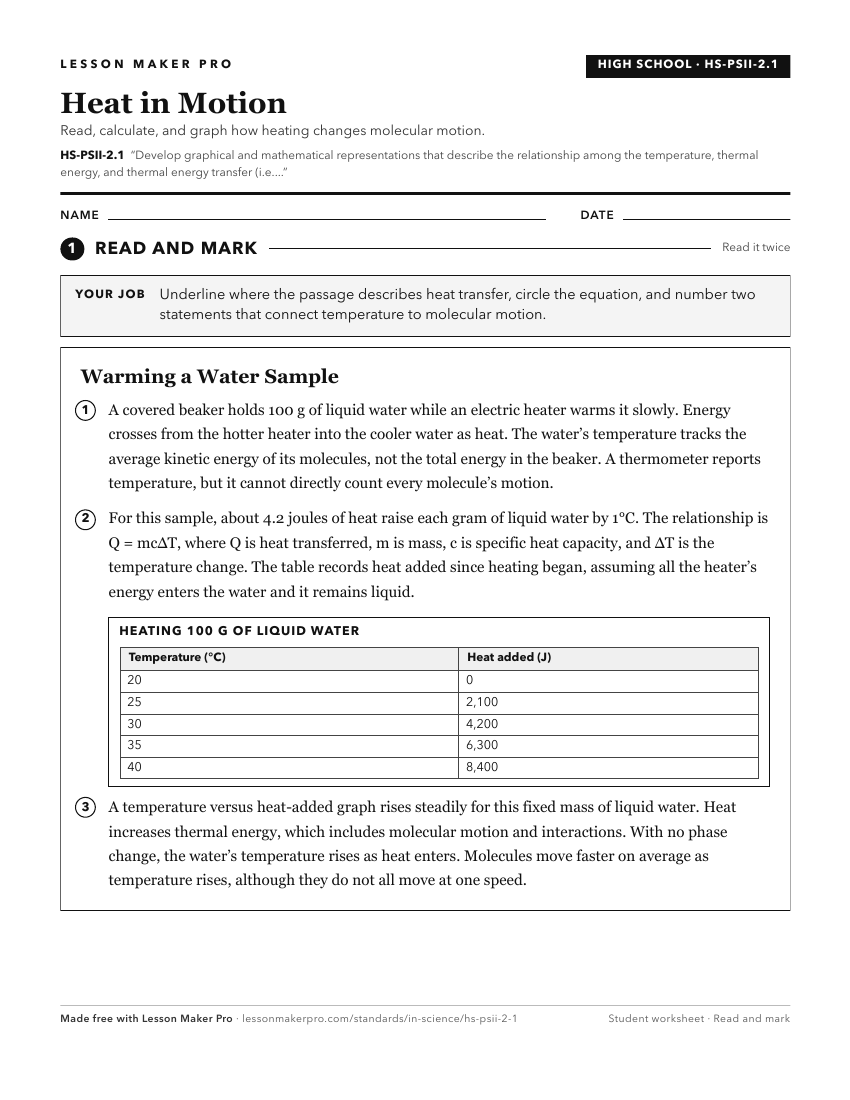
A ready-to-print activity worksheet aligned to HS-PSII-2.1, with an answer key for the teacher on its own page. No account needed.
PDF, US Letter, prints cleanly in black and white.
Download the worksheetKeep exploring
Related Standards
- HS-PSII-2.2
Describe the process of the transfer of thermal energy (i.e., heat) that occurs during the heating cycle of a substance from solid to gas and relate the changes...
- HS-PSII-2.4
Develop graphical and mathematical representations that describe the relationship among the volume, temperature, and number of molecules of an ideal gas in a cl...
Turn this exact standard into a lesson
Grade, subject, topic, and the complete standard are prefilled. Create one free, no account needed.
Also for this standard:Make a WorksheetMake a QuizMake a Sub Lesson