Indiana Science HS-PSII-9.6
The Standard
Develop graphical and mathematical representations that describe the relationship between the angle between two polarizing filters and the intensity of light passed through the filters from an unpolarized light source and apply those representations to qualitatively and quantitatively describe how changing the angle between polarizing filters affects the intensity of light passing through both filters.
Indiana Academic Standards for Science (2023) · Particle and Wave Nature of Light
Teacher's field guide
What This Standard Means
What Students Need to Do
- Students find how much light passes through two polarizing filters as the angle between them changes. They graph transmitted intensity against angle and use a formula to calculate it.
What Mastery Looks Like
- Students can calculate that filters at 0°, 45°, and 90° transmit one-half, one-quarter, and none of the original unpolarized light. They use I = (I₀/2)cos²θ and can explain why the first filter accounts for the one-half.
Common Misconceptions
- Students may treat the first filter as passing all the light, making every answer twice too large. They may expect intensity to drop at a steady rate as the angle increases, or think 45° passes half the original light.
How to Assess It
- Exit ticket: Unpolarized light has an intensity of 80 units. Plot the intensity after two filters at 0°, 45°, and 90°, label each value, and write the equation you used.
Lesson moves
Ways to Teach It
Shine a flashlight through two polarizing sheets, measure light at marked angles with a phone light meter, and plot the readings.
Ask: Why do two filters at 45° pass one-quarter of the original flashlight light, rather than one-half?
Give pairs cards marked 0°, 45°, 60°, 90°, and 1/2, 1/4, 1/8, 0; have them match angles to transmitted fractions.
Design a variable camera filter using two polarizing sheets; calculate the angle that transmits one-eighth of a lamp's original light.
Free download
Printable HS-PSII-9.6 Worksheet
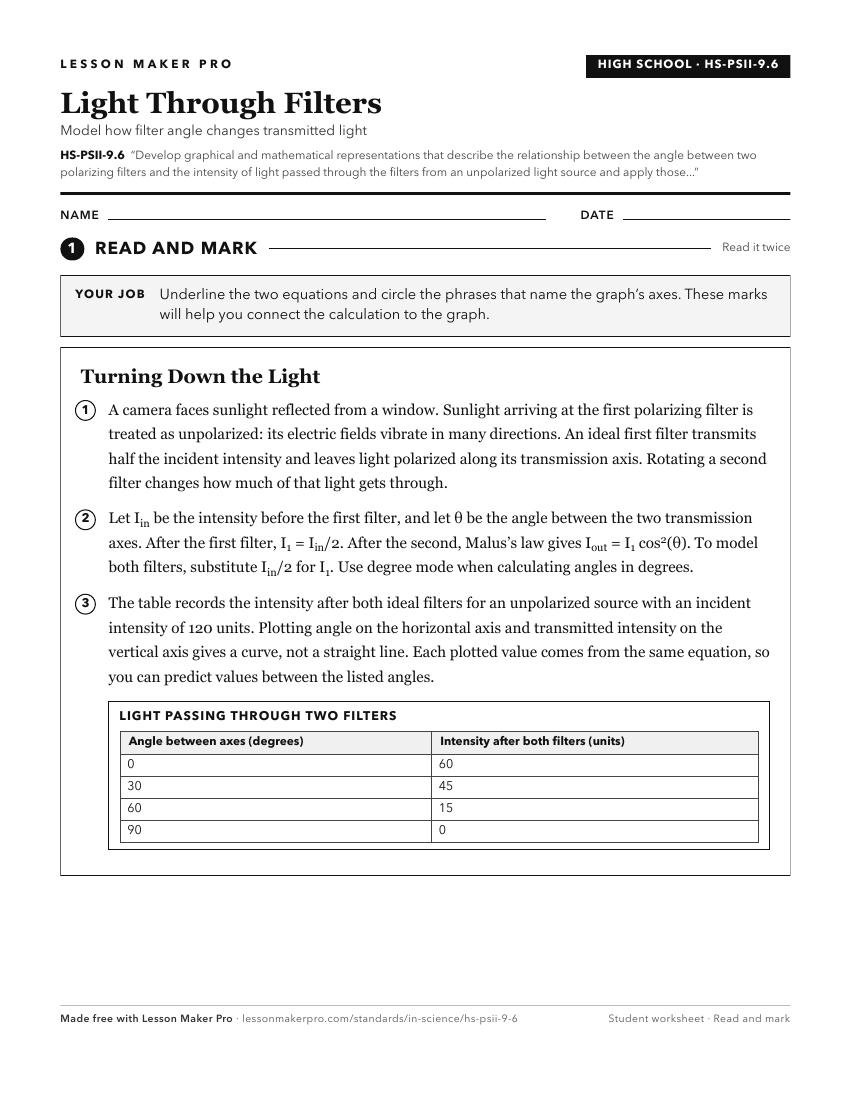
A ready-to-print activity worksheet aligned to HS-PSII-9.6, with an answer key for the teacher on its own page. No account needed.
PDF, US Letter, prints cleanly in black and white.
Download the worksheetKeep exploring
Related Standards
- HS-PSII-9.3
Develop graphical and mathematical representations that describe the relationship between the frequency of a photon and the kinetic energy of an electron emitte...
- HS-PSII-8.2
Develop graphical, mathematical, and pictorial representations (e.g., ray diagrams) that describe the relationship between the angles of incidence and refractio...
- HS-PSII-8.3
Develop graphical, mathematical, and pictorial representations (e.g., ray diagrams) that describe the relationships between the focal length, the image distance...
- HS-PSII-9.5
Develop graphical and mathematical representations that describe the relationship between the wavelength of monochromatic light, spacing between slits, distance...
Turn this exact standard into a lesson
Grade, subject, topic, and the complete standard are prefilled. Create one free, no account needed.
Also for this standard:Make a WorksheetMake a QuizMake a Sub Lesson